Cisco Learning Network Store Promotions Page
Showing posts with label Windows Phone. Show all posts

1.26.2016

Joe Belfiore is using an iPhone, and that's not OK


Joe Belfiore is now on a break from his job at Microsoft, taking an "educational trip" across the globe with his family. Given that Belfiore "runs the team building Phone/Tablet/PC versions of Windows" you might expect him to use a Windows phone to share updates with his followers as, after all, most are Windows enthusiasts.

However, Belfiore is publicly using an iPhone, and he expects his fans to be OK with it. You do not see Jony Ive, for instance, rocking an Android smartphone or a Windows 10 Mobile device, because that would not make the iPhone look like the best smartphone there is. So why would it be fine for Belfiore to use a rival's device?

Yes, Microsoft supports Android and iOS, on top of its own operating system, but Belfiore is not just any employee, so when he decides to use a device from one of his company's rivals it tends to make Windows look bad, as if it is lacking something.

Belfiore has tried to defend his choice by saying that the vacation presents a huge opportunity to test the other (more popular) platforms, and that "it’d be crazy not to [do it]".

Belfiore apparently believes that it is too difficult to experience all the benefits that Android and iOS have to offer in a short period of time, which, to be perfectly honest, is a ridiculous explanation. It sounds as if Belfiore is a stranger to Windows' rivals, and he is only now getting the proper chance to see what all the fuss is about.


This is actually not the first time that Belfiore has been "caught" using an iPhone to tweet, but it should be the last. It gives consumers more reasons to dismiss Windows Phone/Windows 10 Mobile, which hurts the platform's chances of regaining some of the market share it recently ceded to Android and iOS, while making it look like a subpar option in today's market. And none of that helps, Joe.

Photo Credit: PathDoc / Shutterstock

~ Mihaita Bamburic

1.14.2016

Microsoft working on a "breakthrough" smartphone, strongly hints that it's the Surface Phone

  
Microsoft’s past performance in the smartphone market hasn’t been particularly impressive. Windows phones made up only 2.6 percent of the worldwide smartphone OS market in the second quarter of 2015, a decline from 3.4 percent in 2013. But now, the Redmond company has confirmed that is working on something that may turn its smartphone fortunes around.

Speaking during an episode of This Week in Tech’s Windows Weekly podcast, Microsoft executive vice president and chief marketing officer Chris Capossela revealed that the company is working on a “breakthrough” new smartphone – and it’s not a going to be another Lumia.

While Capossela didn't specifically say the new device will be the long-rumored Surface Phone, he did strongly hint at it. “With Surface we had a bunch of early misfires, but that notion of a tablet that could replace your laptop. That notion of saying, Hey, Apple wants to sell you an iPad and they want to sell you a Mac, we think there’s one device that exploits the seam between those two devices. We need some sort of spiritual equivalent on the phone side that doesn’t just feel like a phone for people who love Windows.”

Compared to today’s smartphones, the Surface Phone is expected to be much more like a PC. Microsoft will likely ditch the traditionally-used Qualcomm chips for Intel architecture and use a software setup more commonly found in home computers. It’s also rumored that Microsoft will be giving the Surface Phone the ability to run full Windows software, not just apps from the Windows Store market, creating a true PC/smartphone hybrid device.

A Surface Phone would likely utilize Windows 10 Mobile’s Continuum feature that can turn a smartphone into a PC by allowing it to attach to a monitor, mouse and keyboard in order to create a desktop-like experience.
  
We may have to wait a while before we see the Surface Phone, although some reports say it could be here as early as the second half of 2016. Speaking about the mystery device, Capossela said "I think we have to do more breakthrough work" to make Apple fans "pause before they buy their 17th iPhone.”

~ Rob Thubron

4.27.2015

Microsoft continues earning money from Linux — increases patent licensing agreements


If you choose to laugh at Microsoft over its mobile presence, feel free, but please know that Microsoft is laughing too; all the way to the bank. What you may not know is, Microsoft makes money from Android handset sales thanks to its patent portfolio. In fact, it also collects money from Chromebooks too. In other words, Microsoft is profiting from Linux, since both operating systems are based on the kernel. Today, Microsoft increases its number of patent licensing agreements, by making a deal with Qisda Corp.
 
“Microsoft Corp. and Qisda Corp. on Friday signed a worldwide patent licensing agreement that provides broad coverage under Microsoft’s patent portfolio for an array of Qisda and BenQ devices, including smartphones and tablets, running the Android and Chrome operating systems”, says Microsoft.
 
Nick Psyhogeos, vice president and executive director of Microsoft Technology Licensing LLC explains, “today’s agreement demonstrates the power of licensing to accelerate innovation, because it will provide Qisda with greater patent protection as it brings new devices to market. With this agreement, Microsoft has now entered into patent licensing collaboration agreements with nearly all the top Taiwanese original device manufacturers (ODMs). We are pleased that companies around the world continue to see the value of our patent portfolio, and view mutual respect for patents as an important element of building broader business partnerships”.
 
This agreement with Qisda simply highlights Microsoft’s money-generating machine — its patent portfolio. While I am sure the company wants Windows Phone and the soon-to-be-released Windows 10 for phones to be successful, collecting money from Android and Chromebook sales is definitely a healthy consolation prize.
 
Does it upset you to know Microsoft is profiting from Android and Chrome OS? Tell me in the comments.
 
Photo Credit: Julien Tromeur/Shutterstock
 

10.08.2014

Windows 10 will "run on everything", says CEO Satya Nadella

 
For Microsoft, Windows 10 is a very important step in realizing their next-generation vision for their operating systems. We've already heard how the Windows 10 core will be one and the same across Windows Phone, Windows RT and x86-based Windows (all of which will be branded as Windows 10), and the upcoming revamp of the Xbox OS.
 
Speaking at the Gartner Symposium ITxpo, Microsoft CEO Satya Nadella has reinforced the company's strategy for the next-generation of Windows, stating that "it can run on everything". Crucially, this includes Internet of Things (IoT) devices, which is shaping up to be a major platform in years to come.
 
Nadella believes that Windows 10 will be a fantastic operating system to run on IoT systems, as it's both manageable and secure. "It's the first step in a new generation of Windows as opposed to just another release after Windows 8."
 
Nadella didn't just talk about Microsoft's strategy for IoT; he hinted that we might see a revised licensing scheme for Windows 10. Microsoft has been looking at simplifying the way Windows is licensed, and will perhaps follow in the footsteps of Office 365, providing several options that focus on the user, not devices. This would allow customers to install Windows on a number of their devices with the one license, depending on the package purchased.
 
The cloud was also emphasized as part of Nadella's talk. Azure is an important part of Microsoft's services portfolio, and the company is planning to reveal more about the future of it on October 20th. However, despite the strengths of Azure, Nadella believes that the Office API is the most strategic in the company, which intertwines with their cloud services and has led to "billions of identity transactions in Azure Active Directory".
 
If Microsoft can execute well with all of these products, including Windows 10, 2015 could be the year we finally see their true 'one platform' vision in action.
 
~ Tim Schiesser

9.30.2014

Microsoft rolls out the new MSN, rebrands Bing apps for Windows, Windows Phone

 
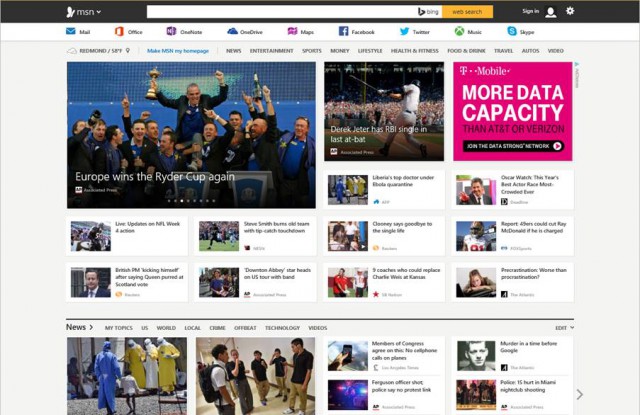
Microsoft did something rather unexpected earlier this month. The software giant unveiled a revamped MSN, saving the online portal from oblivion -- its biggest merit lately is being the default website for Internet Explorer. The new MSN looks great, connects users to Microsoft's consumer-facing cloud services, and can be tailored to suit their preference. It also makes it easy to trigger a search across the InterWebs. Heck, I have even said it might work as the Bing landing page.
 
Fast forward to today and Microsoft announces that more than 10 million users have tested the new MSN, with more than 80,000 of them also submitting feedback. Those numbers look really good. And they should, considering the online portal's Microsoft-focused audience. The feedback it has received must have been good also, as Microsoft announces it is rolling out the new MSN in the next three days.
 
Microsoft says that "more than 425 million people in over 50 countries around the world [...] come to the site each month", which makes this a very important change, that can either attract a bigger crowd or, in the worst-case scenario, alienate the existing user base. The way I see it, the former sounds much more likely. (As you can probably tell, I like what Microsoft has done with the new MSN.)
 
Microsoft is confident that you will love the new MSN so much so that it has even decided to rebrand the Bing app suite to MSN, on Windows and Windows Phone. The writing has been on the wall for the Bing brand on those operating systems, as the software giant has long removed it from app names. The MSN name hasn't surfaced next to the app's title, however, but it can now be easily seen once they're open. Corresponding MSN apps will launch on Android and iOS next, in "the coming months".
 
 
"While Bing will continue to provide search and intelligent experiences, now the apps will be branded to reflect their alignment with MSN as a premium experience for content, combined with personal productivity features", adds Microsoft. "Aside from Bing Finance, which will now be MSN Money, all of the apps retain their existing names".
 
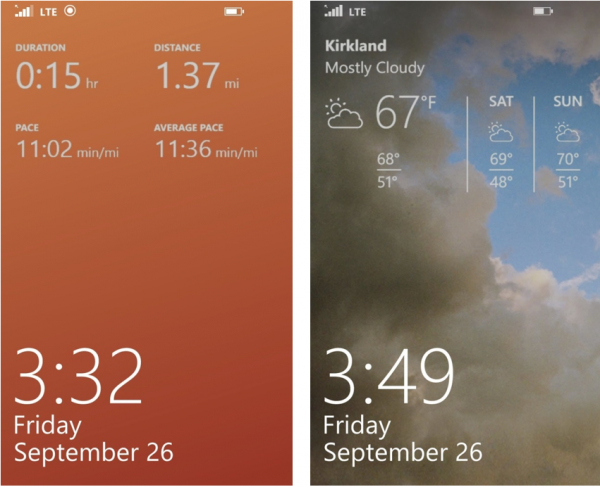
At this point, I should mention that Health & Fitness and Weather for Windows Phone have received something extra in the latest round of updates, which mainly replaces the Bing brand with MSN. Lockscreen support for the latter has been extended to include additional weather information, while the former gains a step counter and GPS tracking information on the lockscreen on certain Windows Phones, like Lumia 630 and Lumia 1520. It's rather nice of Microsoft to do that; it certainly increases the value of those offerings and improves the mobile experience for users. Here's what those changes look like.
 
 
Microsoft reveals that it built the new MSN on its Azure cloud platform. It makes use of more than 30,000 cores and 100 TB for data storage -- that sounds rather impressive, doesn't it? Microsoft says it needed those sort of resources to deliver a "consistent experience" to its customers, no matter if they are using Money, Sports, Food & Drink or any other major feature of the new MSN. As it is customary in what Microsoft calls a "cloud-first, mobile-first world", Microsoft accounts tie users' preferences across the new MSN and today's major platforms, including Android, iOS, Windows, Windows Phone and the web.
 
For the new MSN, Microsoft has partnered with the likes of The New York Times, The Wall Street Journal, The Washington Post, CNN and AOL, in US, while, in other markets, it has teamed up with publications like The Yomiuri Shimbun, The Asahi Shimbun, Sky News, The Guardian, NDTV, Le Figaro and Le Monde.
 
~ Mihaita Bamburic

12.26.2013

Start here: the best apps for all your new devices


Christmas morning is over. The fire is roaring with wrapping paper, broken candy cane pieces litter the phone, and you've just opened a brand-new gadget. Maybe it's a new PlayStation 4, or an iPhone 5C, or the Windows tablet you've been not-so-subtly asking for all year. You've unwrapped it, torn the box to shreds, and turned it on. Now what?
 
This year we've picked out some of the very best apps, games, books, and downloads for your new devices. Dig into below for the very best Android apps, Android games, iPhone apps, iPad apps, iOS games, Windows Phone apps, Kindle books, console games, and for your Mac and PC. They're not the only ones you'll ever need, but they're enough to get you started. And before it's time for your Christmas nap, you'll be up and running with something great on your new device.
 
~ Verge Staff 

12.02.2013

iPhone 5c is a flop? According to one report, it’s just what Apple needed

iPhone 5c is a flop? According to one report, it’s just what Apple needed
Imagine a device that would allow Apple to eat into Android’s market share in several key markets, and yet only have a minimal negative impact on Apple’s margins. While early reports suggested the new iPhone 5c might be a flop when Apple had to cut orders with its manufacturing partners, new data from market research firm Kantar Worldpanel suggests that “the other high-end iPhone” might be just what Apple needed to pull in new business without sacrificing the average selling price (ASP) of its iPhone lineup.
 
The Telegraph on Monday covered a new report issued by Kantar that suggests Apple’s flagship iPhone 5s outsold the iPhone 5c by three to one in the UK during the three-month period that ended on October 31st. That news is hardly a shock. What is extremely interesting, however, is the firm’s note on who bought the iPhone 5c.
 
According to Kantar’s data, 80% of iPhone 5s sales were made to people who were upgrading from earlier iPhone models. Keeping customers onboard is obviously hugely important for Apple, just as it is with any company, but bringing in new business is a necessity for continued growth — and the iPhone 5c is doing just that. Kantar says that nearly 50% of 5c sales were made to people coming from other mobile platforms; namely Android, of course.
 
“The good news for Apple is that this wider appeal is attracting significant switching from competitors,” Kantar analyst Dominic Sunnebo said. ”Almost half of iPhone 5c owners switched from competitor brands, particularly Samsung and LG, compared with 80 per cent of 5s owners who upgraded from a previous iPhone model.”
 
Android is still the top mobile platform in the world by a sizable margin, but Apple’s new iPhone 5c could be the start of a slow and steady gnawing that helps Apple gain some ground. The device will obviously never compete with dirt-cheap phones in emerging markets, but it is apparently eating away at Android in a number of more developed smartphone markets where consumers spend more on mobile devices.
 
“Generally, Apple’s share of the market still remains lower than when the iPhone 5 was released, although this is not wholly unexpected as shoppers tend to react more positively to ‘full’ releases than incremental improvements such as the 5s and 5c,” Sunnebo added. “Momentum for Windows Phone is continuing, although its growth remains reliant on low-end handsets. In Britain, almost three quarters of Nokia Lumia sales in the latest period were low-end devices such as the Lumia 520 and 620 – a pattern that is similar across other EU markets.”
 

10.11.2013

I bought an iPhone 5s, but I returned it the next day

Summary: It's a beautiful device, but it loses out against cheaper Android devices with better usability.

I've been using a Nexus 4 since January. Somewhere down the line I must have developed a deep attachment to it. I really dig that smartphone.  
The iPhone 5s is beautiful. It's perfectly hewn from metal and glass. Everything about it feels carefully thought through and fantastically executed. I loved it, and I loved the gold colouring.
 
It also has all the apps that I need. Over the past year I've adopted quite a high number of day-to-day apps on Android. They're all supported on iOS. So if you looked at it from the perspective of could it do what I need it to do, it certainly could.
 
What I found though was that there were two major problems in the way that it did the things I needed it to do.
 
Firstly, the screen format is bizarre. The actual screen quality is fantastic -- it seems way better and brighter than the iPhone 4S I used for a good long while before changing to the Nexus 4. Another thing I liked was that the surface felt to have physically lower friction and the Nexus 4. Simply, it's more slidy, and that's nice.
 
But the screen has such a funny, illogical shape. It's smaller than I'd like, sure, but this weird "tower" arrangement makes no sense. You hold it in your hand and end up peering at the shape, rather than losing yourself in the content of the screen. To my mind, the screen on the iPhone is something Apple is really mucking up, which is weird if you consider that the iPad mini screen format is so perfect.
 
Going from another other device with a normal screen to the iPhone's weird screen is very off-putting. However, that's the sort of change that people get used to and I'm sure I could have got use to that. That wasn't the main reason why I returned it. 
 
Never go back 
I returned the iPhone to Apple because it didn't have a "back" button.
 
Post-PC encourages users to be lazy. I don't mean that in a bad way, it's just how these devices are supposed to be used. Post-PC devices like smartphones and tablets are designed to hang around in the background, and brought forward into the foreground to be used. These devices need to have very low "cognitive loading". Simply, they shouldn't ask you to think too much. 
 
The problem that Android users going to iOS will have is that Android trains you to use the back button as a lazy way of getting around an app. You never have to look for the back option on Android -- it's always in the same place and does essentially the same things. It's become part of every Android app design.
 
iOS devices don't have back buttons. This means that wherever you are in an iOS app you have to think in order to reach back into the app -- for example, to go back to your inbox, or a list of folders. It's this thinking that makes iOS less easy to use than Android. That grates when you're trying to use the device quickly, or when you desire to do so with little effort -- e.g. when you're on the hoof, or when you're tired.
 
If you consider that an Android phone now more or less does everything an iPhone does, but in a slightly less classy way, you have to think about what you're gaining by going from Android to iOS. You're probably going to be losing hundreds of dollars. What do you get in return?
 
The Nexus 4 is a very cheap phone, even before it was discounted as we approach the Nexus 5. The iPhone 5s is not cheap. I always buy my smartphones SIM-free, so I spent nearly $900 (£549) on a bottom of the range device. And for what? The "joy" of learning how to deal with a funny screen, and for a user experience that was harder than on Android for doing the equivalent things.
 
Plus, the Nexus 4 is so cheap that if I dropped it, lost it, or broke it, I probably wouldn't care. Dropping, losing, or breaking the iPhone 5s would likely make me cry. That's something worth thinking about.

Conclusion 

Talking about back buttons, there's a rumour that Windows Phone will soon lose its hardware back button. That now seems like a tremendously bad idea. It's worth considering that as we approach the 20 year anniversary of mainstream web browsing, we're probably quite used to the notion of "going back", which is why I think it's so natural to use on Android. 
 
What I've learned over this week is that a back button on a smartphone is both very helpful, and a big deal. Smartphones are better with back buttons.
 
Interestingly though, tablets don't seem to suffer with the same problem. That might be because they generally are less often used in casual settings (waiting in line at the store, etc) compared to smartphones.
 
Turns out the cliché was wrong. It's not "never go back", it's supposed to be "always go back".
 
What do you think? Post a comment.
 
~ Matt Baxter-Reynolds


4.14.2012

Microsoft roadmap details IE 10, Office 15, Windows Phone launches

A Microsoft product roadmap has leaked onto the net recently that shows several new items in the pipeline through 2014. The screenshots in question are dated December 22, 2011 and were recently posted on Twitter by Maarten Visser, CEO of Meetroo which is a SharePoint and mobility startup.
 Items of interest include Internet Explorer 10 with a mid-2012 launch window that could likely coincide with a Windows 8 release, although the timing would be off slightly based on a suspected October introduction for the new operating system. It’s more likely that the new browser will launch alongside the Windows 8 Release Candidate in the near future.
Office 15 is scheduled to go into beta sometime near the middle of this year as well with availability listed for early 2013. The exact same can be said for Exchange 15, SharePoint 15, Visio 15 and Project 15. An update for Windows Phone is expected later this year with the icon on the roadmap indicating “general availability.” This could possibly be the Apollo update, otherwise known as Windows Phone 8.

Visser didn’t post every screenshot but we are told that Silverlight shows zero updates after the December 2011 web release. Visual Studio is set to be released to manufacturing later this year alongside SQL Server.

It’s worth pointing out that the term ‘leaked’ is used loosely here as Visser claims that he obtained the slides from the Microsoft Partner Network where they can be downloaded without logon.

~ Shawn Knight