Cisco Learning Network Store Promotions Page
Showing posts with label Yahoo. Show all posts

11.20.2014

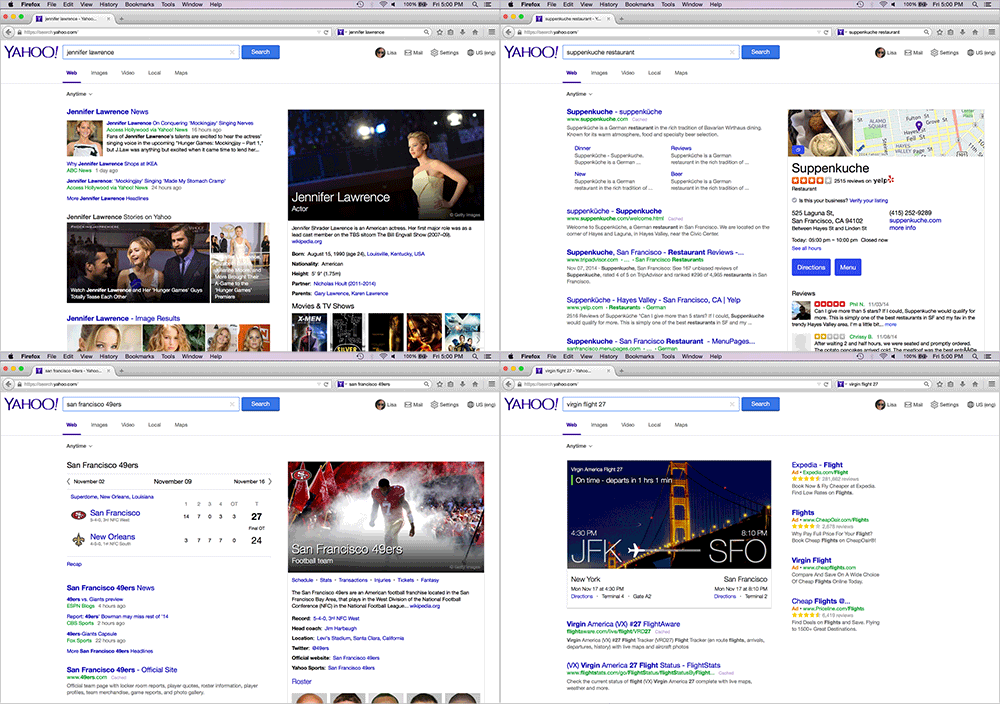
Yahoo is the new default search engine in Firefox -- Google gets kicked to the curb

 
Google is one of the best search engines, providing relative results with a clean design. There is a problem though -- Google also offers a web browser. Why is that a problem? Well, it is a strange thing for a competing web browser to use the Google search engine. It's like Ford using Chevy parts in its cars -- blasphemy!
 
A great example of this is Mozilla Firefox. The Chrome web browser is slowly eroding Firefox usage share, so it has felt odd that Mozilla was sticking with Google's search engine for so long. Well, today everything changes, as Mozilla selects Yahoo as the new default search engine in Firefox for both desktop and mobile. Will users applaud or decry the announcement?
 
"Today, I'm thrilled to announce that we've entered into a five-year partnership with Mozilla to make Yahoo the default search experience on Firefox across mobile and desktop. Mozilla is an inspirational industry leader who puts users first and focuses on building forward-leaning, compelling experiences. This is the most significant partnership for Yahoo in five years and we’re so proud that Mozilla has chosen us as their long-term partner in search", says Marissa Mayer, Yahoo CEO.
 
Mayer further explains, "our teams worked closely with Mozilla to build a clean, modern, and immersive search experience that will launch first to Firefox’s U.S. users in December and then to all Yahoo users in early 2015. The interactive and integrated experience also better leverages our world-class content and personalization technologies".
 
 
This is sure to upset some Firefox fans, however, I think anger is the wrong emotion. Sure, Google is currently the better search engine, but with the emergence of Google Chrome, Mozilla needs to forge new relationships and move away from the search-giant. Don't forget, you can still select Google as your search engine, it just won't be selected by default. Quite frankly, it would probably be best if no search engine was default, and the user was given a choice at first-run, but that probably won't happen anytime soon.
 
If you do not like this move, there is no need to panic -- it does not go into effect until December. You have time to mentally prepare.
 
Photo Credit: Jaimie Duplass / Shutterstock
 
~ Brian Fagioli

2.20.2014

Wall Street sees sense in Facebook's $19 billion WhatsApp purchase

A Whatsapp icon is seen on a Samsung Galaxy S4 phone screen with a Facebook logo in the central Bosnian town of Zenica, February 20, 2014.
 
(Reuters) - Facebook Inc's purchase of fast-growing mobile-messaging startup WhatsApp for $19 billion stunned the markets but analysts said the deal made strategic sense as it will solidify the social network's position as a leader in mobile.
 
Facebook shares were down 3.1 percent before the bell on Thursday, representing a loss of about $5.4 billion in market value.
 
At least two brokerages downgraded their recommendations on Facebook to "hold" but the overwhelming majority of analysts remain positive on the stock.
 
Facebook is paying more than double its annual revenue for a chat program that has little revenue. The purchase price is slightly more than the market value of Sony Corp.
 
But analysts pointed out that WhatsApp currently has over 450 million monthly users - second only to Facebook - and boasts an even higher level of engagement.
 
"Facebook is the leading global social-sharing utility. Now, it has a significant opportunity to be the leading global communications utility," RBC Capital Markets said in a note.
 
WhatsApp is much stronger than Facebook Messenger in Europe, Latin America, Africa and Australia and has attracted lots of young users at a time when fears have been voiced that young people are tuning out of Facebook.
 
Analysts said the price tag for WhatsApp, founded in 2009 by former Yahoo Inc employees Jan Koum and Brian Acton, seemed reasonable from the point of view of value per user.
 
Facebook is paying $42 per user with the deal, compared with a market value per user of $170 for Facebook and $212 for Twitter, Deutsche Bank's Ross Sandler said in a note.
 
WhatsApp has more than 450 million monthly active users, compared with 1.2 billion for Facebook. About 70 percent WhatsApp users are active on any given day, higher than Facebook's 62 percent.
 
Of the 44 analysts who cover Facebook, 37 have a "buy" or a "strong buy" rating on the stock, according to Thomson Reuters data. None has a "sell" rating.
 
"Facebook continues to demonstrate savvy-ness beyond its years as it pivots its business model, footprint and strategy to mobile," Deutsche Bank analyst Ross Sandler said.
 
Analysts have commended Facebook's ability to make money from its mobile app even as investors fret over concerns of youngsters ditching the network. With the WhatsApp deal, all eyes are now on the monetization potential of the chat program's huge number of users.
 
"While we don't expect messaging to be a meaningful near-term or even long-term revenue driver, the real value could be the evolution of the platform to incorporate new functionality such as payments, app distribution, social features ...," Macquarie Equities Research analyst Ben Schachter said.
 
Some analysts, however, said Facebook was paying the high price to keep WhatsApp from being snapped up by a rival.
 
"Facebook shares would have been pressured by more than single-digit percentages in after-market trading if Google Inc had purchased WhatsApp instead," Stifel analyst Jordan Rohan said in a note.
 
Pivotal Research's Brian Wieser, who downgraded his rating on Facebook shares to "hold" from "buy," said he expects Facebook shares to face pressure in the near-term as investors come to terms with the risk of future acquisitions.
 
Facebook shares were trading at $65.95 in premarket trading.
 
~ Soham Chatterjee and Saqib Iqbal Ahmed                 

6.04.2013

Yahoo discontinues Classic Mail, implements e-mail scanning

As promised, Yahoo on Monday discontinued their Classic Mail service and is requiring that all users upgrade to the new version in order to continue to use the service. Yahoo revealed that Classic Mail was being discontinued back in April but they conveniently left out one important bit of information regarding the new terms of service and privacy policy.

Those that agree to the updated ToS / privacy policy should take note of the fine print as acceptance includes automated content scanning and analyzing of your communications content. Yahoo says e-mail scanning will help deliver product features, relevant advertising and abuse protection.

Sound familiar? It should because it is the same sort of policy that Google employs with Gmail. Yahoo allows users to opt out of interest-based and contextual-based advertising resulting from scanned and analyzed communications content but there’s no way to opt out of the scanning and analyzing itself.

So what’s a Yahoo mail user to do if you don’t want to agree to these new terms? The only option at this point is to close your account and move to a different e-mail provider. Yahoo does permit users to download their Yahoo mail using IMAP via a different e-mail program like Outlook, Mac Mail or an app on your mobile device. But even still, you’ll have to agree to the revised terms of service.

How do you feel about Yahoo and Gmail scanning your messages for advertising purposes? One thing is clear - we certainly know Microsoft’s stance on the issue.


~ Shawn Knight

7.17.2012

450K Yahoo passwords online now: Is yours?

Takeaway: Hackers have posted 450K Yahoo email addresses and passwords online, and hint Gmail, Hotmail, other services are next. How can you check if your users’ accounts are among them?

Hackers posted more than 400,000 Yahoo Voice and email names and passwords and the posting might not be over yet.

Yahoo reps say they are working on the compromised system–not great timing for a beleaguered company enduring what Yahoo chair Alfred Amoroso called a “tumultuous” time for the company. The firm apologized in an online statement and did not comment further at this writing.

Not a Yahoo user? IT pros and security experts worry this most recent hack on Yahoo - allegedly perpetrated by a group calling itself d3dd3 - is likely “way bigger than Yahoo,” said Marcus Carey, in a Reuters report. Hotmail, MSN, Live, Gmail and other personal services are at risk, too, he said.

NOTE: If you want to check your own or other users’ Yahoo emails to see if they are part of the current leak, there’s an easy way to check here at Sucuri Malware Labs. Just type in the email address and search.

Plan for next time

Change passwords. Consider training customers on utilities like Lastpass. IT pros we interviewed across the board said users in enterprises who use open cloud-based email services, or other non-enterprise communication methods like Skype or Google Groups, should, at the very least, be using such utilities, which provide more control and protection in case of events like this one.

With so much data potentially compromised via users relying on such BYOD services as these, “the process (to avoid future attacks) is much easier if (users) have Lastpass,” said John Livingston, a tech pro for the American Red Cross in Savannah, Georgia. “Time to change your Yahoo, Google, Hotmail, and AOL passwords. And with LastPass, each site and service has a unique password, which limits damage if the password does get out. Changing passwords then is quick and easy. Plus if you’re a manager you don’t have to worry about remembering a new password.”

“Once this clears, I will be changing the passwords for Gmail, even though there’s no confirmation on that (hack) yet,” said Brian Geniesse, who works the IT tech desk at his firm in Monominee, Michigan. “Also be careful. Password managers can be hacked just the same.”

Yahoo is to blame ultimately, most IT pros we interviewed told us.

“Shame on Yahoo for not running normal security audits on (its) networks - and services that would have detected the SQL injection vulnerability (reportedly) used in the attack,” adds Dan Phillips, an IT pro in Cambridge, Ontario, Canada.

Geniesse expanded on that with a message that will resound with most IT pros and CTOs. Most people use weak passwords–see below.

“You can preach the use of LastPass and the like until you are blue in the face but users will never change their habits unless you force them,” Geniesse said. And “Yahoo needs to force some kind of password complexity to help protect their users.”

So many folks are checking the hack post, the hackers allegedly responsible are having trouble maintaining traffic load. Due to high traffic on this group’s site, the page with the Yahoo hacked emails and passwords is going up and down. We caught part of it in a cut and paste.
 When it was up earlier today, it read in part:
We hope that the parties responsible for managing the security of this subdomain will take this as a wake-up call … not as a threat …
There have been many security holes exploited in webservers belonging to Yahoo … �that have caused far greater damage than our disclosure (today). Please do not take (the posting) lightly. The subdomain and vulnerable parameters have not been posted to avoid further damage …
The author quotes author Jean Vanier from his book, Becoming Human: “Growth begins when we begin to accept our own weakness,” Vanier wrote.

If you’re a Star Wars, Star Trek or comic book fan, just change your passwords right away, other observers add. And talk your users into it to. Check this out: CNET’s Declan McCullagh wrote a program to analyze the most frequently used passwords using data from the post of 450K email addresses and passwords. He listed:
  • 2,295: The number of times a sequential list of numbers was used, with “123456? by far being the most popular password. There were several other instances where the numbers were reversed, or a few letters were added in a token effort to mix things up.
  • 160: The number of times “111111? is used as a password, which is only marginally better than a sequential list of numbers. The similarly creative “000000? is used 71 times.
  • 780: The number of times “password” was used as the password. Apparently, absolutely no thought went into security in these instances.
  • 233: The number of times “password” was used in conjunction with a few numbers behind it. Apparently, the barest minimum of thoughts went into security here.
  • 437: The number of times “welcome” is used. With a password like that, you’re just asking to be hacked.
  • 333: The number of times “ninja” is used. Pirates, unfortunately, didn’t make the list.
  • 137,559: The number of Yahoo credentials that were leaked.
  • 106,873: The number of Gmail credentials that were leaked. Hotmail, which was the next most frequently cited e-mail service, had fewer than half the number of users hit.
  • 161: The number of times “freedom” is used, suggesting a lot of patriotic users. “America” was used 68 times.
  • 161: The number of times the f-word is used in some combination. There are a lot of angry people out there.
  • 133: The number of times “baseball” appears as a password. It’s the most popular sport on the list, proving that it is indeed America’s national pastime. It just may not be the best password.
  • 106: The number of times “superman” is used as a password. That’s nearly double the amount of times “batman” is used and triple the frequency of “spiderman.”
  • 52: The number of times “starwars” is used. The force is not with this password.
  • 56: The number of times “winner” is used.32: The number of times “lakers” appears. It tied with “maverick,” although fortunately “the_heat” or “celtics” weren’t on this list.
  • 27: The number of times “ncc1701? is used as a password. For those of you who aren’t trekkies, that’s the designation code for the Starship Enterprise. “startrek” is used 17 times, while “ncc1701a,” the designation for the Enterprise used in later Star Trek movies, is used 15 times.
 ~ Gina Smith