Cisco Learning Network Store Promotions Page
Showing posts with label iOS 7. Show all posts

5.14.2015

Thieves can easily reset a stolen Apple Watch


1.02.2015

Apple facing lawsuit over shrinking iPhone and iPad storage following iOS 8 update

Summary: Apple is facing a lawsuit over the amount of space that the iOS 8 update takes up on iPhone, iPads, and iPods.
 
Apple is facing a lawsuit over the amount of space that the iOS 8 update takes up on iPhone, iPads, and iPods.
 
The complaint, filed in California by Miami residents Paul Orshan and Christopher Endara, claims that the 16GB iPhones and iPads they purchased had less than the stated amount of usable space, and that this was further reduced after upgrading his iPhone 5S from iOS 7 to iOS 8.
 
The complaint claims that iOS 8 can occupy more than 23 percent of the storage available on some devices, and further goes on to claim that upgrading devices from iOS 7 to 8 can cause users to lose a further 1.3GB of storage.
 
"Apple's misrepresentations and omissions are deceptive and misleading because they omit material facts that an average consumer would consider in deciding whether to purchase its products," the complaint says.
 
"Rather ironically, Apple touts iOS 8 as 'The biggest iOS release ever.' Of course, Apple is not referring to the literal size of iOS 8, which appears to be entirely undisclosed in its voluminous marketing materials extolling the purported virtues of iOS 8."
 
Orshan/Endara complaint
Further, the complaint goes on to assert that users who purchased iPhones, iPads, and iPods with 16GB of storage are being pushed to purchase iCloud storage because of this storage grab.
 
"Using these sharp business tactics, [Apple] gives less storage capacity than advertised, only to offer to sell that capacity in a desperate moment, e.g., when a consumer is trying to record or take photos at a child or grandchild's recital, basketball game or wedding," the complaint says. "To put this in context, each gigabyte of storage Apple shortchanges its customers amounts to approximately 400-500 high resolution photographs."
 
The complaint seeks class action status for others who purchased 16GB Apple devices and damages in excess of $5 million.
 
Apple has not commented on this complaint.
 
~ Adrian Kingsley-Hughes

6.27.2014

New privacy enhancements coming to iOS 8 in the fall

Summary: iOS 8 adds a number of new user controls that keeps your private information (like contacts and location) out of the hands of increasingly data-hungry apps. 
 
Apple rolled out lots of privacy settings in iOS 7 in 2013, and now it's adding even more granular controls to iOS 8 in order to keep your personal information private.
 
Although it doesn't ship to the masses until this fall (likely in September or October), Apple distributed copies of iOS 8 to developers at WWDC earlier this month and began educating them on what to expect in the new OS. At WWDC14 Apple detailed significant changes that it's making in iOS 8 to protect your data and privacy.
 
Apple's WWDC session 715 ("User Privacy on iOS and OS X") details some of the most important privacy changes that are coming to iOS 8 in the fall. Apple posted the complete video from the session (scroll down to "User Privacy") and the corresponding 109-page slide deck (PDF) for anyone to download.
 
Here are some important new privacy enhancements that are coming to iOS 8 in the fall:

App Privacy Settings

Possibly the most important new privacy setting in iOS 8 is the ability to see and modify an app's individual privacy settings on an app-by-app basis.
 
iOS 7 app privacy settings are controlled in Settings > Privacy sorted by the access it requires. For example, you need to touch Settings > Privacy > Contacts to see a list of the apps that have access to your contacts and Settings > Privacy > Microphone to see apps that have access to your microphone, etc.
 
(Image: ZDNet)
In iOS 8 Apple's consolidating all of an app's Privacy settings in one location: Settings > AppName. This means that if you want to see how much access a certain app has to your data, you'll be able to touch Settings > AppName > Privacy, instead of having to burrow through Settings > Privacy > Location, Contacts, Calendar, Reminders, Photos and so on. As a nice touch, Apple's still keeping the iOS 7 behavior too, so you can easily audit all of the apps with access to your Contacts, Location or Microphone in the old location.

App Notification Settings


Just like the new app privacy settings above, iOS 8 now includes an app's Notification settings in the same panel as the new Privacy settings in Settings > AppName. This give users a second – and more convenient – way to mute a pesky app's notifications. In iOS 7 you have to drill down through Settings > Notification Center > AppName to make changes to an offending app's Notifications settings.

Limiting Access to Location

In iOS 7 it was easy to grant an app access to your location on a permanent location. While this makes sense for apps like Maps, Weather and Camera (if you want to geo-tag your photos, for example), does Evernote really need to know your location all the time? Probably not. Changes to the the iOS 8 Location Services APIs give users even more control over how apps use their location. For example, apps that have permanent access to your location will occasionally re-prompt you for access to location in iOS 8, with a dialog that looks like this:

(Image: ZDNet)
This "location shaming" is a huge privacy win for consumers that blindly grant access to everything an overbearing app asks for upon first launch – referred to as the permission "conga line." Location shaming will force developers to reconsider whether they really need full-time access to a user's location because a user that's startled by an app the dialog above is more likely to click on "Don't Allow" and even uninstall the offending app.

(Image: Jason O'Grady)
But wait, there's more. In addition to location shaming, iOS 8 will also notify a user that an app is using their location in the background with a new, brightly colored, double-height status bar – similar to the one's used for phone calles, navigation, and the Voice Memos apps in iOS 7 (above) – to notify a user that an app's using their location in the background. The new double-height status bar is a welcome addition to iOS 8 that will garner more attention than the "purple triangle" did in iOS 7.
 
In iOS 7 you can audit which apps have access to your location in Settings > Privacy > Location Services. And you're familiar with the behavior of the purple arrow, right?

Safari Cookies

iOS 8 includes a new Safari third-party cookie policy includes an option to block all third-party cookies on the Safari browser, 'regardless of whether the user has visited the site previously." in iOS 7, the options in Settings > Safari > Block Cookies are:
  • Always
  • From third-parties and advertisers (My recommendation)
  • Never
(Image: ZDNet)
In iOS 8 Apple has changed the choices to:
  • Always
  • Not from current website (My recommendation)
  • Not from previously visited
  • Never
Takeaway: iOS 8 will allow users to block cookies from everywhere except the "current website." It's not enabled by default, but when checked it results in a net increase in cookie privacy for the end user because "third-parties and advertisers" is not specific enough. Questionable developers could mis-identify their cookies to get around the iOS 7 setting. If an iOS 8 user selects "Not from current website" all cookies not from that domain will be automatically blocked.

People Picker

(dev settings) The new "People Picker" in iOS 8 allows app developers to request access to only a selected contact instead of having to request access to access to your entire Contacts list. This new option only gives the app a temporary (or "static") copy of a contact rather than full-time access to all contacts, including changes, in perpetuity.
 
I hate it when iOS apps request access to my Contacts (ostensibly to "let me know when my friends join the service" or some similar garbage) because this usually means that the developer copies my entire contact list to its server, at will, where it's stored indefinitely. Once your contacts are on someone else's server, they're vulnerable to abuse (internally) and to hacking (externally). I almost always deny Contacts access and encourage you to do the same. Let's all encourage developers to only request access to Contacts using the People Picker on an as-needed basis.
 
An example of how this could be used is AnyList, an excellent list sharing app that I use often. When I installed it, I granted the app Contacts access so that I could share a grocery list with my wife. I checked Settings > Privacy > Contacts and sure enough, AnyList had full-time and permanent access to my contacts when all it need was access to one contact at one time. I hope that AnyList adopts Apple's new People Picker in iOS 8 out of respect for its customer's privacy.
 
In addition to the five major privacy changes in iOS 8 listed above, Apple's also increasing privacy options in the following areas:
  • Send Location To Apple When Battery Reaches Low Level
  • DuckDuckGo Search
  • Auto-Delete Messages
  • Home data settings
Stay tuned for more.
 
~ Jason D. O'Grady

1.03.2014

Is this the era of free operating systems?

Summary: Microsoft's "devices and services" mantra means that the company, eventually, has to make Windows free.
 
Windows 8.1. You have to pay for it.
2013 was a challenging year for Microsoft. It started with Windows 8 just coming into the market, the company's obvious hope being that it would set the world alight.
 
What happened instead was an aggregation of challenges where the company continued to feel pressure on its Windows and Office franchises from the ascendency of a "post-PC" approach to personal computing.
 
Whilst the company isn't blind to this, my thoughts as we go into 2014 for the company are around their "devices and services" mantra and whether this is a tacit admission that operating systems that users actually pay for are now a thing of the past. This is obviously a big deal for a company that sells operating systems.

iOS

With the recent release of iOS 7, it only took Apple about six weeks to get the operating system on 74 percent of compatible devices. What Apple has managed to do here with iOS is to create standardisation whereas Google with Android has created fragmentation. Compare the iOS 7 figure to this chart from Google and it's easy to see what a mishmash of operating systems variants Android is.
Android operating systems variants out in the wild.
Whilst fragmentation creates technical problems for developers, the bigger problem for a platform owner is that it makes marketing your services significantly harder.
 
As we know, operating systems these days aren't simple systems for driving common local and network devices. What constitutes an operating system "platform" like iOS, Android, or Windows includes extra bits and pieces like web browsers, media players and the like. Modern operating systems are massive undertakings designed around delivering a very rich set of capabilities to the users.
 
Having everyone on the same set of platform bits is like having your entire customer base in one location. (I tend to think of this like a giant stadium, for what its worth.) Marketing at a huge bunch of people when they're all in one place is easy. The opposite is that when you're not standardising, you're spreading your customer base out thinly. You can't necessarily pitch the same message or sell the same products to the entire base.
 
Apple seemed to understand this, and their objectives to build out all the infrastructure and capability to prevent fragmentation in the iOS platform has more to do with being able to drive iTunes and App Store content than anything else.

Updating

Technically, if you have a computer system that's always connected to the internet, getting it to automatically update itself is trivial. What's odd is that this is something we've been able to do for nearly two decades and yet remains something relatively nouveau. It's not unusual to find older systems out in the wild that are patchily updates (no pun).
 
Even Google makes a fuss about how Chromebooks can auto-update themselves. This should not be news -- all computer systems obviously should.
 
Historically Microsoft has not forced updates on users, mainly because enterprise users need a level of control over what gets installed and when. There's a balance here though as to whether home users need that level of control. They almost certainly do need to prevent automatic updates to stop apps from breaking, but then they almost certainly should not be able to opt-out of security updates that prevent loss and embarrassment.
 
Here then is one of the impedance mismatches of the new post-PC era that Microsoft has to deal with. Apple seems to understand that with iOS there is significant platform to them as the platform owner in having everyone on the same operating system. This is aped in OS X Mavericks, which is now free.
 
The fact that no one pays for Android is likely a historical accident due to its open source roots, but this does mean that out of all of the major operating systems -- and I'm counting iOS, OS X, Android, and Linux here -- only Windows is something that users have to pay for in a direct fashion.

Conclusion

Microsoft's vision of how PCs work in the post-PC era is based on Windows 8. In order for people to experience that vision, they have to have it on their devices. Currently, the only way for the user to do that is something extremely intentional -- they have to go out of their way to buy new hardware or upgrade it. Those twin barriers of "payment" and "hassle" acts as an enormous drag against delivery of Microsoft's complex vision.
 
In the iOS/OS X model, and even the Android model depending on how far up the versions you are, that doesn't happen. Apple's vision of how their devices work in the post-PC era simply ends up being everywhere without intervention.
 
Of course, the problem here is that Microsoft is dependent on actually selling Windows. Or rather, that was the old way of doing things. As a "devices and services" business, as per Apple and Google, Windows becomes a platform on which Microsoft services run, ergo they cannot charge for it unless they want to limit the scope of those services.
 
So does that mean over the next couple of years as Microsoft starts to out the meat onto the so-called Threshold release will we see them stop charging for Windows? I rather think that we might.
 
~ Matt Baxter-Reynolds 

12.11.2013

Apple Can Track You in Its Stores, and That Might Not Be Bad

Apple Can Track You in Its Stores, and That Might Not Be Bad (ABC News)
Apple wants to know exactly where you are when you enter an Apple Store.
 
On Friday Apple launched a new feature in its Apple Store app, which allows Apple to see specifically where you are in its own stores. Those who have the latest version of the app and have enabled the new location features will be sent alerts based on where they are in the retail spaces.
 
Using its new GPS and Bluetooth-equipped iBeacon devices inside stores, the company will be able to tell whether you are in an Apple Store or not, and then specifically where you are in the store. The point isn't so that Apple can watch you in the store; Apple said it is to serve you better information, including deals in the store.
 
For instance, if you walk into the store and Apple knows you are eligible for an iPhone upgrade, you might get a push alert about where to go to upgrade. Similarly, if you walk into a store and you have already placed an order online it may give you information on where to pick up your order. Again, users have to enable the service; those who don't want to be bothered or tracked can opt out.
 
The service will roll out at 254 Apple Stores. According to the Associated Press, which broke the news about the service on Friday. New York's 24-hour Apple Fifth Avenue store has been equipped with 20 iBeacon devices.
 
Apple Stores, however, are just the start for the iBeacon feature that Apple has baked into iOS 7.
 
"We're really excited about what iOS developers will be able to do with iBeacon, a technology we introduced with iOS 7 that uses Bluetooth Low Energy and geofencing to provide apps a whole new level of micro-location awareness, such as trail markers in a park, exhibits in a museum or product displays in stores," Apple said in a statement provided to ABC News.
 
And it's beyond the store that Apple could have a strong feature on its hands, especially after falling behind in the mapping space, experts say.
 
Ross Rubin, principal analyst for Reticle Research, told ABC News that the app could help Apple thrive in the "indoor mapping space, to help users locate resources in the real world. This will be a key mobile usage case moving forward."


10.03.2013

Apple's iOS 7 kills student filters on school iPads -- report

Some schools have reported that the iPads their students are using in the classroom no longer have the supervision they had on iOS 6.
(Credit: James Martin/CNET)
Apple's iOS 7 might be causing some extra headaches for schools, according to a new report.
 
Several school superintendents have reported to All Things Digital on Thursday that after updating to iOS 7, the iPads they were supervising have been stripped of their filters, allowing students to potentially access inappropriate content.
 
According to the superintendents, the iPads they've deployed throughout their school districts were outfitted with supervision profiles that limit what students can access from the tablets. The profiles were filtering out unwanted content in iOS 6, but were totally lost in iOS 7. The schools were forced to wipe the devices clean and start anew.
 
Apple's iOS 7 launched last month. Just a week after its launch, Apple reported that the operating system was running on 200 million iOS devices worldwide. According to AllThingsD, the operating system was installed on "thousands" of tablets in schools.
 
Apple has acknowledged the bug, saying that it's also seeing it among business users who are presumably using remote device management features. The company has promised a fix for later this month.
 
~ Don Reisinger

9.12.2013

Samsung: our next-gen smartphones will have 64-bit chips, too

Apple is set to launch the first 64-bit mobile processor when the iPhone 5S hits the market September 20. While the immediate performance gains this will bring are debatable -- despite Cupertino’s marketing hyperbole -- Samsung doesn’t intend to stand idle as its arch rival gets the upper hand on the spec sheets.
 
Speaking to the Korea Times, the company’s mobile business chief JK Shin confirmed that their next generation smartphones will have 64-bit chips too. There was no specific time frame for the move except for noting that such devices would arrive "not in the shortest time.” Not that Samsung lacks the expertise for the task; after all, their semiconductor business is going strong and they’ve touted some advances of their own such as Heterogeneous Multi-Processing, which allows all eight cores in the Exynos 5 SoC to operate simultaneously.
 
Samsung could use the ARMv8 64-bit architecture that ARM has been promoting for a while -- the same Apple based its design off. But as things stand right now a 64 bit processor would be worthless to them without proper support on the operating system level. No current version of Android is 64 bit, and while it's assumed that Google will eventually make this happen, it likely won’t be available until some time next year.
 
Apple on the other hand has already reworked iOS 7 and all its native applications to run on the 64-bit A7 chip. During Tuesday’s event, the company promised the benefits would be “huge” as it explained the A7 is up to twice as fast as its predecessor in both CPU and GPU tasks, but in reality the two aren’t necessarily linked to each other -- at least not as Apple would have you believe. Looking at the move to 64-bit computing on the desktop, 64-bit designs don't automatically improve performance for most tasks, and can even have drawbacks.
 
The biggest benefit comes from the capability to accommodate more than 4GB of RAM, and currently no ARM-based smartphone comes close to that. The move is more about Apple laying the groundwork for the future, but it'll be a while before we enjoy all the benefits. I guess you could say the same thing about quad- and octa-core processors in mobile devices. That said, in the realm of smartphone marketing bigger numbers are always better, so it wouldn’t be surprising to see everyone racing to get 64-bit chips on their phones too.
 
~ Jose Vilches

9.11.2013

iPhone 5c not cheap enough for emerging APAC markets

Summary: Compared to its rivals' offerings, the new iPhone targeting emerging markets is a "disappointment" for consumers in developing markets such as China and India, and Apple is losing its "wow factor".
 
The iPhone 5c is not cheap enough to attract consumers in emerging Asia-Pacific markets, especially with the lack of reliable 3G and 4G networks in the region, while the incremental improvements in the iPhone 5s do not appeal to customers of the developed markets.
 
According to Phil Harpur, senior research manager of Frost & Sullivan's ICT practice, the iPhone 5c is a "disappointment" for emerging markets in the region such as China and India. These markets are price-sensitive and look for cheaper options, and this does not fit with Apple's brand, Harpur said, speaking to ZDNet Asia in an interview following the iPhone launch on Wednesday.
Apple unveiled the iPhone 5s, its lower end iPhone 5c, as well as the latest version of its mobile platform iOS7. With a 2-year telco service contract, the iPhone 5s 16GB model costs US$199, while the 32GB is priced at US$299 (32GB), and the 64GB is US$399. The iPhone 5c 16GB model costs US$99, while the 32GB model is priced at US$199. Within Asia, the new iPhone 5s will be available in Japan, China, Hong Kong, and Singapore from September 20, 2013.
 
Harpur pointed out that the lack of reliable 3G and 4G networks in emerging Asian markets also made it less compelling for consumers to pay a premium price for smartphones.
It is becoming difficult for Apple to have any real competitive advantages, he said, adding that rivals such as Samsung, HTC, and LG all offer smartphone models at lower pricepoints and which are taking off in emerging Asia-Pacific countries.
 
In markets that are less price-sensitive such as Singapore, Australia, and New Zealand, while the price tag does not make the latest iPhones less attractive, the new smartphone models do not have anything new to offer the market, Harpur pointed out.
 
Even though the iPhone 5c is slightly more price-competitive, there is a lack of innovation so it is "equally disappointing" to developed markets in the region, he said.
 
Singapore-based engineer Shawn Lee, too, told ZDNet Asia the incremental changes in iPhone 5S were expected, apart from the fingerprint sensor and large-camera sensor, and hopes iPhone 6 will come with more major changes.
 
"Apple is already pretty far down the path of incremental improvements. They seem to be losing the innovativeness and the 'wow' factor that was key to their rise," Lee said.
 
"There's no denying Apple takes the cake in industrial and product design, but I'm an advocate of change and the lack of change in Apple's design is a turn-off for me," said the engineer, who is a Samsung smartphone user. "The iPhone 5s looks good but boring after being in the market for so long. And even though the iPhone 5c adds color, it sticks to the same design language." 

Higher security could offer enterprise potential

However, the iPhone 5s offers increased security which can offer enterprise potential, observed Carolina Milanesi, Gartner's research vice president of consumer technologies and markets, referring to the new biometric function as an example.
Jan Dawson, chief telecoms analyst of devices and platforms at Ovum, added that the new fingerprint scanner should make the device more appealing as it marked the first time a big-selling device offers such a feature.
 
However, overall, there are no other features that make the phone better or more attractive than its predecessor the iPhone 5, especially when BYOD and the use of high-end devices already have been generally accepted by most organizations, Harpur pointed out. 

Consumers unimpressed, unwilling to switch

Consumers with Android devices and older generations of the iPhone told ZDNet Asia they had no plans to switch over to the iPhone 5s or 5c.
 
Lin Surong, who currently owns a HTC phone, said while the iPhone does not become laggy after prolong use, it still has features that "irk [her] as a consumer" such as the non-expandable storage and built-in internal battery. And she is not impressed by the fingerprint sensor, which she described as "dodgy" since such features often do not work properly on laptops that offer them.
 
Lee added he would not switch over to iOS as he liked the customization and open source nature of Android.
 
Peace Chiu, an iPhone 5 user, too noted that while Apple made an effort to make iPhone 5s more visually appealing and added features such as the fingerprint scanner, she would not be considering an upgrade. "I don't think it's enough to convince me to switch to iPhone 5s since I find my current phone adequate. The switching process tends to be quite troublesome as well," Chiu said.
 
Joey Chapman, another iPhone 4 user, added the changes to iPhone 5s and 5c were insignificant and her current phone still works well.
 
"It [also] looks like a phone for kids because of the stupid colors," Chapman said.
~ Ellyne Phneah

Apple reveals iPhone 5S -- the rumors were true

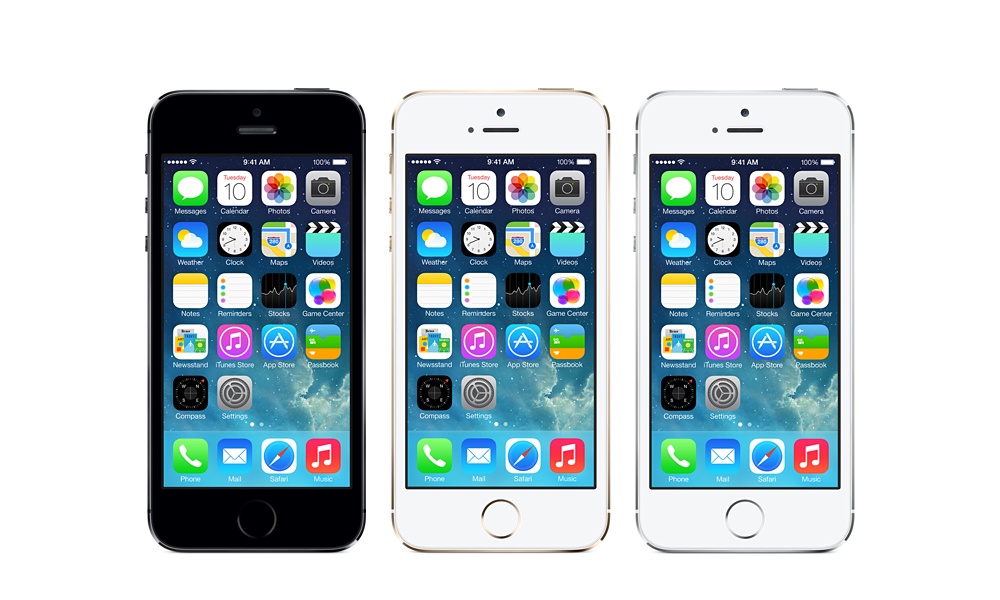
There were so many leaks prior to yesterday's announcements at Cupertino that we pretty much already knew what to expect. Apple has taken the wrapper off the latest version of the iPhone and the company has stuck to its recent release schedule of following up a major iPhone with an S edition -- the iPhone 5S. Visually, things are very much the same as before, but in addition to black and white models, there's also the light gold colored model -- colors we now know should be referred to as space gray, silver and gold.
 
The promise to "brighten everyone's day" seems to have meant not only an addition to the color options for the iPhone 5C and 5S, but also new features. While the 5C retains the same processor as in the 5, the 5S boasts a new A7 processor which is the world's only 64-bit chip in a smartphone. iOS 7 has been re-engineered as a 64-bit operating system, but the chip is capable of running 32-bit and 64-bit apps. Apple claims the processor is double the speed of the iPhone 5 according to the graph they showed. And the processor now supports OpenGL|ES 3.0, the same as Nexus 7.
 
There's also a new M7 co-processor which measures the accelerometer, compass, and gyroscope which Apple claims will lead to a new breed of health and fitness apps. In terms of battery life, iPhone 5S users can expect 10 hours of talk time and 120 hours of standby. As with previous S models, there are other upgrades to the hardware to be found inside the case. The phone's camera has come a long way in recent years, and the 5S take things further boasting an F2.2 aperture lens.
 
The 8 megapixel camera takes multiple photos when the shutter is pressed, processes them and combines the elements of each for the best results. Two LED flashes -- one warm, one cool -- help to create a better light balance in shots, and there is a new burst mode than can take up to 10 shots per second. There's also double-speed video capture to experiment with thanks to 120 FPS video capture at 720p.
 
The rumoured fingerprint reader has indeed materialized, despite the fact many commentators thought it fantastical ahead of today. The Touch ID reader can be used to unlock the iPhone as well as confirming identifies when making a purchase. Forget typing a password or tapping a PIN, your finger is all you need. Orientation is not important as the reader, which is built in to the home button, and can scan at 500ppi in 360 degrees. Talking of the home button, it is now made of sapphire to eliminate the risk of scratches. If you're concerned about security, Apple assures users that fingerprint data is never shared with other apps, or even Apple.
 
Those all-important dimensions? Height: 4.87 inches (123.8 mm), Width: 2.31 inches (58.6 mm), Depth: 0.30 inch (7.6 mm) and Weight: 3.95 ounces (112 grams).
 
Of course, there's also iOS 7. As this had already been previewed there were few surprises here. You don’t have to be packing an iPhone 5S to take advantage of the updated operating system, it can be installed on everything back to the iPhone 4 and iPad 2. There's the new, flat look, improvements to Siri, the addition of iTunes Radio and AirDrop and a new multi-tasking view as well as easy search access and more. Get downloading on 18 September.
 
So we now know the details, we've got the full rundown. When can we get our hands on the iPhone 5S? Not long to wait -- the device will be available from 20 September. Expect to pay $199 for the 16GB model and $299 for the 32GB version and $399 for 64GB -- all on a two-year contract. There are also multi-colored cases available for $39 a piece.
 
Ordering starts 20 September, in the meantime you can check out the iPhone 5S website.
 
~ Mark Wilson

4.07.2013

Apple to reportedly unveil completely redesigned next-gen iPad in April

Apple iPad 5 Shell
Apple (AAPL) has long been rumored to be prepping a completely redesigned full-size iPad that will debut this year, and the new tablet will reportedly be unveiled at a press conference later this month. A number of well-known Apple bloggers held a public discussion on social site Branch on Tuesday, and they covered a number of topics. Among them were Apple’s efforts to overhaul the user interface in iOS 7 and the company’s plans to unveil its next-generation iPad during a press conference this month. Earlier reports suggested that Apple will release a redesigned iPad this year and images of a purported rear shell from the fifth-generation iPad leaked in January, revealing a new design resembling Apple’s smaller iPad mini tablet.

~ Zach Epstein