Cisco Learning Network Store Promotions Page
Showing posts with label Motorola. Show all posts

1.29.2016

There was a record 1.4 billion smartphones shipped in 2015 and almost a quarter came from Samsung

 
The good news for smartphone manufacturers is that worldwide shipments grew by 12% and hit a record high of 1.4 billion in 2015. The bad news is that the industry just isn’t expanding as quickly as it has done in the past. Last year’s fourth quarter shipments grew just six percent from the same period in 2014, marking the sector's slowest growth rate of all time.
 

The results come from research company Strategy Analytics, which says that the slowdown is primarily due to most people in major markets like China already owning a smartphone and not feeling the need to upgrade. It also cites consumer fears over a global economic downturn as a reason for the slow growth rate.
 
When it comes to who leads global smartphone shipments, Samsung continues to stay ahead of the pack, shifting 81.3 million units in Q4 and 319.7 million units throughout 2015. The 9 percent quarter increase from Q4 2014 represents the Korean company’s fastest growth rate for almost 2 years.
 
Samsung stays ahead of Apple, which shipped 74.8 million units in Q4 and 231.5 million across all of last year – a big improvement on the 193 million devices the Cupertino company shipped in 2014.
 
 
The figures show that Samsung had a 22 percent share of the smartphone market across 2015, while Apple took an 18 percent market share. The research site noted that Apple will need to expand into developing markets such as India and Nigeria if it wants to boost iPhone growth in 2016.
 
Just below Apple lies Huawei, which jumped in front of Lenovo-Motorola into third place. The Chinese firm will no doubt be pleased that it shipped over 100 million smartphones in one year for the first time ever. Lenovo-Motorola, meanwhile, was the only company in the top five to see its shipments decline – down 18 percent across the whole of 2015.
 
Xiaomi stayed at fifth place with a five percent market share. It shipped 11 million more handsets in 2015 than it did in 2014, but growth slowed down in the final quarter. Xiaomi only shipped 2 million more units in Q4 2015 than it did in Q4 2014.
 
~ Rob Thubron

4.30.2015

Samsung leads the smartphone market again, leaves Apple behind

 
Something interesting happened in the last quarter of 2014: Apple tied with Samsung on smartphone shipments. Both players moved 74.5 million units, reaching this figure from two opposite directions. The Cupertino, Calif.-based vendor saw its iPhone shipments increase by a whopping 46.07 percent year-over-year, while its South Korean rival dealt with a 13.37 percent decline.
 
But, luckily for Samsung, things changed in the first quarter of 2015. According to Strategy Analytics, its smartphone shipments reached 83.2 million units, while Apple's iPhones shipped in just 61.2 million units. And just like that, Samsung is, once again, back at the top. However, it is not yet in tip-top form.
 
Samsung's shipments actually decreased year-over-year, falling by 6.5 percent from 89 million units in Q1 2014. Its current market share is 24.1 percent, again lower than a year ago when it claimed a more comfortable 31.2 percent of the smartphone market. Sequentially, shipments are up, as Q4 2014 was, alongside Q2 of last year, its weakest of 2014.
 
Strategy Analytics notes that Samsung experienced some issues in "Asia and elsewhere, but its global performance has stabilized sufficiently well". The new Galaxy S6, and Galaxy S6 edge, could help Samsung's numbers in the following quarter, as its flagships are currently in high-demand in markets across the globe.
 
That said, Samsung's still seeing the effect of Apple's flagships, iPhone 6 and iPhone 6 Plus, which continue to sell in droves six months after their release. According to Strategy Analytics, "Apple’s new iPhone 6 portfolio is flying off the shelves in China and the United States, its two biggest markets". In fact, the former is Apple's biggest market now.
 
Year-over-year, iPhone shipments increased by 40.04 percent, rising from 43.7 million units. Apple's market share in Q1 2015 reached 17.7 percent, higher than the 15.3 percent captured a year ago. It is slightly smaller sequentially, but still higher than in any of the first three quarters of last year. In Q4 2014, Apple's market share was 19.6 percent.
 
In third place is Lenovo, combined with Motorola. Its shipments reached 18.8 million units in the first quarter of 2015, deceasing by 4.5 percent year-over-year from 19.7 million units (at the time, however, Motorola wasn't under Lenovo's leadership, so it is not exactly an accurate representation of the duo's performance).
 
Market share is just 5.4 percent, lower than the 6.9 percent a year ago. Its performance decrease sequentially, as in Q4 2014 the duo moved 24.7 million units and claimed 6.5 percent of the market. Strategy Analytics blames pressure in China faced by Lenovo and Motorola's inability to capitalize on its success in the North American and India markets, for the duo's weak results.
 
Total smartphone shipments for the first quarter of 2015 are said to be 345 million units, 21.05 percent higher year-over-year. In Q1 2014, smartphone shipments reached 285 million units, increasing by 33.2 percent year-over-year compared to Q1 2013. Year-over-year growth is obviously slowing down.
 
Photo Credit: Pieter Beens / Shutterstock.com
 
~ Mihaita Bamburic

11.02.2014

Nexus 6 and Note 4 compared on video! Which one should you buy?

In the world of Android, there is rarely a clear-cut "best" smartphone. This is a good thing, as it signifies variety in the Android marketplace. In other words, consumers do not all have the same tastes; some like a smaller screen, some a larger screen and some even like having a stylus. However, with that said, even though people have different preferences, it is easy to identify the top flagship phones.
 
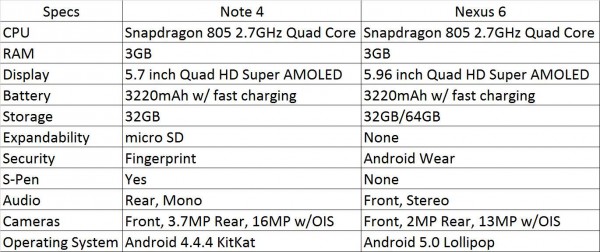
BetaNews has the two top Android smartphones in our lab. Yes, we have both the Samsung Galaxy Note 4 and Google's Motorola-manufactured Nexus 6. For the immediate future, these will be the phones of many consumers' desires. Deciding which of these two smartphones to buy is very problematic, but hey -- it's a great problem to have, right? Please read on, to see how the phones differ and which one you should buy.
 
Specs
 
 
Video Comparison
 
 
As you can see in the video above, consumers have some tough decisions to make. Unfortunately, this fight must be declared a tie -- for now. Ultimately, you can't go wrong with either phone, but your wants and needs will make one of them a winner for you. Yes, only you the consumer can decide the winner.
 
So I ask you, which one will you buy? Tell me in the comments.
 
Photo Credit: CYCLONEPROJECT / Shutterstock
 
~ Brian Fagioli

10.30.2014

Nexus 6 pre-orders sell out instantly -- Don't cry, there is still hope

 
If you are a fan of Android, there is something you may live and breathe for -- Nexus. True, fans may choose other devices for various reasons, but Nexus devices are the best way to get timely updates and a pure Android experience. As many of us have learned the hard way, non-Nexus devices may get stranded without updates and get left behind. Regardless of who is to blame, whether it is the manufacturers or the carriers, it can be an unpleasant experience to say the least.
 
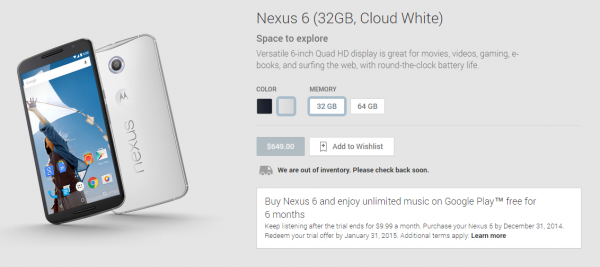
The Nexus 6 is the newest Google handset, this time built by Motorola. Pre-ordering went live today, but something rather tragic happened -- it sold out. Yes, in merely a minute or so, the world raced to pre-order the smartphone and it is now out of stock from the Google Play Store. If you did not get to order one, you have my sympathies; it understandably sucks. However, all is not lost, you can still score one on launch day.
 
If you want a Nexus 6, you will have to be crafty. Using the online pre-order frenzy as an indicator, in-store interest will be high too. So, what does this mean? Well, much like the Apple fans, you may have to wait in a line, or try and place a pre-order at a store like Best Buy or at a carrier directly, such as Verizon or AT&T. Quite frankly, depending on where you live, you may be able to waltz into a local store, such as Best Buy, on launch day (November 12th) without issue. However, I caution that this may not be the case.
 
Probably the biggest disappointment you face is not getting the color or storage size that you desire. You see, the phone comes in both white and midnight blue, plus either 32GB or 64GB. You may have to settle for something you do not want. With that said, regarding color, don't forget that a case will cover it anyway. I would suggest focusing more on the storage size and making the color a secondary decision (they both look sexy, do not worry).
 
 
If you did not get to pre-order, what is your game plan? Tell me in the comments.
 
Photo Credit: 4634093993 / Shutterstock
 
~ Brian Fagioli

9.17.2014

Android L rollout: What and when to expect

Wondering if your device will get Android "L" or when the rollout should start? Jack Wallen has some of the details to satisfy your curiosity.  

 
The next iteration of Android will start hitting devices later this year (2014). Naturally, every roll out of a major Android release is big news -- but not quite this big. Android L marks some major changes for the Android ecosystem. We're talking about a serious shift in design. According to Sundar Pichai, head of Android, L is to be one of the biggest upgrades to Android yet. The new design scheme will be a much flatter look, but every animation, every shadow, every single element will look "real." Shadow gradients, 3D tiles, and a much more consistent look and feel will spread across the whole of Android.
 
From everything Google is saying, this will be the most intuitive version of Android to date. Other than a total overhaul of the look, you'll find plenty of change in the platform. Other bits and pieces you should expect:
  • Notification panel and lock screen integration
  • Prioritized notifications (based on what you look at most)
  • Interlocking apps (apps can "talk" to one another)
  • Major performance boost
  • Default to ART runtime
  • Much improved battery life (thanks to Project Volta)
  • Improved Android wear experience
  • Android TV integration
There's plenty more goodness in the list, but that should be enough to get you hoping for an "L" upgrade to your device as soon as possible.

The big question: "Will device X get L?"

This question is on the minds of almost every Android user. Will my device get "L"? As you've all come to know, OS upgrades are dependent on a couple of major variables:
  • Carrier
  • Device
Not all devices are L-compatible. Most devices manufactured in 2014 should be. Here is a short list of compatible devices that are likely a lock for "L":
  • All Google Play edition phones
  • Nexus 5
  • Nexus 7
  • LG G Pad
  • All HTC devices released after the M7
  • LG G3
  • Motorola Moto X/G/E
  • Samsung Galaxy S 5
  • Samsung Galaxy S 4 (this will roll out well after the 5)
  • Samsung Galaxy Note 3/4
  • Sony Xperia Z1/Z2/Z3
OnePlus has also claimed that all of their newer phones will be getting the "L" update -- but there is no indication as to which devices and when.
 
The "when" is the tricky part, due to the carriers. The order in which these devices (by carrier) will most likely see "L" looks like:
  1. Google devices
  2. HTC
  3. Motorola
  4. Samsung
  5. LG
  6. Sony
This order, of course, is totally thrown out of whack because of carriers. Some carriers update much faster than others. For example, if you're on a contract with AT&T, expect your upgrade to "L" to be delayed. Of the three major US carriers, my best guess for "L" rollouts would be (based on previous major update rollouts):
  1. Verizon
  2. Sprint
  3. AT&T

The big "when?"

The rollout of "L" should begin around November or December of 2014. That will, most likely, be for Google devices only. I would suspect that most other devices won't see the "L" update until the beginning of the new year (although a Verizon-branded HTC M8 update could happen sooner).
 
No matter when the update occurs -- all Android users should be excited about what may be the most significant improvement to the platform to date. If your current device doesn't support "L" and you're getting ready to purchase a new device, make sure you land one that does support "L" or wait until after the "L" release to purchase. It will be worth the wait.
 
Are you excited for the newest iteration of Android? If so, what feature(s) are you most looking forward to?
 
~ Jack Wallen

9.28.2012

Apple: The accuser becomes the accused

Takeaway: On the heels of the Apple/Samsung lawsuit, Apple drops IOS 6 on the public. Just like IOS 5, there are plenty of features stolen directly from Android, alleges Jack Wallen.


Much to my chagrin, my wife has an iPhone. Yesterday she upgraded the OS to 6 and the upgrade brought a few shocks, but no surprises, to my eyes. It seemed every time my wife would shout, “Oh cool!”, it would turn out yet another feature on IOS 6 was another bit of clever thievery on the part of Apple.

Now, the only reason this is even remotely important (at least to me) is that it comes after the ridiculous IP lawsuit Apple won over Samsung. Prior to that, Apple was doing its usual ‘Oh, that’s a cool feature Android has, let’s steal it, put it in our platform, and pretend we invented it.’ I’ve been used to that ever since various desktops started stealing from Linux long ago. But this time there was something else involved — hypocrisy.

Apple sues the bankroll off of Samsung for patent design issues (does anyone actually have any details on just what design issues?) and then turns around and releases a new OS that clearly “borrows” from Android. Apples to Apples? Shouldn’t this be a case of the pot calling the kettle black?

There were so many pundits pontificating on why Apple brought this insane law suit to court. I myself stated it was a cash grab in hopes of stopping the Samsung Galaxy S3 from getting into the hands of too many people before the iPhone 5 arrived. But now, I wonder if it was little more than a diversionary tactic so people might not notice (or even bother to bring up) the fact that Apple did just what they claimed Samsung was doing.

Let’s see:
  • You can now create auto responses to phone calls in the form of texts (been in Android for a long time now)
  • All Facebook contacts show up in Contacts (been in Android since day one)
  • Bluetooth sharing (again, been in Android since day one)
  • Document syncing (Sync your Android docs with Google docs)
  • Offline Reading (tons of Android apps have already had this)
This list doesn’t even include the list of IOS 5 features that were “borrowed” from Android. And in a show of unprecedented shenanigans, Apple even stole the design for their clock design from the Swiss National Railway!

Ultimately, what gets me about this whole mess is that Apple seems to always have a Get Out Of Jail Free card hidden in their back pocket. It seems the darling dear of the tech world can do what they want, when they want, and get away with it, knowing full-well there will be no consequences.

It’s very clear that Apple wants to be the only big man on campus. Fundamentally there is nothing wrong with that — we all do in our respective fields. But to win a lawsuit to the tune of over two billion dollars and then turn around and pull off the same thing you just sued a company for is beyond the realm of audacity (and I’m not talking the amazing, open source audio recording tool)!
Every maker of Android devices needs to stand up to the bully. Actually, it’s time Google came up to bat and knocked Apple out of the park. Make Apple aware they can’t bully everyone on the playground just because they are Apple. Slap them with an iLawsuit that will finally make the public aware that the accuser is now the accused. Sure, the public at large won’t care. But those with a finger in this tasty pie (aka Android developers and designers) would certainly feel validated and vindicated.

Apple should be ashamed of themselves for wasting taxpayers’ money on a lawsuit that could just as easily be aimed at themselves. I realize that nothing will probably come of this, mostly because the public is far too awash in a sea of delight that is the iPhone 5 to realize said delight is brought to them by a completely different platform. But maybe, just maybe this will come back to haunt Apple when Samsung, HTC, Motorola, and Google have had enough and drop the gauntlet to Cupertino. Should that happen, the court system and the court of public opinion might have a surprise for Apple up their sleeves.

~ Jack Wallen

8.28.2012

Apple seeks quick bans on eight Samsung phones

(Reuters) - Apple Inc is seeking speedy bans on the sale of eight Samsung Electronics phones, moving swiftly to translate its resounding court victory over its rival into a tangible business benefit.

The world's most valuable company wasted no time in identifying its targets on Monday: eight older-model smartphones, including the Galaxy S2 and Droid Charge. While Apple's lawsuit encompassed 28 devices, many of those accused products are no longer widely available in the world's largest mobile market.

Although Samsung's flagship Galaxy S III phone was not included in the trial, the jury validated Apple's patents on features and design elements that the U.S. company could then try to wield against that device. Apple may not have to seek a new trial over the S III, but can include it in a "contempt proceeding" that moves much faster, according to legal experts.

Many on Wall Street believe Apple now has momentum behind it in the wake of its near-complete triumph over the South Korean company on Friday.

"The evidence and weight of the case are heavily in Apple's favor," said Jefferies & Co analyst Peter Misek. "We expect there's a two-thirds chance of an injunction against Samsung products."

An injunction hearing has been set for September 20. If U.S. District Judge Lucy Koh grants sales bans, Samsung will likely seek to put them on hold pending the outcome of its appeal.
Samsung said it will take all necessary measures to ensure the availability of its products in the U.S. market. A source familiar with the situation said Samsung has already started working with U.S. carriers about modifying infringing features to keep products on the market should injunctions be granted.

Apple's win on Friday strengthens its position ahead of the iPhone 5's expected September 12 launch and could cement its market dominance as companies using Google Inc's Android operating system - two-thirds of the global market - may be forced to consider design changes, analysts say.

Apple was awarded $1.05 billion in damages after a U.S. jury found Samsung had copied critical features of the iPhone and iPad. The verdict could lead to an outright ban on sales of key Samsung products.

Apple's stock scored another record high on Monday.

While the victory does not cover new Samsung products including the Galaxy S III, Apple will push its case on these products in the near-term, Evercore Partners analyst Mark McKechnie said.

"While a ban would likely increase Apple's leading smartphone share in the U.S. market, we believe this verdict could lead to Samsung also delaying near-term product launches as it attempts to design around Apple's patents," Canaccord Genuity analysts said in a note.

TOOTH-AND-NAIL 

Apple's shares gained 1.9 percent to close at $675.68, tacking on another $12 billion-plus to its already historically leading market value. Samsung lost about the same amount in market capitalization as its shares slid 7.5 percent in Seoul. 

Samsung shares rebounded 1.8 percent on Tuesday.

"The ruling marks an important victory for Apple against Android. Competitors may now think twice about how they compete in smart mobility devices with the industry's clear innovator," Barclays analyst Ben Reitzes wrote on Monday. "If Apple forces competitors to innovate more, it could take longer for competitive products to come to market, and make it more expensive to develop them."

The victory for Apple - which upended the smartphone industry in 2007 with the iPhone - is a big blow to Google, whose Android software powers the Samsung products found to have infringed on patents. Google and its hardware partners, including the company's own Motorola unit, could now face legal hurdles in their effort to compete with the Apple juggernaut.

Google shares closed 1.4 percent lower at $669.22. Microsoft Corp, a potential beneficiary if smartphone makers begin to seek out Android alternatives, ended up 0.4 percent. Nokia, which has staked its future on Windows phones, gained 7.7 percent.

Even Research in Motion - which has hemorrhaged market share to Apple and Google - climbed more than 5 percent, before ending 2 percent higher.

"The mobile industry is moving fast and all players, including newcomers, are building upon ideas that have been around for decades," Google responded in a Sunday statement. "We work with our partners to give consumers innovative and affordable products, and we don't want anything to limit that."

The verdict came as competition in the device industry is intensifying, with Google jumping into hardware for the first time with the Nexus 7 and Microsoft's touchscreen-friendly Windows 8 coming in October, led by its "Surface" tablet.

Samsung, which sold around 50 million phones between April and June - almost twice the number of iPhones - will have to pay damages equivalent to just 1.5 percent of the annual revenue from its telecoms business.
"The verdict does not come as a surprise," wrote William Blair & Co analysts. "From Apple's perspective, Samsung's market position and its leadership in the handset world was something the company could no longer overlook, and viewing this as another 'imitation is a form of flattery' was not possible."

"Companies such as Samsung, who we categorize as fast followers, have been viewed by the industry for their ability to quickly adopt the latest handset trends ... rather than their ability to introduce fundamental innovation."

~ Sayantani Ghosh and Sruthi Ramakrishnan                     

3.25.2012

Samsung, Google unveil phone for revamped Android


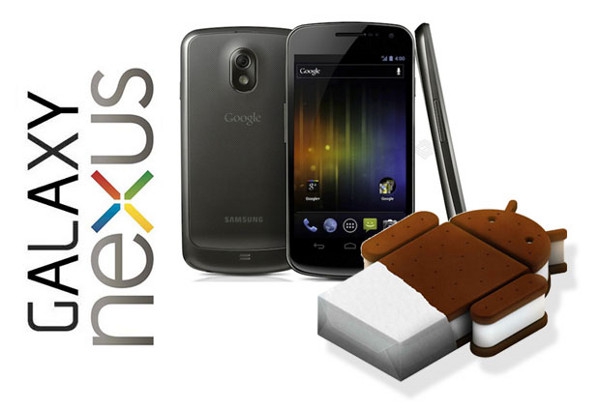
(Reuters) - Samsung Electronics (005930.KS) unveiled the first smartphone running on Google's (GOOG.O) latest version of the Android operating system, which combines software used in tablets and smartphones, as they step up competition against
Apple.


The global launch of the Galaxy Nexus kicks off in November and comes as competition intensifies between Samsung and Apple Inc. (AAPL.O) to win market share in the booming tablets and smartphones industry.

Samsung and Google introduced the high-end model at an event in Hong Kong, after delaying the launch last week as a tribute to the late Apple co-founder Steve Jobs. Apple is Samsung's biggest customer for microprocessors.


"This will be our strategic product for year-end holiday season, as (Apple's) iPhone 4S just came into the market," JK Shin, president and head of Samsung's mobile communications business, said in a pooled report with reporters ahead of a packed product launch in Hong Kong.

This also marks the first major rollout from Google since it announced plans in August to acquire Motorola Mobility Holdings (MMI.N) for $12.5 billion.


The deal had raised concerns among hardware makers that Google may favor Motorola over other handset vendors such as Samsung, HTC (2498.TW) and LG Electronics Inc (066570.KS) that rely on the free software.


Google's Android mobile software -- already the world's most-used smartphone platform -- powers 190 million devices, up from 135 million in mid-July.


The latest version of Android, named Ice Cream Sandwich, is designed to unite tablet and smartphone platforms, potentially attracting more application developers and consumers to the Android camp, which has fewer applications available than Apple's.


Samsung, the top seller of Android phones and the biggest challenger to Apple, said the phone will have access to more than 300,000 applications and games, versus over 425,000 apps from Apple's App Store.


The release comes after Apple unveiled its latest operating system earlier this month which allows much-touted
voice-recognition technology dubbed "Siri."


Technology websites ran live blogs of the event, indicating the buzz generated for the new Android software and Nexus.


During the launch in Hong Kong, executives demonstrated several features of the new gadget, including Android beam that allows two phones to connect back-to-back to share news articles on the Internet and Google maps.
 
Samsung's new device, which touts a 4.65-inch high-definition "super" AM-OLED display and a 1.2 GHz dual-core processor, features such new functions as face recognition to unlock the phone.


The world's No.2 handset maker said it also plans to introduce a version of the Galaxy Nexus that runs on faster Long-Term Evolution (LTE) networks.


Samsung's event came less than a day after Apple reported quarterly results that missed expectations for the first time in years, blaming rumors of the new iPhone for hurting demand in the September quarter.


Apple and Samsung have been locked in an acrimonious legal dispute in 10 countries involving smartphones and tablet computers as they jostle for the top spot in the fast-growing markets.


Analysts said they expect Apple and Samsung to remain dominant in their rankings.


"I don't see Apple and Samsung getting kicked out of their positions anytime soon (in the next year or so)," said Melissa Chau, research manager for client devices at research firm IDC.


"It will be a very close race between Apple and Samsung mainly because I think Apple is in a high-end and more niche category than Samsung, whereas Samsung can certainly bring that scale all the way down in price."

Samsung said on Monday that sales of its Galaxy S and Galaxy S II smartphones topped 30 million units, with the once-smartphone-laggard expected to overtake Apple as the world's biggest smartphone vendor in the third quarter.


~ Lee Chyen Yee and Hyunjoo Jin