Cisco Learning Network Store Promotions Page
Showing posts with label Beats Music. Show all posts

3.09.2015

Watch Apple's 'Spring Forward' event live on any device including Windows and Android

Whether you think the Apple Watch will revolutionize wearables, or be a rare misstep for Apple, we’re about to find out as the tech giant is all set to launch its latest new product at a 'Spring Forward' event which is being hosted today at the Yerba Buena Center for the Arts Theater in San Francisco.
 
While the Apple Watch will be the center of attention, it’s possible that Apple will have a few other products to show off too including maybe a Retina MacBook Air and Beats Music Service.
 
The event starts at 10am PST, which is 1pm EDT and 5pm GMT (thanks to the change in Daylight Savings Time in the US). There will be a live stream, but as always with Apple, there are some restrictions.
 
Apple likes to preach to the faithful, so live streaming the event requires Safari 5.1.10 or later on OS X v10.6.8 or later; Safari on iOS 6.0 or later. Streaming via Apple TV requires second- or third-generation Apple TV with software 6.2 or later. Assuming you have what's required, you can watch the event live here.
 
If you have a Windows PC or an Android device you can still watch the event, but you’ll need VLC Media Player installed. Assuming you do, open it, and click on "Media" at the top left. Go to "Open Network Stream" and paste in the network URL of the live Apple event which is:
 
http://p.events-delivery.apple.com.edgesuite.net/14pounqefvoiubefvpiub10/m3u8/atv_mvp.m3u8
 
You should also be able to paste this address straight into Chrome or Firefox on Windows too, assuming you have VLC Media Player installed. It should be detected as a live stream and start playing. Naturally, all this will only work once the stream is live, so if you get an error, try again nearer the broadcast time.
 
Tune in once the event starts and feel free to share your comments about what Apple is showing off in the comments below. Will you be buying an Apple Watch?
 
~ Wayne Williams

1.01.2015

Apple's rumored iTunes and Beats Music 'Exclusives' plan is potentially evil

 
Imagine if in the 1990's, there were CDs that only played on certain players. In other words, what if Warner Brothers released the Red Hot Chili Peppers' iconic album, "Blood Sugar Sex Magik", and it only worked on CD players made by, say, Pioneer? Not only would it harm consumers, but also limit the reach of the artist. If you did not own a Pioneer CD player, you could not hear the album.
 
If a new rumor by the New York Post is to be believed, Apple is planning such a thing, but rather than CD players, its iTunes and Beats Music would be the means of harming the consumer. Yes, the fruit-logo company may be working with artists (and ultimately record labels) to bring album-exclusives to its own music services.
 
"It's been a while since we've heard much about Jimmy Iovine and Dr. Dre's Beats Music, but our music industry spies say Iovine is having fresh talks with artists about doing exclusives", says Claire Atkinson of the New York Post.
 
Atkinson further explains, "Beats executives -- now Apple employees -- are looking to replicate the kind of success Beyoncé had with her iTunes album, 'Beyoncé by Beyoncé'', back in December 2013".
 
Yes, many will point to BeyoncĂ©'s self-titled album as an example of success; it was an iTunes exclusive for a week, before expanding to greater availability. While this release sparked consumer interest on its limited nature alone, it would not likely be duplicated if commonplace.
 
Currently, iTunes and many retail stores, such as Target and Best Buy, offer exclusive bonus tracks, in addition to the album. I find this to be acceptable, as the perks are an added bonus. Apple's plan of limiting albums to its own iTunes or Beats, however, is an entirely different ball game, which does nothing to benefit the consumer.
 
Let's not forget, not everyone uses Apple products, such as iPads and iPhones. While iTunes is available for Windows, what about Chromebook users? or traditional Linux distribution users? Hell, some people use Android exclusively. Not everyone will have access to iTunes, and quite frankly, not everyone wants to access it.
 
Even worse is exclusivity to streaming services. If this practice were to catch on, consumers might have to shell out multiple monthly subscription fees in order to gain access to all of their favorite artists. Even then, with the music spread across multiple services, the user could not create playlists using all of the desired music.
 
Again, this is all rumor at this point, and I hope it is not true. With that said, the potential harm to consumers is so great, that even the mere notion should have music fans up in arms.
 
UPDATE: As a reader points out, iTunes already has some exclusives such as The Beatles. Obviously, expanding this practice would further harm consumers, much like not having the Fab Four on other services already does.
 
Photo CreditAfrica Studio / Shutterstock
 
~ Brian Fagioli

8.01.2014

Apple eliminates jobs following Beats acquisition

Summary: As Apple's acquisition of Beats Electronics and Beats Music comes close to completion, hundreds of employees may find their positions redundant and their pink slips issued. 
 
Credit: Apple
As the acquisition of Beats Electronics and Beats Music looms closer, Apple has begun transitioning some employees to its own workforce -- but others will feel the sting of redundancy.
 
The Cupertino and Santa Monica, California-based companies have begun shifting Beats employees to Apple, as reported by Bloomberg. A source with knowledge of the restructuring said approximately 200 workers at Beats Electronics will be axed.
 
According to 9to5Mac, Apple executives visited the Beats headquarters this week, and have notified some members that they are not to be included in the transition. The majority of Beats staff in creative roles will be offered positions at Apple, but cuts are expected to hit human resources, finance and roles where there is overlap between the two companies.
 
Some employees are believed to be offered different positions at Cupertino, while others will be guaranteed work until January 2015.
 
The acquisition of Beats was announced in May. The deal, signed for $3 billion, is Apple's largest acquisition in years, and gives the tech giant the opportunity to explore rapidly growing music subscription services -- as well as potentially create a line of premium headphones. The deal was recently approved by the European Commission, and Beats co-founders Jimmy Iovine and Dr. Dre will join Apple as mid-level executives.
 
The Apple-Beats deal is expected to finally close in this quarter, ending mid-September.
 
The iPad and iPhone maker accounted for 41,300 employees as of the end of June.
 
~ Charlie Osborne

6.03.2014

Why Apple no longer innovates

 
The more I ponder Apple's Beats acquisition, the less sense it makes. Buying big well-known brands that compete with yours is usually a bad idea -- worse when the acquirer owns no foreign brands. Extinguishing the big name, as Microsoft does with Nokia, is marketing murder. There's no place for the Beats brand in the Apple lexicon. The gun is drawn and ready to fire.
 
What I do see is another sign that Apple has lost its way. Tim Cook is a very able CEO, but as stated previously he is Star Trek's Spock without Captain Kirk (Steve Jobs). Cook's approach to business logistics, while brilliant, unmakes Apple. Beats is an acquisition that is off-key -- out of tune with the culture that made the fruit-logo company great. As such, on this Thursday in May, comes my confession. I was wrong five years ago in post "Why Apple succeeds, and always will". That company is gone.
 
Dynamic Duo
 
Like Kirk and Spock, Jobs and Cook were complimentary, when working together: The inspired visionary looking to bring good taste and understated design to otherwise complex products and the man responsible for getting them to market. Kirk is the leader, the charismatic one. Spock is the empowering sidekick but not as effective leader.
 
Jobs, like Kirk, was a risk-taker who took logic-defying gambles that played to his strengths. Based on what Apple has done -- or hasn't -- since autumn 2011, Cook is more cautious, more corporate in approach. Mixing metaphors, he doesn't exhibit what I have long called "David Thinking".
 
David Thinking
 
During the Steve Jobs era, Apple repeatedly defied the status quo by using guerilla tactics that changed the rules of engagement. I wrote five years ago, when praising the approach:
Apple doesn't play by the rules. It reinvents them. Apple applies what I call 'David Thinking' to its broader business, product development and marketing. Apple is David to Microsoft Goliath -- and other ones, too. Goliath plays by one set of rules. David choses to change the rules, which favor his strengths rather than those of Goliath.
David Thinking derives from research political scientist Ivan ArreguĂ­n-Toft conducted. In 2005 book, How the Weak Win Wars: A Theory of Asymmetric Tactics, he explains how seemingly weaker opponents can prevail against stronger ones by changing the rules of engagement. (So that you don't have to purchase the book, review paper "How the Weak Win Wars: A Theory of Asymmetric Conflict" as an alternative.)
 
ArreguĂ­n-Toft produces excellent historical data showing that, in wars, when smaller rivals apply David Thinking they are more likely to win, even against mightier opponents. The Biblical example of David vs. Goliath is good analogy. Rather than fight like Goliath -- and almost certainly lose by dawning armor and sword -- David relied on his own strengths. A slingshot and stone kept him out of Goliath's reach but still on the offensive.
 
But Apple has gone through dramatic transformation since my "always will succeed" post. The fruit-logo company is no longer David but Goliath. Apple's size and success makes it the status quo and encourages management decisions that seek to preserve what is rather than take forward-reaching risks.
 
Under Cook's leadership, rather than innovate, Apple iterates. Over more than a year of conference calls, I heard the chief executive promise new innovations that the company has yet to deliver. The only industry-transforming products are those put forth by scads of rumor-spreading Apple blogs. They promote vaporware.
 
That said, Cook the tactician brilliantly preserves status quo revenue streams through exceptional control of manufacturing and distribution logistics. I wouldn't want to play chess with the man. But Jobs the poker player -- master of bluff and misdirection -- made Apple a great innovator.
 
Cook chooses to preserve what is rather than reach for something more, and use daring tactics in process. From a different perspective, he acts responsibly. Every public company's first moral mandate is to shareholders, whose priority is profitable. Cook magnificently squeezes high-margins from Apple's supply chain, whether existing or new markets. That's how Apple succeeds today, but the "always will" I asserted in 2009 is gone.
 
Glory Days
 
Too many people obsess too much about Apple creating another new product category. On the other hand, Jobs' guerilla tactics produced many. Among the examples:
  • iMac (1998)
  • iTunes (2001)
  • Titanium PowerBook (2001)
  • iPod (2001)
  • iTunes Music Store (2003)
  • iLife (2003)
  • iPod mini (2004)
  • iPod nano (2005)
  • iPhone (2007)
  • App Store (2008)
  • MacBook Air 13.3-inch (2008)
  • iPad (2010)
  • MacBook Air 11.6-inch (2010)
Each of these products opened new categories for the company, and some for the broader tech industry. Like a sculptor, Apple refined each product line over the years. iPod and iTunes Store are among the best examples of successful iteration from initial innovation. iPad and iPhone are others.
 
Product refinement -- that is iteration -- reflects Cook's capabilities. But where is the innovative, risk-taking, David Thinking, category-changing product since 2010? Nowhere. Cook smartly preserves the status quo, but that's hallmark of Goliaths against which Apple acted as David.
 
For example, rather than make iPhone better -- or transcend it the way the handset did iPod in 2007 -- Apple improves marketing. I love the new "Powerful" ad campaign, but it's the wrong response to innovations that HTC, Motorola, and Samsung bring to market.
 
Beats Me
 
Then there is Beats, which for $3 billion is pocket change to Apple. Beats spotlights what's wrong. Apple isn't, or wasn't, known for buying big brands for loads of cash -- the kind of thing large Goliaths do to expand -- but to purchase smaller, innovative shops that fit the Apple Way and expand it.
 
Beats Music will give the fruit-logo company a streaming service rather than just straight sales. But the headphones are, well, brand conflict. They don't fit well. What would have been better: Apple releasing a risky product that transforms the art of listening. Instead, Beats is very status quo -- bass-booming cans that mask the imperfections of low-bit, compressed AAC.
 
Clear Pattern
 
The trend is both clear and frustrating to watch. Apple stands at the pinnacle of success, where down is the only direction to go. I've pulled a chronological selection of my analyses over the last 18 months that look specifically at Apple as a business. I encourage contrasting them against the company portrayed in the 2009 "always will succeed" analysis:
I want to specifically call out three others. The first two, from this month: "Apple should be very afraid" and "Apple isn't phabulous" look at the changing mobile device market that undermines iPad and iPhone, which during first calendar quarter accounted for 74 percent of revenues. Competitors playing to their strengths -- that is changing the rules of engagement -- undermine the Apple device status quo. The fruit-logo company has much to lose but risks little to keep it.
 
New Sidekick
 
The other post, "Apple needs a COO, not new CEO" responded to demands for Cook's ouster a year ago. The company needs him, but he's not, ah, cook enough in the kitchen. The Jobs-Cook team was a great matchup as top exec and chief operating officer.
 
Cook largely deserves credit for Apple's amazing success -- at the least during this decade, and really longer. As COO for most of the time, and CEO since August 2011, he managed day-to-day operations. But Cook has a problem: He is half of a whole, a man responsible for two jobs: Vision and management, and he does neither as well as he could just one.
 
A COO, and the right one -- to compliment Cook's weaknesses -- could make a crucial difference. He needs a sidekick with vision, someone willing to take real risks and think like David rather than Goliath.
 
Photo Credit: Joe Wilcox
 
~ Joe Wilcox

1.13.2014

Beats Music is launching January 21st -- here's a sneak peek

 
That's Beats' new streaming service. No surprise, of course. Seems like the Jimmy Iovine / Dr. Dre's red headphone-pushing company has been eyeing the space since the World Class Wreckin' Cru days. Last month, the company offered up a bit of information in the form of an online teaser, noting that it would finally be dropping in January. The exact date, it turns out, is the 21st, though the company happily let us download an iOS teaser of the offering (it'll be available on "nearly all the major platforms" at launch according to the company). The product is reportedly the culmination of two years of work, an attempt to approach music streaming from a different angle -- namely populism. The rep I spoke with told me the company sees many of the current streaming offerings as appealing primarily to the early adopter.
 
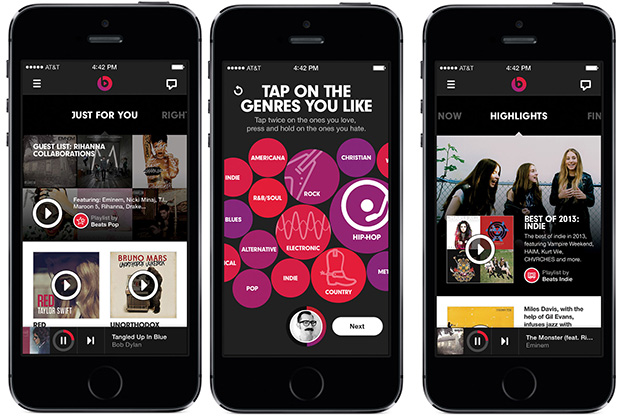
The first part of the solution is the "on-boarding" process. Here you tap bubbles on a series of screens, first designating your favorite genres (one tap for "like," two taps for "love" and holding down on the bubble to make it disappear -- take that, electronic music). Next up, do the same thing with artists, designating your favorites amongst the offerings. Then, the system begins "curating music based on what you like." The idea is somewhere between a Spotify and a Pandora, offering up custom playlists based on your listening habits, curation that will change as you continue to utilize the service. The playlists, as the company puts it, are based on ""feels like, not sounds like," and future iterations will also include options to make it possible to follow your listening habits based on location, so you can, say, get a workout playlist when you're at the gym.
 
The result of that initial curation is a page full of artwork not dissimilar from Spotify's current front page, offering up songs and playlists with big Play icons in the middle. This is called Just for You. Swipe to the right and you'll see the Right Now page, where you choose your location, activity and genre choice, so the app can build a playlist. Another swipe brings you to Highlights, a page of playlists curated by the "experts" and one more brings you to Find It, where you can search for music by Genre, Activities and Curators. All in all, it's a pretty promising offering, with a sharp and highly dynamic interface -- of course, it's hard to say how much the world is clamoring for another streaming offer. Though most of the ones that come along certainly don't have the marketing force of a Beats Music.
 
At launch, the service will offer up 20 million tracks for $10 a month.