Cisco Learning Network Store Promotions Page
Showing posts with label CES. Show all posts

1.07.2015

Apple's next MacBook Air will remove almost all traditional hardware ports: report

A render of the 12 inch Macbook Air projection from 9to5Mac.com. Photo: 9TO5MAC.COM
In a world of falling laptop sales, Apple's immensely popular MacBook Air stands tall.

But the current line feels stale to many, lacking the retina display of the MacBook Pro and the razor thinness of some of its competitors. An update is due some time this year, and as with all things Apple, rumours are everywhere.
  
A new report from 9to5Mac's Mark Gurman, which is built on information from sources within Apple, describes a new 12 inch MacBook Air that is thinner than both the current 13 and 11-inch models, with much less 'bezel' (think borders) getting in the way.

"Besides a new look for the front of the computer, the entire unibody has been revamped from the keyboard to the trackpad to the speakers. Taking cues from the 12-inch PowerBook introduced by Steve Jobs over a decade ago, the new keyboard sits edge-to-edge across the width of the laptop. In addition to going edge-to-edge, the entire key set has been subtly redesigned so that each key sits noticeably closer together."
Where are all the ports?! Render by 9to5Mac.
 
As well as saving space on bevels and keys, this projected model eschews almost every port, including Apple's own ThunderBolt and MagSafe ports. What's left? One standard headphone port and one USB Type-C port.
 
This new reversible USB port would allow for charging as well as your usual USB needs, including external monitor support. The prospect of Apple ditching that many ports at once seems somewhat far fetched, but with a pricy adaptor and a healthy dose of arrogance it does feel very Apple. Gurman takes care to note that Apple test many different versions of most devices, so the Air that ships may well have more ports on offer.
 
This news comes during CES, a huge gadget industry showcase that Apple do not take part in. They often offer some sort of counter-programming to disrupt the tech news cycle, which isn't to say this is an intentional leak, or even an authentic one. As with all things Apple, we won't know anything for sure until the device's release - likely at WWDC in the middle of this year. For more details and renders, check out the full report on 9to5Mac. 
 
Would you buy a MacBook Air with only two ports? 

~ Henry Cooke

1.05.2015

Advertisers to get a glimpse of Apple Watch promise, challenge

The new Apple Watch is pictured during an Apple event at the Flint Center for the Performing Arts in Cupertino, California, September 9, 2014.
Credit: Reuters/Stephen Lam
 
(Reuters) - Apple’s forthcoming smartwatch poses a conundrum for advertisers: How to tap the enticing possibilities of the tiny gadget without overwhelming consumers with messages.
 
At this week's Consumer Electronics Show in Las Vegas, mobile-marketing firm TapSense plans to release an Apple Watch ad-buying service. The service will provide a first glimpse of how businesses can serve up ads on the watch, even though the gadget will not be available until later this year. 
 
At issue: the same qualities that render the watch exciting to Madison Avenue, such as the ability to detect customers approaching a store and to zap an ad directly to their wrists, also risk alienating those customers. 
 
Apple declined to comment on the use of its watch by advertisers, and will not attend CES officially. But many companies that make devices and services based around Apple products will be there, including several that are working with WatchKit, a software-development tool Apple released in November that allows developers to build watch-tailored applications. 
 
Using that tool, developers are devising Apple Watch ad formats including interactive wallpapers on the watch dial with brand logos and personalized clock faces, said TapSense's chief executive Ash Kumar. His product helps developers insert ads, bought and sold instantaneously, in those apps. 
 
The watch’s main screen allows the display of several tiny icons, including for email, weather, time, and potentially a few favorite service and retail apps. 
 
Businesses could use those apps to notify customers of special deals, but only within already-opened apps, Kumar said. Otherwise, the vendor risks annoying consumers by introducing an ad that is out of sync with whatever they are doing.
 
If a consumer is using a transit app on the watch to monitor delays, for example, an advertiser could insert a marketing offer that would light up on the watch face for a ride-sharing service or a deal at a coffee shop nearby, Kumar said.
 
SMARTWATCH SPAM BOX?
  
But moderation is key. Push notifications and banner ads on smartphones can be turn-offs. Some marketers advise avoiding showing ads to users who typically click out of them or delivering the same ad too many times to any one user.
 
"If it feels like your smartwatch is turning into a spam box, you will take it off," said Padden Guy Murphy, who heads business development and public policy at car-sharing service Getaround. 
 
The startup is exploring using Apple Watch's location-based features to target new customers. Apple has not added global positioning on the Apple Watch, but apps can track location as the device is tethered to a smartphone. 
 
If a consumer shows interest in an ad, such as raising the wrist for a better look, WatchKit allows for notifications that expand and take up more room on the screen. Conversely, a disinterested consumer could tap an "X" mark to exit the ad, TapSense's Kumar said. 
 
Communicating through buzzing or vibrations is currently only available on Apple's own apps on its wearable device. 


FORCE PUSH
 
     Whether Apple scores a hit with its upcoming Apple Watch and creates a new mass-market category remains unclear. Venture capitalist Fred Wilson caused a stir last week by predicting the watch “will not be the home run product that iPod, iPhone, and iPad have been.”
 
But advertisers see potential. They particularly like a watch feature that Apple calls "Force Push" that activates when a user taps the screen with extra pressure, opening up a menu with up to four actions. They envision coupons that when tapped can show directions to a store, for example.
 
Ad executives hope that the watch can overcome challenges that have prevented location-based ads from succeeding on mobile phones. Unlike on phones, says Jeff Malmad, North American mobile director at media agency Mindshare, users will not need to dig into a bag or pocket to see the ad. They will be right on a user’s wrist, in sight at all times. 
 
But to keep them effective, he says, consumers will need to opt for them, much as many consumers opt to receive email messages from various retailers.                
 
~ Malathi Nayak

1.10.2014

What to expect from Ubuntu in 2014

Summary: Ubuntu 2014: One Linux codebase to rule them all: smartphone, tablet, and desktop.

You won't see an Ubuntu Edge at CES this week. Ubuntu's parent company, Canonical, raised $12.8-million on Indiegogo to develop and build this Ubuntu Linux/Android-powered Ubuntu Edge combination smartphone and PC, but it still fell far short of its $32 million goal. So what?

Ubuntu's Unity design vision.
 
To gadget hounds, what Canonical has planned for 2014 may not be as tasty as the all-in-one Ubuntu Edge, but if its plans come to fruition they'll be more important than just another sexy device.
 
After, finally, shipping Ubuntu Touch in October 2013, Canonical's version of Ubuntu for smartphones, the company's partners will start shipping smartphones in major markets. In the United States, T-Mobile and Verizon are expected to ship Ubuntu smartphones.

Ubuntu Touch: The next hot smartphone operating system

Canonical hopes to become the number three mobile operating system, after Android and iOS. To make this happen, the company is depending on Ubuntu’s good looks, the Ubuntu Touch's eye-candy interface. The business is also betting on an improved software delivery system that gives developers a fast way to deliver updates while preserving user security.
 
Rather than using a permission at installation mechanism, such as that used by Android, noted Marc Deslauriers, Canonical's security tech lead, "users get to make decisions on sensitive actions at the moment they are needed, instead of at application installation time. This is performed by system components called "Trusted Helpers.'"
 
Ubuntu Touch applications can only access their own directories, and their own data. Instead of granting permissions to access generic user data, Ubuntu grants access to request user data using Trusted Helpers. This allows applications to access specific data as approved by the user instead of granting permissions to access all of it.
 
"For example," Deslauriers explained, "instead of granting permission to directly access a user’s complete contact list, an application can request access to a contact. The system address book will display a list of contacts and only the specific contact selected by the user will be sent to the application. The application only has access to the contact which was specifically authorized by the user."
 
Once given, a user can either grant an app the right to use Trusted Helpers to always pull data from that one resource in the future or to continue to ask permission each time. Thus, "Trusted Helpers allows users to specify which private information can be accessed by applications. The decision to grant these permissions is done at the moment the access is needed, giving the user the appropriate context for making an informed decision."
 
The end result: Users get more control and developers get their app updates pushed to users very quickly. This should make Ubuntu Touch popular to both.

Ubuntu 13.10: A desktop tour

On the software side, Jono Bacon, Ubuntu Community Manager, wrote recently on Google+ that by "This time next year we will have a single platform code-base for phone, tablet, and deskto that adapts to harness the form-factor and power of each device it runs on. This is not just the aesthetics of convergence, it is real convergence at the code level. This will be complemented by an Ubuntu SDK (software developer kit) in which you can write an app once and deliver it to any of these devices, and an eco-system in which you can freely publish or sell apps, content, and more with a powerful set of payment tools."
 
Bacon continued: "These pieces will appear one phase at a time throughout 2014. We are focusing on finishing the convergent pieces on phone first, then bringing them to tablet, and then finally bringing our desktop over to the new convergent platform."
The end result will be one Linux-based operating system for smartphones, tablets, and desktops and single applications that will work on all three platforms.
 
And that, friends, is more exciting to me than the hottest new hardware to makes its appearance at CES this week.
 
~ Steven J. Vaughan-Nichols

1.09.2014

McAfee name set to disappear in Intel rebranding


Yesterday's speech at CES by Intel CEO Brian Krzanich contained lots of stuff about plans for wearable technology and computers housed in SD card form factors.
 
But also in there was the announcement of a new Intel Security brand and the news that McAfee products will transition to this over time. Krzanich also says that Intel is planning to offer some elements of McAfee security products free of charge to protect the latest mobile devices.
 
Back in 2010 the chip giant paid $7.68 billion for McAfee, one of the best known names in information security. Since then it has operated as a subsidiary whilst retaining its brand identity. Now it seems that the McAfee name is to be dropped, though the familiar red shield logo will be retained.
 
"The complexity of keeping digital identities safe grows as mobile applications and devices become a more important part of our daily lives," Krzanich says. "Intel's intent is to intensify our efforts dedicated to making the digital world more secure, and staying ahead of threats to private information on mobile and wearable devices".
 
Details of the free protection solutions for mobile devices will be announced later this year. BYOD is also in the company's sights as Krzanich announced that Intel Security this year will offer "Intel Device Protection" technology, aimed at helping Intel-based Android mobile devices meet security standards for use at home and work.
 
The decision to drop a big-name brand that you've paid a lot of money for seems a bit strange. It may have to do with the security company's founder John McAfee. Although he hasn't been involved with the company since 1994, he has become a magnet for publicity. This has included his alleged involvement in a murder in Belize and his bizarre laptop-shooting video guide to uninstalling McAfee Antivirus. He's currently trying to sell his life story.
 
Speaking to BBC News, John McAfee seemed pleased with Intel's decision, "I am now everlastingly grateful to Intel for freeing me from this terrible association with the worst software on the planet. These are not my words, but the words of millions of irate users. My elation at Intel's decision is beyond words".
 
~ Ian Barker

1.08.2014

Forget the MacBook Air, Samsung's new ultrabook touts even more battery life

 
Battery life has long been the Achilles' heel for Windows laptops, as manufacturers have mostly focused on other areas such as outright performance, portability or touchscreens. Consumers who have needed to use their device unplugged for a considerable amount of time have had to attach an external or extended capacity battery, turn to an Apple MacBook (Air) or even switch to a tablet.
 
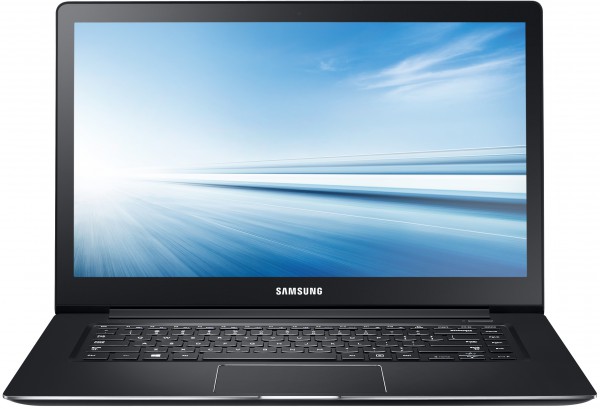
Samsung, though, is looking to change the perception that Windows laptops and great battery life do not mix. The South Korean maker's latest ultrabook, the ATIV Book 9 2014 Edition that was just unveiled at CES, touts 14 hours of battery life. If the device can deliver on its promise, it will be a game changer.
 

For reference, Apple's 13.3-inch MacBook Air (2013 generation) touts up to 12 hours of Wi-Fi browsing or 10 hours of video playback (on iTunes). Some tech blogs have managed to outmatch the company's estimates. However, based on my experience you should expect less when some multitasking or background tasks and syncing are involved.
 
Unlike other new ultrabooks, the ATIV Book 9 2014 Edition (not the catchiest of names, is it?) employs a more conservative display, resolution wise -- 15.6-inch panel with 1920 by 1080.
 
The main hardware features are: Intel Core i5 and Core i7 ULV (Haswell generation) processors, Intel HD Graphics 4400, 8 GB of RAM, up to 1 TB of SSD storage (dual units), 720p user-facing camera, two USB 3.0 ports, one USB 2.0 port, HDMI port, mini VGA port and an SD card slot.
 
The ATIV Book 9 2014 Edition runs Widows 8.1. Samsung says the ultrabook also has a "UL Certified ergonomically designed keyboard" for more comfortable and faster typing, SPlayer+ for lossless audio playback (which works together with the Wolfson DAC chip).
 
The ultrabook will be available in only a single trim, Solid Black, globally. There is no word yet on when the rollout will commence.
 
~ Mihaita Bamburic


1.06.2014

Samsung's new Smart Home service outlined, wants to connect to third-party services and products

 
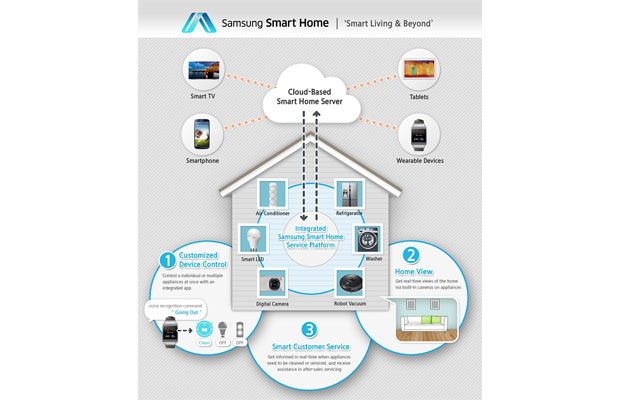
We heard whispers that Samsung was planning big for CES, and we're not just talking TV panels. It's now revealed Smart Home, which attempts to tie together Smart TVs, home appliances and handheld smart devices into one single platform. Perhaps more importantly, the company says it's going to collaborate with third-party partners to extend the platform to products and services beyond only those with Samsung branding.
 
At the middle of it all, there will be a single app that (as the picture above suggests) will get its hooks into all your wearables, phones and white goods with a cloud-based server keeping your data moving. Device Control will let users adjust lighting and temperature management through your smartphone. Meanwhile, Smart Home will also included embedded voice commands: if you say "going out" into your Galaxy Gear, then the system will automatically turn off your smart lighting and "selected appliances", so presumably not your fridge. The, once out, Home View will let you tap into devices with cameras inside your house, offering up some not-so-covert video streams to your Galaxy phone. Alongside the new system, the company announced a new software protocol too, hoping to forge a new ecosystem -- with Samsung in the middle of it all. Expect to hear more later this week.