Cisco Learning Network Store Promotions Page
Showing posts with label Windows Vista. Show all posts

1.02.2014

The biggest threat to Windows: ‘People simply don’t care about it’

The biggest threat to Windows: ‘People simply don’t care about it’
If Windows ever dies out, it will likely go out with a whimper and not with a bang. Windows enthusiast Paul Thurrott worries that the biggest problem facing Microsoft right now is that Windows just isn’t as important to most consumers’ lives as it used to be and that app developers’ creative energies have shifted more toward iOS and Android.
 
“Windows is in trouble because people simply don’t care about it anymore,” he writes. “It’s not outright hostility; there’s far less of that than the anti-Microsoft crowd would like to believe. It’s ambivalence. It’s ambivalence driven by the nature of ‘good enough’ mobile and web apps. It’s ambivalence driven by the allure of anytime/anywhere computing on tiny devices that are more cool to use and even cooler to be seen using.”
 
Where did it all go wrong for Microsoft? Thurrott singles out the same mistake that outgoing CEO Steve Ballmer cited as his biggest regret: The out-and-out debacle that was Windows Vista. Because Microsoft had to devote so much of its talent and resources to fixing all the many issues with Vista, it fell way behind its competition when it came to developing a strong mobile computing platform. This means that by the time that Microsoft finally got its act together with Windows Phone 8 in 2012, iOS and Android had already become established as the two dominant players in the mobile market.
 
“While this was happening, web apps, phones, and then tablets were becoming first viable and then truly powerful,” Thurrott explains. “While this was happening, developers stayed away from Microsoft’s new APIs in droves and created absolutely zero major new applications with that technology. While this was happening, desktop applications such as Office, Photoshop, and iTunes lumbered along, more out of inertia than anything else.”
 
And this is looking like the biggest challenge for the next CEO of Microsoft: How to generate not only consumer enthusiasm but genuine developer enthusiasm for Windows again.


12.10.2013

The stats don't lie: Windows 8.1 seriously underperforming compared to Windows 7

Following Windows market share on NetApplications, as I do every month, it’s clear to me that Windows 8.x isn’t the hit Microsoft hoped for. There are several reasons for this, all of which I’ve discussed previously -- dwindling PC sales, users dislike of touch and the Modern UI, and so on.
 
 
Last month Windows 7’s growth outpaced that of Windows 8.x by four fold, and it’s not the first time the older OS has proven the more popular choice either. It’s becoming something of a regular occurrence. Adoption of the tiled OS is slow, very slow. Especially compared with the strong pick up Windows 7 enjoyed from the start.
 
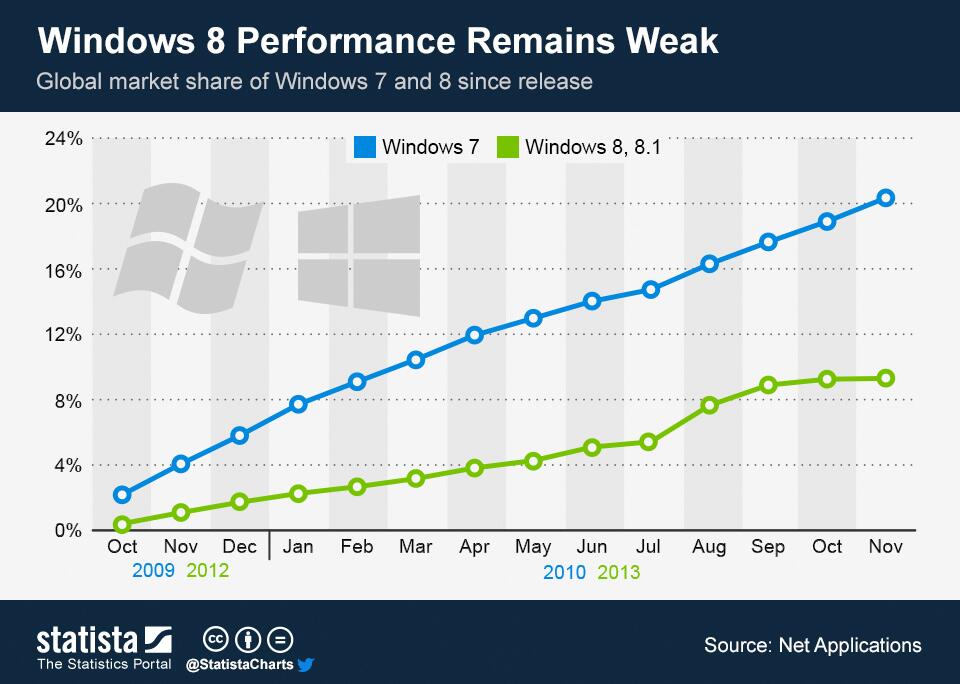
Statista has taken global market share of both Windows 7 and Windows 8/8.1 since launch and plotted the growth on a chart, and the difference is stark. While Windows 8.x has a respectable sounding 9.3 percent of the global market as of the end of last month, Windows 7 had claimed over twice that in the same time period (fourteen months).
 
And that’s not the worst part. While the Windows 7 graph shows a steep upwards trend, Windows 8.x growth is clearly slowing, and heading for a plateau. The launch of Windows 8.1 gave the OS a significant bump, but now the appeal is waning it seems.
 
It’s easy to make excuses for Windows 8.x’s failure to perform. Windows 7 adoption was higher because it followed the half-baked Windows Vista -- users on XP wanted a newer OS to switch to, and users on Vista wanted to get off it, quickly. Windows 7 was, and still is, hugely popular, and Windows 8.x is struggling to follow it.
 
But, however you look at things, Windows 8.1 was released a mere two months ago, and instead of the upwards curve you'd expect following a major launch we’re seeing significant slowdown.
 
It’s possible sales over the holiday period will boost market share for the tiled OS, and restart the (short-lived) growth spurt Windows 8.1 experienced at launch, but it would take a brave man to bet on that outcome.
 
Microsoft is advertising its new OS everywhere, the software is on all new PCs, but still consumers don’t seem interested. What else can the software giant do to boost Windows 8.x adoption?
 
~ Wayne Williams

12.03.2012

Windows 8 is a disaster

Quick, someone add "Nearer My God to Thee" to Steve Ballmer's Xbox Music queue. Microsoft's CEO has a real problem -- well, at least his OEM partners. Simply stated: US Windows PC sales still suck and got absolutely no lift from Windows 8's release. So much for 40 million licenses sold in the first month (and we know it really was longer, since license sales to businesses started in August). Then there is increasing context for Windows chief Steven Sinofsky's sudden departure. The new operating system sinks like Windows Vista. Cue the violins.

New Windows version is supposed to lift PC sales, but they're down 21 percent since the October 26 launch. Notebook sales slumped 24 percent and desktops 9 percent, for the same time period a year ago. "Clearly Windows 8 did not prove to be the impetus for a sales turnaround some had hoped for", Stephen Baker, NPD's vice president of industry analysis, says.

But he cautions: "After just four weeks on the market, it’s still early to place blame on Windows 8 for the ongoing weakness in the PC market. We still have the whole holiday selling season ahead of us". NPD measures US brick-and-mortar and online retail sales.

Tablets sink Faster

Not that manufacturers demonstrate enough commitment to Windows 8. The Modern UI and emphasis on convertibles and tablets should have brought bunches of new designs to market -- and consumer sales with them. Three years ago, Windows 7 launched about the same time of year and accounted for 83 percent of PC unit sales during the first month. Windows 8: Just 58 percent. That says much about what's for sale and what people buy.

Third-quarter PC sales already were bad and left some collateral damage for Windows 8's launch. "The bad Back-to-School period left a lot of inventory in the channel, which had a real impact on the initial sell-through rates for Windows 8", Baker says.

Most surprising -- and I'm seeing Sinofsky's pink slip before my mind's eye -- NPD describes Windows tablet sales as "almost non-existent", accounting (cough, cough) for just 1 percent of sales. Have you seen the Best Buy commercial with the kid using Apple gadgets to contact Santa? With retail partners like this, what are Windows 8 slates' chances?

Still, there's room in the lifeboats to save something from this sinking ship. "The strong performance of Windows 8 notebooks with touchscreens, where Windows 8 truly shines, offers some reason for optimism", Baker says. "These products accounted for 6 percent of Windows 8 notebook sales at an average price of $867 helping to re-establish a premium segment to the Windows consumer notebook market".

"Premium" is not a word often associated with Windows PCs -- rather Macs. But Windows 8 lifts average selling prices. Let me tell you from covering this market for so long, Windows PC ASPs usually only go one direction. Down. But, year over year, notebook ASPs are up 80 bucks to $477 (not exactly Mac pricing territory), while desktop ASPs are up 10 percent. NPD attributes the rise to costlier touchscreen models.

Surveying Wreckage

There has been much debate, particularly the past 10 days, about Windows 8's success or failure. Early holiday PC sales are simply tragic. Not that this misery is new. Ten months ago, IDC described 2011 as the worst year for PC shipments since 2001 -- the year terrorists attacked the United States and during a recession. There is no good news since, just more bad for PC manufacturers -- that despite Intel's efforts to rally the market around ultrabook.

In January, following disappointing Q4 2011 PC shipments, I asserted that "Only Windows 8 can save the PC market now". The new OS has come, and unless something really dramatic happens between now and Christmas Day, fourth quarter is a lost cause -- all while Apple sells iPads faster than the US Mint can print money.

If Sinoksky is captain of this ship, he isn't going down with it. Or stated differently, the crew threw him overboard and he is first casualty of the sinking. His future name is Scapegoat Sinofsky. No matter that the rudder was too small, the ship too big to turn around the iceberg.

Perhaps Windows 8's sinking was inevitable, as people shift buying to other device types. You know, tablets. That's the category where Microsoft bet the larger Windows ecosystem would give great sales lift. Not among US consumers. Sinofsky will be blamed, whether or not he deserves it. He's separated from Microsoft and surely won't risk any severance package by disagreeing too loudly.

For those left behind, I say this: Man the life boats. Women and children first.

~ Joe Wilcox


9.19.2012

Microsoft readies Office 2010 to Office 2013 upgrade program

Summary: Microsoft is said to be prepping to launch its latest Office upgrade offer this fall, and give qualifying users a choice of different Office versions to which they can move.


Just like it does with Windows, Microsoft typically offers its Office customers an upgrade guarantee program, allowing them to buy the current version of a product with a free or discounted upgrade to the next one being part of the package.

One of my contacts said the Office 2013 upgrade guarantee will begin in about a month's time -- specifically on October 19. If this is correct, users purchasing Office 2010 between that date and the end of the covered period (which my same contact said is April 30, 2013) will get some kind of guaranteed upgrade to Office 2013 once it is generally available.

Microsoft officials have not shared public guidance as to Office 2013's planned release-to-manufacturing (RTM) or general availability dates. My sources have heard that the RTM target is November 2012, with general availability slated for February 2013. (Those with TechNet/MSDN and volume-licensing agreements would likely get the final bits shortly after they RTM.)

Microsoft offered the Office 2010 tech guarantee program for those purchasing Office 2007 as of March 2010. The period of coverage was seven months, roughly the same amount of time the Office 2013 tech guarantee supposedly will last.

The Office 2010 tech guarantee upgrade program was free. It's unknown whether the Office 2013 one will be, as well. If Office follows Windows' lead, it may not be. Microsoft announced it will be charging those who purchase Windows 7 PCs between June 2 and January 31, 2013, $14.99 to obtain an upgrade to Windows 8 Pro once it is generally available. The Windows Vista upgrade program before this was free.

My contact sent me a couple of screen shots of what allegedly appeared briefly on the Office.com/offer page (which is not currently available), which I have included below.
It appears the upgrade offer for Office will be for Windows users who purchase Office 2010 Home & Student, Home & Business 2010, Professional 2010 or University 2010 and Mac users who purchase University 2011 or Home & Student 2011 between October 19 and April 30, 2013. Windows users who buy these SKUs will have a choice of upgrading to Office 365 Home Premium (which is currently one of the new Office versions that is being beta tested) or Office 2013 SKUs that are more comparable to what's out there already.
The chart above shows some of the differences between Office 365 Home Premium and these more traditional Office 2013 releases. Office 365 Home Premium can be installed on up to five PCs and/or Macs and is licensed to a user as a one-year subscription, which will need to be renewed to continue usage. The more traditional Office 2013 SKUs can be installed on only one Windows PC with a non-transferrable license. (The Office for University and Mac Home & Student users will have the option to upgrade to Office 365 Home Premium only.)

I am not sure whether these Office upgrades will be free, but given there's no visible price on these screen shots, I'd say there's a chance.

I've asked Microsoft for comment on the details and dates of the coming Office upgrade program but have yet to hear back.

Update: Microsoft officials said they had no comment on anything about the alleged Office upgrade program.

Update (September 17): Microsoft officials confirmed all the details about the upgrade offer, including the start and end dates and the SKU listings. The listed upgrades will be free to users who purchase Office 2010 between October 19 and the end of April, officials said.

~ Mary Jo Foley