Cisco Learning Network Store Promotions Page
Showing posts with label WhatsApp. Show all posts

2.12.2017

WhatsApp adds two-step verification -- here's how to enable it

 
It has been a little while coming, but WhatsApp is finally rolling out support for two-step verification to its messaging app.
 
The extra layer of security means that it is now more difficult to gain unauthorized access to an account, and it is a feature that is being made available to iOS, Android and Windows users. With the feature enabled, if you -- or anyone else, for that matter -- tries to verify your phone number on WhatsApp, you -- or they -- will have to provide the 6-digit passcode you create.
 
In addition to creating a passcode to secure your account, WhatsApp also lets you provide an email address which can be used to disable two-step verification. Oddly, WhatsApp has chosen not to run email addresses through any sort of confirmation or verification process, so the FAQ helpfully suggests: "We highly recommend you provide an accurate email address so that you're not locked out of your account if you forget your passcode."
 
If you want to secure your account, it's a very simple process. Head to Settings > Account > Two-step verification and flip the setting to Enable. Job done!
 
Something else worth noting also crops up in the FAQ:
If you have two-step verification enabled, your number will not be permitted to reverify on WhatsApp within 7 days of last using WhatsApp without your passcode. Thus, if you forget your own passcode, but did not provide an email to disable two-step verification, even you will not be permitted to reverify on WhatsApp within 7 days of last using WhatsApp. After these 7 days, your number will be permitted to reverify on WhatsApp without your passcode, but you will lose all pending messages upon reverifying -- they will be deleted. If your number is reverified on WhatsApp after 30 days of last using WhatsApp, and without your passcode, your account will be deleted and a new one will be created upon successfully reverifying.
Now: go forth and secure!
 
Photo Credit: dennizn / Shutterstock.com
 
~ Mark Wilson

1.13.2017

Backdoor in WhatsApp's end-to-end encryption leaves messages open to interception

 
Facebook has long-claimed that its WhatsApp messaging service is completely secure and messages cannot be intercepted thanks to its use of end-to-end encryption. But researchers have unearthed a serious security flaw that makes it possible to read encrypted messages.
 
Based on Open Whisper Systems' Signal Protocol, the unique security keys used to implement end-to-end encryption should keep messages secure. But WhatsApp can force offline users to generate new keys and this could allow Facebook -- and third parties -- to read messages.
 
The problem is a serious one, as WhatsApp's supposed security has earned it a good deal of respect, and it is a communication tool that those who wish to remain anonymous have come to rely upon. Tobias Boelter, a security researcher at the University of California, discovered the security problem. He says: "If WhatsApp is asked by a government agency to disclose its messaging records, it can effectively grant access due to the change in keys".
 
As the Guardian explains:
WhatsApp has the ability to force the generation of new encryption keys for offline users, unbeknown to the sender and recipient of the messages, and to make the sender re-encrypt messages with new keys and send them again for any messages that have not been marked as delivered.
The recipient is not made aware of this change in encryption, while the sender is only notified if they have opted-in to encryption warnings in settings, and only after the messages have been resent. This re-encryption and rebroadcasting effectively allows WhatsApp to intercept and read users’ messages.
The problem does not lie with the Signal protocol itself -- the issue is entirely related to how WhatsApp has implemented it. Despite the fact that Boelter reported the problem to Facebook last April, the backdoor is still present. The company says that it is not actively working on it, and goes on to say that it is "expected behavior".
 
Privacy experts are concerned that WhatsApp is actually far less secure than users have been led to believe. Boelter says that people "might say that this vulnerability could only be abused to snoop on 'single' targeted messages, not entire conversations. This is not true if you consider that the WhatsApp server can just forward messages without sending the 'message was received by recipient' notification (or the double tick), which users might not notice. Using the retransmission vulnerability, the WhatsApp server can then later get a transcript of the whole conversation, not just a single message".
 
Speaking to the Guardian, a WhatsApp spokesperson remains adamant that security is high:
Over 1 billion people use WhatsApp today because it is simple, fast, reliable and secure. At WhatsApp, we've always believed that people's conversations should be secure and private. Last year, we gave all our users a better level of security by making every message, photo, video, file and call end-to-end encrypted by default. As we introduce features like end-to-end encryption, we focus on keeping the product simple and take into consideration how it's used every day around the world.
In WhatsApp's implementation of the Signal protocol, we have a "Show Security Notifications" setting (option under Settings > Account > Security) that notifies you when a contact’s security code has changed. We know the most common reasons this happens are because someone has switched phones or reinstalled WhatsApp. This is because in many parts of the world, people frequently change devices and sim cards. In these situations, we want to make sure people’s messages are delivered, not lost in transit.
~ Mark Wilson

10.23.2016

Amnesty International ranks message apps according to privacy -- Facebook wins!

 
Despite a desire to be more connected than ever before, people are simultaneously more concerned than ever about their security and privacy. This is certainly true when it comes to messaging tools, and the privacy features offered by a particular app or service can be what sways your decision to use it one way or the other.
 
Justice group Amnesty International has spent some time analyzing the privacy and encryption found in a number of popular messaging tools and compiled results in a ranked list. The findings make for interesting reading, not least because Facebook is ranked the most highly.
 
The organization looked at 11 popular messaging services, checking not only whether they made use of encryption, but also at the attitudes of the companies behind each of the services.
 
So what is Amnesty International interest in all of this? The organization is keen for human rights campaigners, whistle-blowers and people in need to be able to communicate securely without having to worry about whether their messages are being read by others.
Our communications are under constant threat from cybercriminals, malicious hackers, and unjustified spying by state authorities. Young people, activists and journalists who share personal details over messaging apps are especially at risk.
Many of us trust these apps with intimate details of our personal life. Companies that fail to take basic steps to protect our communications are failing that trust.
The group goes on to say:
Amnesty International is calling on companies to apply end-to-end encryption as a default. It is also calling on technology companies to clearly inform users of the level of encryption applied to their messaging services.
Facebook is praised for WhatsApp and Messenger for offering end-to-end encryption (although not by default in the latter) and for its transparency and interest in human rights. Apple finds itself in second place, and praised for its opposition to backdoors, while Google nestles in fourth position, largely because of Hangout's more questionable security and privacy.
 
Microsoft is in a very disappointing eighth place -- disappointing for both the company and users of its products. Skype is criticized for having been "a major target of government surveillance worldwide".  Amnesty International also says: "Despite Microsofts strong policy commitment to human rights, it is still using a weak form of encryption on Skype."
 
Here's the chart in full:
  1. Facebook: 73 / 100
  2. Apple: 67 / 100
  3. Telegram: 67 / 100
  4. Google: 53 / 100
  5. Line: 47/ 100
  6. Viber Media: 47 / 100
  7. Kakao: 40 / 100
  8. Microsoft: 40 / 100
  9. Snapchat: 26 / 100
  10. Blackberry: 20 / 100
  11. Tencent: 0 / 100
Photo credit: David M G / Shutterstock
 
~ Mark Wilson

5.12.2016

The WhatsApp native desktop app for Windows and Mac has arrived

 
Facebook-owned messaging service WhatsApp has announced the arrival of its native desktop app, which you can download here. It’s available for Windows 8 and above, and for Mac OS X 10.9 (Mavericks) and above.
 
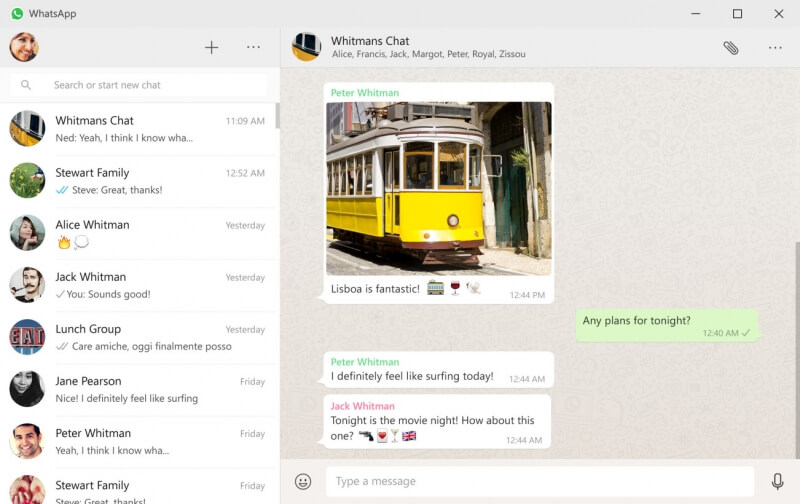
You’ll need to scan a QR code using WhatsApp on your smartphone to log in to the desktop app (look for WhatsApp Web menu under Settings). Once you’re set up, you’ll get desktop notifications, better keyboard shortcuts, and more.
 
This desktop WhatsApp is very similar to the web version that’s been available since 2015, copying much of the user interface. “Like WhatsApp Web, our desktop app is simply an extension of your phone,” the company said in a statement.
 
 
The software syncs with your phone to mirror conversations and messages. It also supports voice dictation. WhatsApp suggests connecting your phone to Wi-Fi as a way of keeping data costs down.
 
Rumors that a full desktop version of the app was in the works surfaced last week after screenshots appeared on Twitter. The app now joins the likes of Facebook Messenger and Skype, both of which have desktop incarnations.
 
WhatsApp was in the news again last week, after being banned in Brazil for the second time in six months. The app was blocked in the country for 72 hours for refusing to hand over chat records related to a drug case, something the company says it couldn’t do as its messages are encrypted. A different judge overturned the ruling and the service was restored 24 hours into the ban.
 
~ Rob Thubron

1.17.2016

ISIS has its own secure messaging system -- this illustrates the futility of communication surveillance


Moves by governments to monitor web-based communication with a view to thwarting terrorism is utterly, utterly futile. Just like the NSA's dragnet-style dredging for intelligence, mass communication surveillance does little to home in on target -- the ones that government should be concerned about are the very ones who know who to evade detection.

This is something that was perfectly demonstrated this week when it became apparent that ISIS has developed its own secure messaging system. No longer reliant on the likes of WhatsApp, ISIS is using a custom-built, Android-based encrypted messaging tool that is incredibly difficult -- if not impossible -- for the FBI and NSA to monitor.

The news comes from Ghost Security Group, and the counterterrorism network that warns about the capabilities of ISIS. It is the result of having such a high-profile surveillance campaign; the very people who governments might want to monitor have been driven underground. ISIS has already proved itself to be a master manipulator of the media, and the group is also technologically savvy. If the reports about the development of its own messaging app are correct, any surveillance has been rendered impossible.

Of course, this does not mean that surveillance is going to stop -- the government has plenty of other targets to go after besides ISIS -- but it does highlight a serious issue for intelligence agencies. Surveillance, hacking, and tapping are now so well known that any group worth its salt is going to go the extra mile to ensure that it can slip under the radar.

Using a roll-your-own solution means that the government is not able to make formal requests of a company to hand over encryption keys, to provide backdoors, or give up user account information. There's no real solution that the government could employ -- this is a problem largely of its own making, and there is little to be done.

Online surveillance is pointless. It is more trouble than it is worth, and it has been for some time. Of course, you won't hear an admission of futility from the government any time soon…

Photo credit: lavitrei / Shutterstock

~ Mark Wilson

1.07.2016

New malware attack targets WhatsApp users


A new malware campaign is aiming specifically at businesses and consumers using the WhatsApp mobile messaging service.

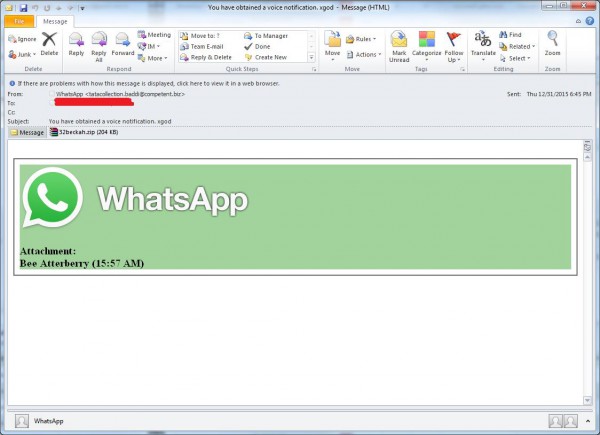
Uncovered by researchers at Comodo Labs the campaign uses emails masquerading as WhatsApp content. These have an attached zip file containing a malware executable.

The emails have a variety of subject lines including, "You have obtained a voice notification," and "An audio memo was missed," each followed by a short string of random characters which are probably used to identify the recipient.


If the zip file in the email is opened and executed, the malware is installed on the PC. It's a variant of the 'Nivdort' family. When run it replicates itself into different system folders, as well as adding itself into an auto-run in the computer's registry.

"Cybercriminals are becoming more and more like marketers - trying to use creative subject lines to have unsuspecting emails be clicked and opened to spread malware," says Fatih Orhan, Director of Technology for Comodo and the Comodo Antispam Labs. "As a company, Comodo is working diligently in creating innovative technology solutions that stay a step ahead of the cybercriminals, protect and secure endpoints, and keep enterprises and IT environments safe".

More details of the attack are available on the Comodo blog.

Photo Credit: Balefire/Shutterstock

~ Ian Barker

1.22.2015

WhatsApp finally arrives on the desktop as a web app

 
Update: For all of you with an Android phone who could not find the WhatsApp Web option yesterday, that was because you where one version behind. The new version 2.11.498 can be downloaded here and I guarantee it works. Just download the new version on your Android phone, install it, open the app, click on the menu (upper right corner where there are three squares one on top of each other), select WhatsApp Web, open a browser (Chrome or any other plug-in based) on the desktop computer you want to connect to your account, enter https://web.whatsapp.com/, and with your phone from the WhatsApp Web option, scan the QR code on your computer screen.
 
If you’re one of the 700 million people that use WhatsApp and you also have a desktop or notebook, you’ll probably be interested to learn that the Facebook-owned company has finally released a web-based client.
 
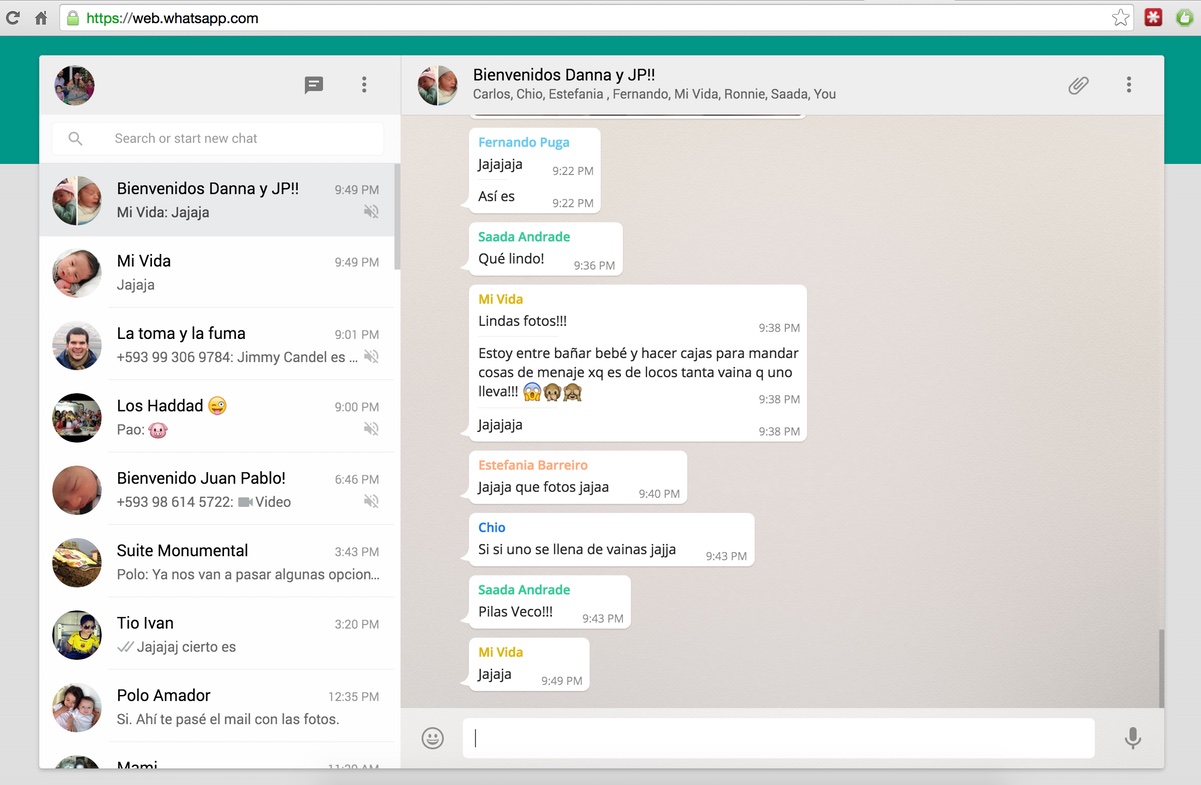
WhatsApp for the web is, once again, a web-based client so there isn’t a dedicated program that you download onto your computer. To get started, simply head over to the WhatsApp Web page using Google Chrome as your browser and scan the QR code using the WhatsApp app on your phone to log in.
 
 
That may seem like a weird requirement – and I suppose it is – but that's because WhatsApp uses your phone number for user verifications instead of a username / password. This also pairs WhatsApp on your phone with the WhatsApp web client because, after all, the WhatsApp web client is simply an extension of the phone app.
 
That means all of your conversations are still kept on your phone and what’s more, you’ll need to keep your phone connected to the Internet during your WhatsApp web session. We've been using the web app for a couple of hours since it launched and it's working smoothly.
 
The process is said to work on Android, BlackBerry and Windows Phone but not iOS due to what CEO Jan Koum described as Apple platform limitations. A spokesperson for WhatsApp told The Verge that a web client for iOS was in the works but the timeframe for its arrival was unclear.
 
~ Shawn Knight

11.18.2014

WhatsApp taps Open Whisper for end-to-end encryption

Summary: The encryption fete is significant, as it makes WhatsApp one of the most secure text messaging apps available. 
WhatsApp has made end-to-end encryption a default feature in the most recent update to its messaging app for Android.
 
The encryption fete is significant, as it makes WhatsApp one of the most secure text messaging apps available. With end-to-end encryption, any party other than the message sender and receiver cannot decrypt messages sent between WhatsApp users – this includes WhatsApp, meaning that any law enforcement requests for decryption are moot.
 
WhatsApp partnered with Open Whisper Systems for the encryption launch, using the company's open source TextSecure protocol. TextSecure's forward secrecy feature is known for its ability to keep messages encrypted even if a hacker cracks the key exchange between users.
 
Twitter acquired Open Whipser in 2011 for an undisclosed amount, but Whisper Systems' TextSecure software code was released as free and open source shortly after the acquisition.
 
In a blog post announcing the encryption partnership, Open Whisper expressed pride for the encryption accomplishment, noting that Android's fragmented device platforms pose ongoing challenges to ensuring the deployments run successfully. But it also gave a hat tip to WhatsApp for its contribution to the year-long project:
WhatsApp deserves enormous praise for devoting considerable time and effort to this project. Even though we're still at the beginning of the rollout, we believe this already represents the largest deployment of end-to-end encrypted communication in history. Brian Acton and the WhatsApp engineering team has been amazing to work with. Their devotion to the project as well as their thoroughness in getting this done are inspiring in a world where so many other companies are focused on surveillance instead of privacy.
For now, the encryption is for Android only, with no word yet on when it will hit iOS. Additionally, the WhatsApp Android client does not support encrypted messaging for group chat or media messages, but Open Whisper says it plans to roll out support for those next, as well as support for more client platforms.
 

~ Natalie Gagliordi 

10.10.2014

Facebook has no near-term plan to monetize WhatsApp: CEO

Facebook CEO Mark Zuckerberg walks at the annual Allen and Co. conference at the Sun Valley, Idaho Resort July 11, 2013.
Credit: Reuters/Rick Wilking
 
(Reuters) - Facebook Inc (FB.O), which closed its acquisition of mobile messaging service WhatsApp on Monday, has no near-term plan to make money from the service, Chief Executive Mark Zuckerberg said on Thursday.
 
Zuckerberg, who is visiting India to participate in an event to boost Internet usage, did not give details.
 
Facebook's final WhatsApp acquisition price tag has risen an additional $3 billion to roughly $22 billion because of the increased value of Facebook's stock in recent months.
 
WhatsApp works across different types of phones, across borders, and without advertising. The app only charges a 99 cent annual subscription fee, which is waived for the first year.   
 
~ Aditya Kalra

6.03.2014

WhatsApp's CEO Is Angry About Apple's New iMessage Features

Apple just announced a slew of new features for iOS, including video, audio, and location tagging for iMessage and the ability to name (and leave!) group chats. WhatsApp CEO Jan Koum isn't too happy about the new additions:
Twitter / Jan Koum
His point is that Apple just added features for iMessage that WhatsApp users have had for a long time. WhatsApp users could always record media, like audio or video, and share location data easily through messages. 

The fact that Apple has put a huge emphasis on improving iMessage is very telling of the growing power of messaging apps like WhatsApp — which Facebook bought earlier this year for $19 billion — Snapchat, Facebook Messenger, Line, and Kik.
 
WhatsApp currently has more than 500 million users; Facebook's Messenger app has more than 200 million monthly users; Snapchat has around 70 million monthly users. It makes sense that Apple would want to integrate features from those popular apps into its own in-house messaging system. 
 
After all, Apple wants all iPhone owners to use iMessage, instead of downloading and using other apps.
 
~ Jillian D'Onfro

2.20.2014

Wall Street sees sense in Facebook's $19 billion WhatsApp purchase

A Whatsapp icon is seen on a Samsung Galaxy S4 phone screen with a Facebook logo in the central Bosnian town of Zenica, February 20, 2014.
 
(Reuters) - Facebook Inc's purchase of fast-growing mobile-messaging startup WhatsApp for $19 billion stunned the markets but analysts said the deal made strategic sense as it will solidify the social network's position as a leader in mobile.
 
Facebook shares were down 3.1 percent before the bell on Thursday, representing a loss of about $5.4 billion in market value.
 
At least two brokerages downgraded their recommendations on Facebook to "hold" but the overwhelming majority of analysts remain positive on the stock.
 
Facebook is paying more than double its annual revenue for a chat program that has little revenue. The purchase price is slightly more than the market value of Sony Corp.
 
But analysts pointed out that WhatsApp currently has over 450 million monthly users - second only to Facebook - and boasts an even higher level of engagement.
 
"Facebook is the leading global social-sharing utility. Now, it has a significant opportunity to be the leading global communications utility," RBC Capital Markets said in a note.
 
WhatsApp is much stronger than Facebook Messenger in Europe, Latin America, Africa and Australia and has attracted lots of young users at a time when fears have been voiced that young people are tuning out of Facebook.
 
Analysts said the price tag for WhatsApp, founded in 2009 by former Yahoo Inc employees Jan Koum and Brian Acton, seemed reasonable from the point of view of value per user.
 
Facebook is paying $42 per user with the deal, compared with a market value per user of $170 for Facebook and $212 for Twitter, Deutsche Bank's Ross Sandler said in a note.
 
WhatsApp has more than 450 million monthly active users, compared with 1.2 billion for Facebook. About 70 percent WhatsApp users are active on any given day, higher than Facebook's 62 percent.
 
Of the 44 analysts who cover Facebook, 37 have a "buy" or a "strong buy" rating on the stock, according to Thomson Reuters data. None has a "sell" rating.
 
"Facebook continues to demonstrate savvy-ness beyond its years as it pivots its business model, footprint and strategy to mobile," Deutsche Bank analyst Ross Sandler said.
 
Analysts have commended Facebook's ability to make money from its mobile app even as investors fret over concerns of youngsters ditching the network. With the WhatsApp deal, all eyes are now on the monetization potential of the chat program's huge number of users.
 
"While we don't expect messaging to be a meaningful near-term or even long-term revenue driver, the real value could be the evolution of the platform to incorporate new functionality such as payments, app distribution, social features ...," Macquarie Equities Research analyst Ben Schachter said.
 
Some analysts, however, said Facebook was paying the high price to keep WhatsApp from being snapped up by a rival.
 
"Facebook shares would have been pressured by more than single-digit percentages in after-market trading if Google Inc had purchased WhatsApp instead," Stifel analyst Jordan Rohan said in a note.
 
Pivotal Research's Brian Wieser, who downgraded his rating on Facebook shares to "hold" from "buy," said he expects Facebook shares to face pressure in the near-term as investors come to terms with the risk of future acquisitions.
 
Facebook shares were trading at $65.95 in premarket trading.
 
~ Soham Chatterjee and Saqib Iqbal Ahmed