Cisco Learning Network Store Promotions Page
Showing posts with label Social Network. Show all posts

6.30.2016

Facebook uses Irish headquarters to skirt privacy laws

 
Facebook has won an appeal against a court ruling that said the social network could not store data about people that did not have an account. It had been ruled that Facebook could not gather data about non-users in Belgium.; Facebook responded by blocking access to those without an account.
 
Back in 2015, Facebook was told to stop this blocking or face hefty daily fines. Facebook felt that the ruling was unfair and appealed. In a new ruling today, the Brussels Court of Appeal said: "Belgian courts don't have international jurisdiction over Facebook Ireland, where the data concerning Europe is processed".
 
Facebook had been ordered to stop storing data about internet users without an account with the social network. The threat of €250,000 ($277,800) prompted the company to fight back against the Belgian data protection commission and today's ruling overturned that of the previous court. Facebook will now allow Belgians without accounts to access pages on the site.
 
The crux of the case is that Facebook is headquartered in Ireland. This meant that -- regardless of the rights or wrongs of what Facebook has done -- the court in Belgium was simply not able to wield any power over the social network.
 
Ireland has been used by many company as a handy way to funnel income whilst avoiding hefty tax bills, and it seems the country could become a means of avoiding certain laws as well.
 
In a statement responding to the ruling, Facebook said:
We are pleased with the court’s decision and look forward to bringing all our services back online for people in Belgium.
Photo credit: dolphfyn / Shutterstock
 
~ Mark Wilson

10.23.2015

There has never been a better time to tweak your Facebook privacy settings

 
Facebook and privacy are not words you tend to find together in the same sentence -- at least not in a positive sense. Just a few days ago, the social network announced that all public posts were to be made searchable -- although it wasn't really billed as such.
 
You might not be entirely happy with this. While you may now be careful that you only share posts with your friends, a huge number of historic posts have now been made searchable. If you'd prefer to keep your content private, now is the time to act.
 
In fact, there are a couple of things you need to do -- limit the audience that can access everything you post from this point forward, and limit the audience that can access your past posts. Quite why this could not be covered by a single setting is anyone's guess, but that's just the way it is. Here's what you need to do.
  • Fire up your web browser and pay a visit to Facebook.
  • Click the padlock symbol in the blue bar at the top of the page, and then click Who can see my stuff?
  • From the dropdown menu labelled Who can see my future posts?, select Friends -- or anything other than Public.
  • Now click the See More Settings link at the bottom of the Privacy Shortcuts menu.
  • Click Limit Past Posts and you can restrict all of your past posts so they can only be seen by people on your friend list.
  • Click the Limit Old Post button followed by Confirm, and you're done.
Photo credit: graja / Shutterstock
 
~ Mark Wilson

1.15.2015

Firefox 35 includes streamlined Hello video chat, MP4 support on Mac, easier social network sharing

 
Version 35 of Mozilla’s Firefox web browser is now available for download. Arriving roughly five weeks after its predecessor, the latest iteration includes a handful of noteworthy features in addition to the usual gamut of minor updates and behind-the-scenes fixes.
 
Firefox Hello, Mozilla’s WebRTC-based real-time video and audio calling service, has been streamlined a bit. Previously, users had to simply wait idly for the person on the other end to connect to the call. In Firefox 35, a small window opens showing a self view until the invited person joins and in the meantime, the caller can perform other tasks like surfing the web.
 
  
It’s a small change but any way to add productivity is welcomed in my book.
 
Another time-saver is the ability to create multiple conversations and save them for later use which makes it easier to reconnect with people you talk to on a regular basis without having to create a new link each time. All of this can be done without having to create an account or forfeit any user information.
 
Elsewhere, Firefox 35 enables desktop users to access the Firefox Marketplace, built-in support for MP4 playback on Mac OS X (Snow Leopard and newer) and makes it easier to share web content on social networks like Facebook, Twitter, Tumblr, LinkedIn and Google+. Mozilla has also fixed nine security-related issues in the new release according to its securities advisories page.
 
Firefox 35 is available for Windows, Mac and Linux.
 
~ Shawn Knight

12.15.2014

Facebook drops Microsoft's Bing in favor of its own search tool

 
Bing has been unceremoniously dumped by Facebook. The social network had been using the Microsoft search tool to power its Graph Search platform for some time now, but no longer. While no announcement has been made, Facebook confirmed the news to Reuters.
 
The lack of official announcement meant that the dropping of Bing was immediately noticed. Facebook does not have a replacement partner in mind -- there is no danger of the social network teaming up with Google -- but will go it alone instead.
 
It seems that the decision tied in with Facebook's recent updating of its own search tool. A few days ago, the search tool was updated to make it possible to find specific posts rather than users and pages. This made Facebook Search more like a "proper" search engine, and probably led to questions about the value of maintaining links with Bing. But there are other reasons behind ditching Bing.
 
Facebook issued a statement to VentureBeat in which it explained the switch in focus:
We're not currently showing web search results in Facebook Search because we're focused on helping people find what's been shared with them on Facebook.
While Microsoft will undoubtedly be unhappy with Facebook's decision, it's one that will probably go down well with users of the site. The move is an interesting one, if not one that is entirely surprising. The problem with using Bing to display web search results within Facebook was that it did just that -- display search results from the wider web rather than just Facebook.
 
This meant that while there was arguably a better experience for users thanks to the extra features, there was a far stronger risk that people would navigate away from Facebook and stop consuming ads. It's not yet clear whether Facebook will start to cast its search net wider, displaying results and pages in a closely controlled built-in browser, but this is certainly something to look out for further down the line.
 
Photo credit: 1000 Words /Shutterstock
 
~ Mark Wilson

6.10.2014

U.S. spy agency joins Facebook, Twitter

The lobby of the CIA Headquarters Building in McLean, Virginia, August 14, 2008.
Credit: Reuters/Larry Downing
(Reuters) - The CIA, which has long trolled social media to try to uncover global trends and track evil-doers, officially joined Twitter and Facebook on Friday.
 
The spy agency cast the move as an effort to better get out its message and engage directly with the public, but its first Twitter message, sent out shortly before 2 p.m. EDT (1800 GMT), did not indicate there would be major revelations.  
 
It said simply: "We can neither confirm nor deny that this is our first tweet."
 
The lack of content did not dampen interest: in less than 90 minutes, the CIA account had nearly 84,000 followers, and that number was climbing fast.
 
The Central Intelligence Agency has long had a public website, and maintains official accounts on YouTube and Flickr, the photo-sharing site.
 
"By expanding to these platforms (Facebook and Twitter), CIA will be able to more directly engage with the public and provide information on CIA’s mission, history, and other developments," CIA Director John Brennan said in a statement.
 
Among the items to be posted are artifacts from the CIA's (non-public) museum, and updates to its "World Factbook," a compendium of world leaders, maps and similar information.
 
Critics say the Obama administration is more secretive than its predecessors. It has cracked down on once-normal interactions between reporters and intelligence officials.
 
In recent directives, Director of National Intelligence James Clapper has banned intelligence officials from speaking to reporters without permission, even about unclassified information, and also from citing news articles based on unauthorized disclosures.
 
The CIA's Facebook page is www.facebook.com/central.intelligence.agency. Its Twitter "handle" is @CIA. 
 
~ Warren Strobel         

6.05.2014

Facebook acquires mobile data plan firm Pryte

Facebook CEO Mark Zuckerberg speaks during a news conference at Facebook headquarters in Palo Alto, California May 26, 2010.
Credit: Reuters/Robert Galbraith/Files
(Reuters) - Facebook Inc is acquiring Pryte, a Finnish company that aims to make it easier for mobile phone users in under-developed parts of the world to use wireless Internet apps.
 
Facebook did not disclose financial terms of the deal, which spokeswoman Vanessa Chan said is expected to close later this month. 
 
Pryte's service, which has not publicly launched yet, seeks to make it easier for consumers without wireless data plans to use online services by selling short-term passes that would provide access to particular mobile apps, such as Facebook or Foursquare. 
 
Facebook, the world's largest social network with 1.28 billion users, is primarily interested in the team behind Pryte, led by Chief Executive Markku Makelainen, Chan said.
 
The one-year old, Helsinki-based company has valuable experience and relationships working with wireless operators, particularly in emerging markets, she said. 
 
The company has fewer than 30 employees, though it's not clear how many will join Facebook. 
 
The deal marks Facebook’s latest effort to advance its mission of connecting people in under-developed parts of the world to the Internet. Facebook has partnered with wireless operators in certain countries to offer free access to its social network and the company is building drones and satellites that will beam Internet access to remote regions of the world.
 
Facebook Chief Executive Mark Zuckerberg has said that connecting the “next five billion people” to the Internet is one of the company’s top priorities going forward.
     
~ Alexei Oreskovic

2.20.2014

Wall Street sees sense in Facebook's $19 billion WhatsApp purchase

A Whatsapp icon is seen on a Samsung Galaxy S4 phone screen with a Facebook logo in the central Bosnian town of Zenica, February 20, 2014.
 
(Reuters) - Facebook Inc's purchase of fast-growing mobile-messaging startup WhatsApp for $19 billion stunned the markets but analysts said the deal made strategic sense as it will solidify the social network's position as a leader in mobile.
 
Facebook shares were down 3.1 percent before the bell on Thursday, representing a loss of about $5.4 billion in market value.
 
At least two brokerages downgraded their recommendations on Facebook to "hold" but the overwhelming majority of analysts remain positive on the stock.
 
Facebook is paying more than double its annual revenue for a chat program that has little revenue. The purchase price is slightly more than the market value of Sony Corp.
 
But analysts pointed out that WhatsApp currently has over 450 million monthly users - second only to Facebook - and boasts an even higher level of engagement.
 
"Facebook is the leading global social-sharing utility. Now, it has a significant opportunity to be the leading global communications utility," RBC Capital Markets said in a note.
 
WhatsApp is much stronger than Facebook Messenger in Europe, Latin America, Africa and Australia and has attracted lots of young users at a time when fears have been voiced that young people are tuning out of Facebook.
 
Analysts said the price tag for WhatsApp, founded in 2009 by former Yahoo Inc employees Jan Koum and Brian Acton, seemed reasonable from the point of view of value per user.
 
Facebook is paying $42 per user with the deal, compared with a market value per user of $170 for Facebook and $212 for Twitter, Deutsche Bank's Ross Sandler said in a note.
 
WhatsApp has more than 450 million monthly active users, compared with 1.2 billion for Facebook. About 70 percent WhatsApp users are active on any given day, higher than Facebook's 62 percent.
 
Of the 44 analysts who cover Facebook, 37 have a "buy" or a "strong buy" rating on the stock, according to Thomson Reuters data. None has a "sell" rating.
 
"Facebook continues to demonstrate savvy-ness beyond its years as it pivots its business model, footprint and strategy to mobile," Deutsche Bank analyst Ross Sandler said.
 
Analysts have commended Facebook's ability to make money from its mobile app even as investors fret over concerns of youngsters ditching the network. With the WhatsApp deal, all eyes are now on the monetization potential of the chat program's huge number of users.
 
"While we don't expect messaging to be a meaningful near-term or even long-term revenue driver, the real value could be the evolution of the platform to incorporate new functionality such as payments, app distribution, social features ...," Macquarie Equities Research analyst Ben Schachter said.
 
Some analysts, however, said Facebook was paying the high price to keep WhatsApp from being snapped up by a rival.
 
"Facebook shares would have been pressured by more than single-digit percentages in after-market trading if Google Inc had purchased WhatsApp instead," Stifel analyst Jordan Rohan said in a note.
 
Pivotal Research's Brian Wieser, who downgraded his rating on Facebook shares to "hold" from "buy," said he expects Facebook shares to face pressure in the near-term as investors come to terms with the risk of future acquisitions.
 
Facebook shares were trading at $65.95 in premarket trading.
 
~ Soham Chatterjee and Saqib Iqbal Ahmed                 

1.11.2014

Google linking of social network contacts to email raises concerns

SAN FRANCISCO (Reuters) - A new feature in Google Inc's Gmail will result in some users receiving messages from people with whom they have not shared their email addresses, raising concerns among some privacy advocates.
 
The change, which Google announced on Thursday, broadens the list of contacts available to Gmail users so it includes both the email addresses of their existing contacts, as well as the names of people on the Google+ social network. As a result, a person can send an email directly to friends, and strangers, who use Google+.
 
Google is increasingly trying to integrate its Google+, a two-and-a-half-year old social network that has 540 million active users, with its other services. When consumers sign up for Gmail, the company's Web-based email service, they are now automatically given a Google+ account.
 
Google said the new feature will make it easier for people who use both services to communicate with their friends.
 
"Have you ever started typing an email to someone only to realize halfway through the draft that you haven't actually exchanged email addresses?" the company said in a blog post announcing the feature. "You're in luck, because now it's easier for people using Gmail and Google+ to connect over email."
 
Google said that users who did not wish to receive email messages from other people on Google+ could switch the settings so that they receive messages only from people they have added to their networks of friends or from no one at all.
 
Some privacy advocates said Google should have made the new feature "opt-in," meaning that users should explicitly agree to receive messages from other Google+ users, rather than being required to manually change the setting.
 
Marc Rotenberg, the executive director of non-profit Electronic Privacy Information Center, called the new feature "troubling."
 
"There is a strong echo of the Google Buzz snafu," he said, referring to a social networking service that Google launched in 2010. Buzz initially used its Gmail users' contact lists to create social networks that the rest of the world could see, leading to an uproar and ultimately a settlement with the U.S. Federal Trade Commission.
 
Google said the new feature would not expose the email addresses of any Google+ users to strangers. Emails from strangers on Google+ will be routed to a special section within the recipients mailbox that is separate from messages from friends and other contacts. If the recipient does not reply to the message, Gmail will block any future messages from that person.
 
A Google spokeswoman said the company planned to send an email to all Google+ users during the next two days alerting them to the change and explaining how to change their settings.
 
One exception to the new feature is celebrities on Google+, who are followed by a large number of fans. According to the spokeswoman, the Gmail accounts of such public figures will not automatically receive emails from other Google+ users.
 
~ Alexei Oreskovic

12.28.2013

Facebook? What’s that, granddad? Teenagers fall out of love with Zuckerberg's social network

 
Once the darling of the social networking world, it looks as though Facebook is falling out of favor. At least that seems to be the case with teenagers. An extensive and ongoing study into social media finds that huge swathes of 16 to 18 year-olds are abandoning Facebook and jumping ship to the likes of Instagram, Twitter, and Snapchat. In total, nine different regions are being studied over a course of 15 months.
 
As Professor of Material Culture at University College London, Daniel Miller says, Facebook is now uncool. Mum and Dad are now not only using the social network (which is an immediate nail in the coffin), but actively encouraging their kids to share details about what they're doing: "Parents have worked out how to use the site and see it as a way for the family to remain connected".
 
While the likes of Whatsapp have exploded in popularity none of the alternatives which are attracting younger users offer quite the same set of options as Facebook. Instagram is great for sharing photos, but in terms of organization and interaction, it is found wanting. Snapchat and Twitter have their plus points, but lack a lot of functionality.
 
Which social networks do you align yourself with? Have you found that your preferences have changed over the years or do you stick ruggedly to whichever network you first used? I was something of a lurker on Facebook for a couple of years before becoming fully immersed in it. At 34, I probably fit neatly into the average demographic and I like the network because it offers a nice combination of instant communication and slower, laid-back newsy style.
 
Twitter was more of a slowburner for me. Again, I signed up for an account pretty much as soon as it was possible to do so, and then did little for some time. Twitter bemused me, and I couldn’t see the point. Then I experimented and found that it blended blogging, instant messaging and news delivery in one neat package. I'm now in love. Force me to choose two networks to use and Twitter and Facebook would win without question, but choosing between these two to pick a winner would be hard.
 

~ Mark Wilson

9.09.2013

Now your public Facebook posts could appear on the news!

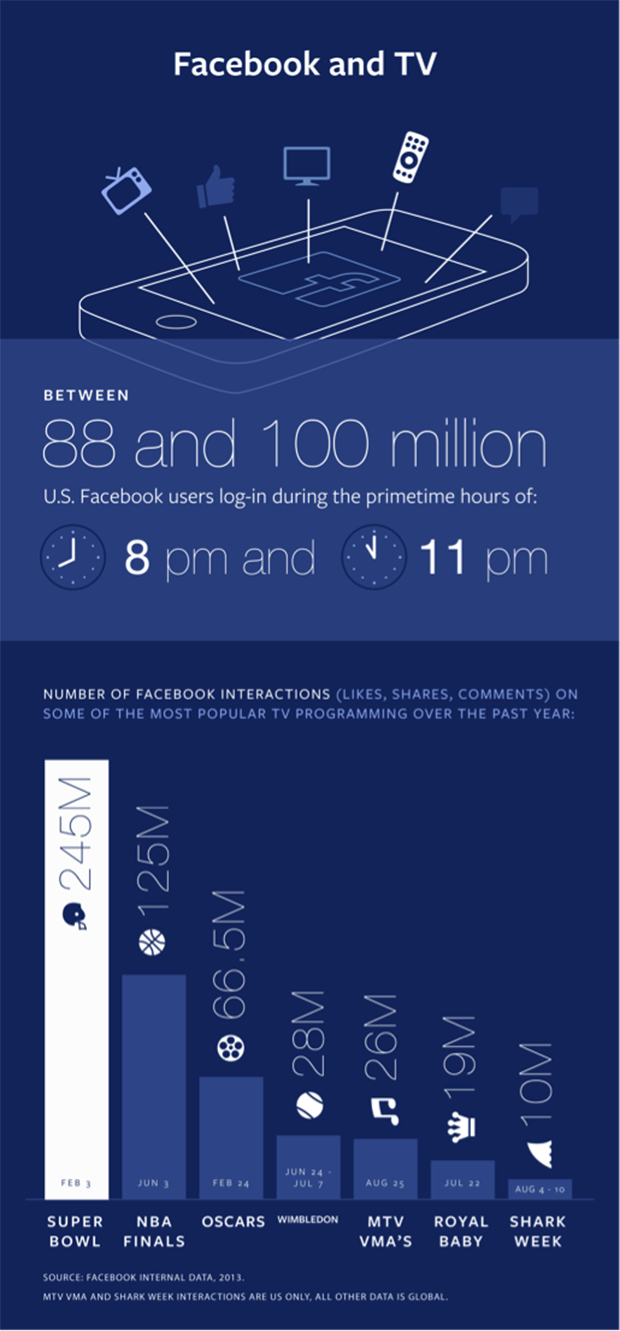
Facebook is making it easier for news outlets such as BskyB, CNN and NBC to integrate conversations from the social network into their broadcasts. Using the Public Feed API, broadcasters are now able to display a real-time feed of posts that contain a specific word. Considering that, according to Facebook's own figures, last week's kick-off of the new NFL season resulted in over 20 million likes, comments and shares, that's a lot of data to be dealing with.

There is also the new Keyword Insights API which can be used to determine how many posts mentioned a particular term in a specified timeframe. But the API goes further than this, also making it possible to filter results -- allegedly anonymously -- based on gender, age and location. At the moment both of these APIs are only being made available to a limited number of partners, but the list is certain to grow over time.

For news shows looking to find new ways to interact with their audience, this is a great announcement. Now, rather than just presenting viewers with the news, programs can pontificate about how viewers from different parts of the country feel about a given story. A lot of people like the idea of hitting the headlines, but this is unlikely to be what they had in mind.

What is interesting to note is that, as you'd probably guess from the name, the Public Feed API can only be used to access public posts, but no such limitations are mentioned in relation to the Keyword Insights API.

The blog post that Facebook uses to announce the new "feature" -- referred to, almost comically as "tools for surfacing conversations" -- is also home to an interesting little infographic that shows the number of Facebook interactions generated by various TV programs.

So… what do you think? Should we have been expecting something like this to happen? Does it seem like a reasonable implementation of Facebook's terms of service? Anyone planning on storming away from the social network in a stroppy protest?

 ~ Mark Wilson