Cisco Learning Network Store Promotions Page
Showing posts with label HTC. Show all posts

8.29.2016

Verizon switches on LTE Advanced in 461 cities -- is your phone compatible?

 
Verizon Wireless is what I consider to be the best cellphone carrier in the USA. Yes, it is expensive comparatively, but you get what you pay for. Both coverage and speed is top notch across the country, meaning you should have a solid experience in many places where you travel.
 
Today, the carrier announces that its LTE is getting much faster. In 461 cities across the USA, it switches on the speedier "LTE Advanced" (LTE-A). Best of all, many existing devices are compatible. Wondering if your phone, tablet, or hotspot can take advantage? Read on for the list.
 
"Verizon LTE Advanced uses software that combines multiple channels to speed mobile data over the network more quickly than ever before. The result is 50 percent faster peak speeds in cities nationwide for Verizon customers using one of the 39 LTE Advanced-capable phones and tablets already on Verizon's network -- including top-selling Samsung Galaxy S6 and S7 smartphones, Moto Droids and Apple iPhones. As new devices from Apple, Samsung, LG and other manufacturers are introduced, they will be LTE Advanced-capable right out of the box", says Verizon.
 
The wireless carrier further says, "LTE Advanced currently uses a combination of two- and three-carrier aggregation. Customers will continue to enjoy typical download speeds of 5 - 12 Mbps, but two-channel carrier aggregation has shown peak download speeds of up to 225 Mbps, far exceeding the current speeds being experienced by wireless data networks nationwide. While the speeds of two channel carrier aggregation provide a leap forward, three-channel carrier aggregation provides even greater efficiency. Verizon engineers deploying three-channel carrier aggregation have experienced speeds greater than 300 Mbps".
 
Wondering if your phone, hotspot, or tablet is compatible? Please see the list below.
  • Apple iPhone 6
  • Apple iPhone 6 Plus
  • Apple iPhone 6s
  • Apple iPhone 6s Plus
  • Apple iPhone 5 SE
  • Apple iPad Pro
  • Apple iPad Pro 9.7
  • Apple iPad Air 2
  • Apple iPad Mini 4
  • Asus Zenpad Z8
  • Blackberry PRIV
  • HTC 10
  • HTC Desire 626
  • HTC One M9
  • LG V10
  • LG G4
  • LG G5
  • Motorola Nexus 6
  • Moto X
  • Moto Z Force Droid
  • Moto Z Droid
  • Motorola Droid Turbo 2
  • Motorola Droid Turbo
  • Netgear MHS AC791L
  • Novatel MiFi i6620L
  • Novatel MiFi USB620L
  • Samsung Galaxy S6 Edge Plus
  • Samsung Note 5
  • Samsung Galaxy S6
  • Samsung Galaxy S6 Edge
  • Samsung Galaxy S7 Edge
  • Samsung Galaxy S7
  • Samsung Galaxy View
  • Samsung Galaxy Tab S2
  • Samsung Galaxy Tab E 8.0
  • Samsung Galaxy Note 7
  • Sony Xperia Z3v
  • Sony Xperia Z2 Tablet
 
I reached out to Verizon to find out how a customer can tell when they are on LTE-A. Unfortunately, it will not be displayed on your device. In other words, whether you are on regular LTE or LTE-A, the device will just display "LTE". The only way to tell if you are getting the faster speed is to run a speed test using an app or website. This is a bit disappointing, but since it carries no additional cost, I am OK with it. Hopefully it can be more apparent in the future.
 
Are you excited for this Verizon LTE roll-out? Check out the infographic below and tell me your thoughts in the comments.
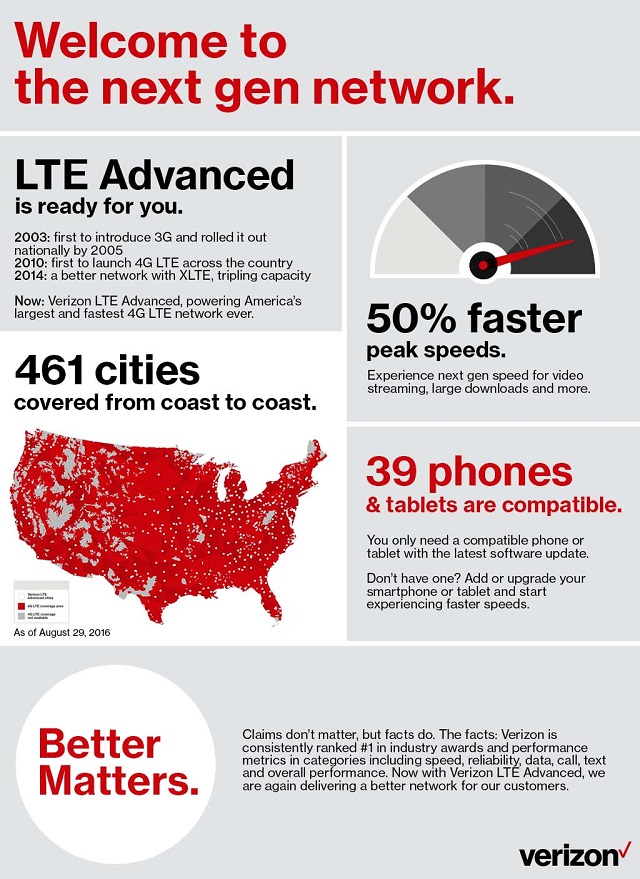
 
 
Photo Credit: siiixth/Shutterstock
 
~ Brian Fagioli

10.21.2015

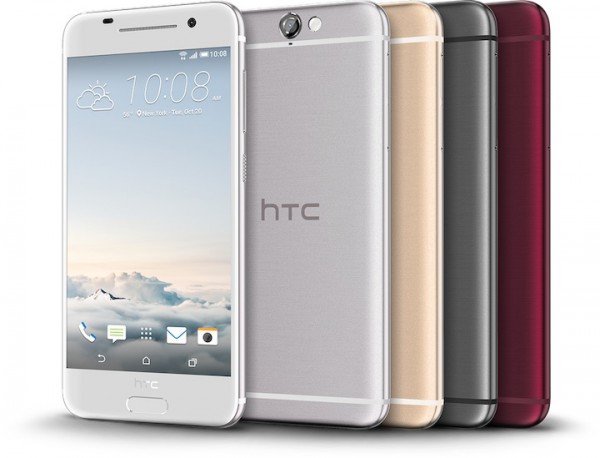
HTC launches the One A9 with iPhone-like design and Android 6.0 software, priced at $399

 
At an event on Tuesday, HTC announced the launch of One A9, "the best HTC smartphone in years", according to the company. The handset comes with a big promise. HTC claims that it will deliver the latest version of Android to the One A9 within 15 days of its availability.
 
The metal-clad HTC One A9, which looks very similar to the iPhone, comes with a 5-inch Full HD 2.5D AMOLED display with Corning Gorilla Glass 4 protecting the screen. It is powered by a Snapdragon 617 octa-core processor with integrated X8 LTE, and offers users a choice between a 2GB or 3GB of RAM. For storage, users get to pick between 16GB and 32GB, with both variants supporting microSD card for external storage.
 
On the camera front, there’s a 13-megapixel sensor at the back with OIS, and an UltraPixel shooter on the front. The company says that the selfie camera can capture 300 percent more light than conventional smartphone cameras.
 
The company also spent several minutes explaining the audio capability of the One A9. The handset comes with HTC BoomSound integrated into the headset combined with Dolby Audio.
 
On the connectivity front, the handset comes with support for optional HTC Rapid Charger 2.0 which can offer up to 75 percent faster charging. These are just numbers without the much needed context, so we will have to check the device ourselves to see how accurate the company’s claims are.
 
The biggest attraction of the handset is its Android 6.0 Marshmallow software. It is the third handset after Google’s Nexus 6P and the Nexus 5X to ship with the latest version of Google’s mobile operating system. The company also mentioned that it would offer the latest Android software version within 15 days of its release.
 
The HTC One A9 comes in Opal Silver and Carbon Gray, Deep Garnet, and Topaz Gold color options and starts at $399 and will start shipping beginning November 2015.
 
~ Max Nottingham

9.17.2014

Android L rollout: What and when to expect

Wondering if your device will get Android "L" or when the rollout should start? Jack Wallen has some of the details to satisfy your curiosity.  

 
The next iteration of Android will start hitting devices later this year (2014). Naturally, every roll out of a major Android release is big news -- but not quite this big. Android L marks some major changes for the Android ecosystem. We're talking about a serious shift in design. According to Sundar Pichai, head of Android, L is to be one of the biggest upgrades to Android yet. The new design scheme will be a much flatter look, but every animation, every shadow, every single element will look "real." Shadow gradients, 3D tiles, and a much more consistent look and feel will spread across the whole of Android.
 
From everything Google is saying, this will be the most intuitive version of Android to date. Other than a total overhaul of the look, you'll find plenty of change in the platform. Other bits and pieces you should expect:
  • Notification panel and lock screen integration
  • Prioritized notifications (based on what you look at most)
  • Interlocking apps (apps can "talk" to one another)
  • Major performance boost
  • Default to ART runtime
  • Much improved battery life (thanks to Project Volta)
  • Improved Android wear experience
  • Android TV integration
There's plenty more goodness in the list, but that should be enough to get you hoping for an "L" upgrade to your device as soon as possible.

The big question: "Will device X get L?"

This question is on the minds of almost every Android user. Will my device get "L"? As you've all come to know, OS upgrades are dependent on a couple of major variables:
  • Carrier
  • Device
Not all devices are L-compatible. Most devices manufactured in 2014 should be. Here is a short list of compatible devices that are likely a lock for "L":
  • All Google Play edition phones
  • Nexus 5
  • Nexus 7
  • LG G Pad
  • All HTC devices released after the M7
  • LG G3
  • Motorola Moto X/G/E
  • Samsung Galaxy S 5
  • Samsung Galaxy S 4 (this will roll out well after the 5)
  • Samsung Galaxy Note 3/4
  • Sony Xperia Z1/Z2/Z3
OnePlus has also claimed that all of their newer phones will be getting the "L" update -- but there is no indication as to which devices and when.
 
The "when" is the tricky part, due to the carriers. The order in which these devices (by carrier) will most likely see "L" looks like:
  1. Google devices
  2. HTC
  3. Motorola
  4. Samsung
  5. LG
  6. Sony
This order, of course, is totally thrown out of whack because of carriers. Some carriers update much faster than others. For example, if you're on a contract with AT&T, expect your upgrade to "L" to be delayed. Of the three major US carriers, my best guess for "L" rollouts would be (based on previous major update rollouts):
  1. Verizon
  2. Sprint
  3. AT&T

The big "when?"

The rollout of "L" should begin around November or December of 2014. That will, most likely, be for Google devices only. I would suspect that most other devices won't see the "L" update until the beginning of the new year (although a Verizon-branded HTC M8 update could happen sooner).
 
No matter when the update occurs -- all Android users should be excited about what may be the most significant improvement to the platform to date. If your current device doesn't support "L" and you're getting ready to purchase a new device, make sure you land one that does support "L" or wait until after the "L" release to purchase. It will be worth the wait.
 
Are you excited for the newest iteration of Android? If so, what feature(s) are you most looking forward to?
 
~ Jack Wallen

9.11.2013

iPhone 5c not cheap enough for emerging APAC markets

Summary: Compared to its rivals' offerings, the new iPhone targeting emerging markets is a "disappointment" for consumers in developing markets such as China and India, and Apple is losing its "wow factor".
 
The iPhone 5c is not cheap enough to attract consumers in emerging Asia-Pacific markets, especially with the lack of reliable 3G and 4G networks in the region, while the incremental improvements in the iPhone 5s do not appeal to customers of the developed markets.
 
According to Phil Harpur, senior research manager of Frost & Sullivan's ICT practice, the iPhone 5c is a "disappointment" for emerging markets in the region such as China and India. These markets are price-sensitive and look for cheaper options, and this does not fit with Apple's brand, Harpur said, speaking to ZDNet Asia in an interview following the iPhone launch on Wednesday.
Apple unveiled the iPhone 5s, its lower end iPhone 5c, as well as the latest version of its mobile platform iOS7. With a 2-year telco service contract, the iPhone 5s 16GB model costs US$199, while the 32GB is priced at US$299 (32GB), and the 64GB is US$399. The iPhone 5c 16GB model costs US$99, while the 32GB model is priced at US$199. Within Asia, the new iPhone 5s will be available in Japan, China, Hong Kong, and Singapore from September 20, 2013.
 
Harpur pointed out that the lack of reliable 3G and 4G networks in emerging Asian markets also made it less compelling for consumers to pay a premium price for smartphones.
It is becoming difficult for Apple to have any real competitive advantages, he said, adding that rivals such as Samsung, HTC, and LG all offer smartphone models at lower pricepoints and which are taking off in emerging Asia-Pacific countries.
 
In markets that are less price-sensitive such as Singapore, Australia, and New Zealand, while the price tag does not make the latest iPhones less attractive, the new smartphone models do not have anything new to offer the market, Harpur pointed out.
 
Even though the iPhone 5c is slightly more price-competitive, there is a lack of innovation so it is "equally disappointing" to developed markets in the region, he said.
 
Singapore-based engineer Shawn Lee, too, told ZDNet Asia the incremental changes in iPhone 5S were expected, apart from the fingerprint sensor and large-camera sensor, and hopes iPhone 6 will come with more major changes.
 
"Apple is already pretty far down the path of incremental improvements. They seem to be losing the innovativeness and the 'wow' factor that was key to their rise," Lee said.
 
"There's no denying Apple takes the cake in industrial and product design, but I'm an advocate of change and the lack of change in Apple's design is a turn-off for me," said the engineer, who is a Samsung smartphone user. "The iPhone 5s looks good but boring after being in the market for so long. And even though the iPhone 5c adds color, it sticks to the same design language." 

Higher security could offer enterprise potential

However, the iPhone 5s offers increased security which can offer enterprise potential, observed Carolina Milanesi, Gartner's research vice president of consumer technologies and markets, referring to the new biometric function as an example.
Jan Dawson, chief telecoms analyst of devices and platforms at Ovum, added that the new fingerprint scanner should make the device more appealing as it marked the first time a big-selling device offers such a feature.
 
However, overall, there are no other features that make the phone better or more attractive than its predecessor the iPhone 5, especially when BYOD and the use of high-end devices already have been generally accepted by most organizations, Harpur pointed out. 

Consumers unimpressed, unwilling to switch

Consumers with Android devices and older generations of the iPhone told ZDNet Asia they had no plans to switch over to the iPhone 5s or 5c.
 
Lin Surong, who currently owns a HTC phone, said while the iPhone does not become laggy after prolong use, it still has features that "irk [her] as a consumer" such as the non-expandable storage and built-in internal battery. And she is not impressed by the fingerprint sensor, which she described as "dodgy" since such features often do not work properly on laptops that offer them.
 
Lee added he would not switch over to iOS as he liked the customization and open source nature of Android.
 
Peace Chiu, an iPhone 5 user, too noted that while Apple made an effort to make iPhone 5s more visually appealing and added features such as the fingerprint scanner, she would not be considering an upgrade. "I don't think it's enough to convince me to switch to iPhone 5s since I find my current phone adequate. The switching process tends to be quite troublesome as well," Chiu said.
 
Joey Chapman, another iPhone 4 user, added the changes to iPhone 5s and 5c were insignificant and her current phone still works well.
 
"It [also] looks like a phone for kids because of the stupid colors," Chapman said.
~ Ellyne Phneah

1.01.2013

Superphone showdown: HTC Droid DNA vs. Samsung Galaxy S3

One of the curious things about the Android vs. iOS argument is that there’s some confusion as to which Android phone is the best, which makes it hard to compare any one piece of hardware against Apple’s latest iPhone. Inside Android circles there are smaller groups of fans that support one manufacturer or another so, when deciding which Android phone is the best you really have to look at the flagship from each manufacturer.

Now, both HTC and Samsung have a handset that could easily be considered the Android flagship. When you compare the Samsung Galaxy S3 to the HTC Droid DNA, which comes out on top?

     Build quality


HTC and Samsung have always had wildly different design ideas. While both manufacturers use a lot of plastic in their phones, Samsung tends to go for high gloss and high shine, while HTC uses matte surfaces and darker colors. On paper, these two phones are very similar. The Droid DNA features a 5-inch screen and weighs in at 138g while the Galaxy S3 features a 4.8-inch screen and weighs in at 133g. Both phones are 2.78 inches across, but the S3 is 4.4mm shorter and 1.3mm thinner than the thickest point of the Droid DNA.

Ultimtely, the Galaxy S3 is a flat slab of plastic and glass, while the back of the DNA curves to feel more comfortable in the hand. The DNA also features a soft touch coating on the back, making the it feel much more stable in your hand.

HTC takes the point here for build quality, but there is something to be said for the hit to usability that Droid DNA takes if you have smaller hands.

     Under the hood


Depending on which Samsung Galaxy S3 you are using, the Droid DNA offers a spec boost in one direction or another. The GSM variant of the S3 features a quad-core 1.4GHz Exynos processor with 1GB of RAM, while the LTE variant uses a dual-core Snapdragon with 2GB of RAM. The Droid DNA only comes in Verizon LTE form, and features a 1.5GHz Snapdragon S4 Pro and 2GB of RAM.

Samsung’s GPU, a Mali 400, does a pretty good job of standing up to the DNA’s Adreno 320. If the Droid DNA and the GS3 had similar screen resolutions the Adreno 320 would overpower the Mali 400, as was demonstrated when comparing the Galaxy S3 and the LG Optimus G. Since the Adreno 320 has to work a lot harder to drive the 1080p screen on the Droid DNA, the Galaxy S3 actually outperforms the HTC phone in graphics benchmarks.

The Galaxy S3 comes in 16, 32, and 64GB sizes, with an external storage slot capable of holding another 64GB. The Droid DNA advertises having 16GB on board, but the user only has access to 11 of those gigabytes. Since there’s no removable storage, you’re stuck relying on either the cloud or something like a Kingston Wi-Drive for holding extra music and movies.

HTC clearly has a more powerful phone on paper, but if your smartphone is where you play video games or listen to music the Samsung Galaxy S3 is likely the more functional phone in real world cases.

     Display


Both phones use Corning’s Gorilla Glass 2 to protect the screens, but the displays underneath couldn’t be more different. Samsung uses a Super AMOLED display with a 1280×720 resolution at 306ppi. The Droid DNA uses a Super LCD 3 display with a 1920×1080 resolution at 440 ppi. Typically Samsung AMOLED displays are capable of outperforming LCD displays outdoors, but the Droid DNA handles itself well even in direct sunlight. The Droid DNA is also a big winner when trying to use the phone in a completely dark room, while even on the dimmest setting the Galaxy S3 can be irritatingly bright.

While both of these smartphones feature color rich displays that function well both indoors and outdoors, the screen on the Droid DNA is undeniably superior when holding the phones up close. Text is sharper, images clearer, but video playback is almost identical.


HTC chose a great display for the Droid DNA, and is the clear winner in this category.

      Camera


It has been a little while since we have seen anything from Samsung or HTC that didn’t ship with a great rear camera. Both phones have 8MP cameras that record video 1080p at 30fps, and both phones have flash. HTC’s ImageSense offers a backlit sensor that takes great shots in low light, but Samsung’s camera does a better job with HDR shots and offers way more in the way of photo features.


HTC has recently made some huge improvements to their front-facing camera, which is now a 2.1MP camera instead of the 1.9MP on the Galaxy S3. The camera on the front of the Droid DNA is also capable of grabbing a wider field, which makes things like video chats a much more enjoyable experience.


Overall, HTC and Samsung offer very similar experiences, but the Droid DNA’s front-facing camera puts it out in front. 


     And the winner is…


While it may seem like the HTC Droid DNA won in a landslide, it’s important to point out that this is just a handful of small victories added up. The Droid DNA and the Galaxy S3 are both great phones in their own respects, and the Galaxy S3 is available everywhere while the DNA is stuck on Verizon Wireless.


If you are looking at a new phone on Verizon, or a good excuse to switch to Big Red, the HTC Droid DNA is easily the best phone on their network right now.

Russell Holly


9.28.2012

Apple: The accuser becomes the accused

Takeaway: On the heels of the Apple/Samsung lawsuit, Apple drops IOS 6 on the public. Just like IOS 5, there are plenty of features stolen directly from Android, alleges Jack Wallen.


Much to my chagrin, my wife has an iPhone. Yesterday she upgraded the OS to 6 and the upgrade brought a few shocks, but no surprises, to my eyes. It seemed every time my wife would shout, “Oh cool!”, it would turn out yet another feature on IOS 6 was another bit of clever thievery on the part of Apple.

Now, the only reason this is even remotely important (at least to me) is that it comes after the ridiculous IP lawsuit Apple won over Samsung. Prior to that, Apple was doing its usual ‘Oh, that’s a cool feature Android has, let’s steal it, put it in our platform, and pretend we invented it.’ I’ve been used to that ever since various desktops started stealing from Linux long ago. But this time there was something else involved — hypocrisy.

Apple sues the bankroll off of Samsung for patent design issues (does anyone actually have any details on just what design issues?) and then turns around and releases a new OS that clearly “borrows” from Android. Apples to Apples? Shouldn’t this be a case of the pot calling the kettle black?

There were so many pundits pontificating on why Apple brought this insane law suit to court. I myself stated it was a cash grab in hopes of stopping the Samsung Galaxy S3 from getting into the hands of too many people before the iPhone 5 arrived. But now, I wonder if it was little more than a diversionary tactic so people might not notice (or even bother to bring up) the fact that Apple did just what they claimed Samsung was doing.

Let’s see:
  • You can now create auto responses to phone calls in the form of texts (been in Android for a long time now)
  • All Facebook contacts show up in Contacts (been in Android since day one)
  • Bluetooth sharing (again, been in Android since day one)
  • Document syncing (Sync your Android docs with Google docs)
  • Offline Reading (tons of Android apps have already had this)
This list doesn’t even include the list of IOS 5 features that were “borrowed” from Android. And in a show of unprecedented shenanigans, Apple even stole the design for their clock design from the Swiss National Railway!

Ultimately, what gets me about this whole mess is that Apple seems to always have a Get Out Of Jail Free card hidden in their back pocket. It seems the darling dear of the tech world can do what they want, when they want, and get away with it, knowing full-well there will be no consequences.

It’s very clear that Apple wants to be the only big man on campus. Fundamentally there is nothing wrong with that — we all do in our respective fields. But to win a lawsuit to the tune of over two billion dollars and then turn around and pull off the same thing you just sued a company for is beyond the realm of audacity (and I’m not talking the amazing, open source audio recording tool)!
Every maker of Android devices needs to stand up to the bully. Actually, it’s time Google came up to bat and knocked Apple out of the park. Make Apple aware they can’t bully everyone on the playground just because they are Apple. Slap them with an iLawsuit that will finally make the public aware that the accuser is now the accused. Sure, the public at large won’t care. But those with a finger in this tasty pie (aka Android developers and designers) would certainly feel validated and vindicated.

Apple should be ashamed of themselves for wasting taxpayers’ money on a lawsuit that could just as easily be aimed at themselves. I realize that nothing will probably come of this, mostly because the public is far too awash in a sea of delight that is the iPhone 5 to realize said delight is brought to them by a completely different platform. But maybe, just maybe this will come back to haunt Apple when Samsung, HTC, Motorola, and Google have had enough and drop the gauntlet to Cupertino. Should that happen, the court system and the court of public opinion might have a surprise for Apple up their sleeves.

~ Jack Wallen