Cisco Learning Network Store Promotions Page
Showing posts with label Facebook. Show all posts

1.13.2017

Backdoor in WhatsApp's end-to-end encryption leaves messages open to interception

 
Facebook has long-claimed that its WhatsApp messaging service is completely secure and messages cannot be intercepted thanks to its use of end-to-end encryption. But researchers have unearthed a serious security flaw that makes it possible to read encrypted messages.
 
Based on Open Whisper Systems' Signal Protocol, the unique security keys used to implement end-to-end encryption should keep messages secure. But WhatsApp can force offline users to generate new keys and this could allow Facebook -- and third parties -- to read messages.
 
The problem is a serious one, as WhatsApp's supposed security has earned it a good deal of respect, and it is a communication tool that those who wish to remain anonymous have come to rely upon. Tobias Boelter, a security researcher at the University of California, discovered the security problem. He says: "If WhatsApp is asked by a government agency to disclose its messaging records, it can effectively grant access due to the change in keys".
 
As the Guardian explains:
WhatsApp has the ability to force the generation of new encryption keys for offline users, unbeknown to the sender and recipient of the messages, and to make the sender re-encrypt messages with new keys and send them again for any messages that have not been marked as delivered.
The recipient is not made aware of this change in encryption, while the sender is only notified if they have opted-in to encryption warnings in settings, and only after the messages have been resent. This re-encryption and rebroadcasting effectively allows WhatsApp to intercept and read users’ messages.
The problem does not lie with the Signal protocol itself -- the issue is entirely related to how WhatsApp has implemented it. Despite the fact that Boelter reported the problem to Facebook last April, the backdoor is still present. The company says that it is not actively working on it, and goes on to say that it is "expected behavior".
 
Privacy experts are concerned that WhatsApp is actually far less secure than users have been led to believe. Boelter says that people "might say that this vulnerability could only be abused to snoop on 'single' targeted messages, not entire conversations. This is not true if you consider that the WhatsApp server can just forward messages without sending the 'message was received by recipient' notification (or the double tick), which users might not notice. Using the retransmission vulnerability, the WhatsApp server can then later get a transcript of the whole conversation, not just a single message".
 
Speaking to the Guardian, a WhatsApp spokesperson remains adamant that security is high:
Over 1 billion people use WhatsApp today because it is simple, fast, reliable and secure. At WhatsApp, we've always believed that people's conversations should be secure and private. Last year, we gave all our users a better level of security by making every message, photo, video, file and call end-to-end encrypted by default. As we introduce features like end-to-end encryption, we focus on keeping the product simple and take into consideration how it's used every day around the world.
In WhatsApp's implementation of the Signal protocol, we have a "Show Security Notifications" setting (option under Settings > Account > Security) that notifies you when a contact’s security code has changed. We know the most common reasons this happens are because someone has switched phones or reinstalled WhatsApp. This is because in many parts of the world, people frequently change devices and sim cards. In these situations, we want to make sure people’s messages are delivered, not lost in transit.

~ Mark Wilson

10.23.2016

Amnesty International ranks message apps according to privacy -- Facebook wins!

 
Despite a desire to be more connected than ever before, people are simultaneously more concerned than ever about their security and privacy. This is certainly true when it comes to messaging tools, and the privacy features offered by a particular app or service can be what sways your decision to use it one way or the other.
 
Justice group Amnesty International has spent some time analyzing the privacy and encryption found in a number of popular messaging tools and compiled results in a ranked list. The findings make for interesting reading, not least because Facebook is ranked the most highly.
 
The organization looked at 11 popular messaging services, checking not only whether they made use of encryption, but also at the attitudes of the companies behind each of the services.
 
So what is Amnesty International interest in all of this? The organization is keen for human rights campaigners, whistle-blowers and people in need to be able to communicate securely without having to worry about whether their messages are being read by others.
Our communications are under constant threat from cybercriminals, malicious hackers, and unjustified spying by state authorities. Young people, activists and journalists who share personal details over messaging apps are especially at risk.
Many of us trust these apps with intimate details of our personal life. Companies that fail to take basic steps to protect our communications are failing that trust.
The group goes on to say:
Amnesty International is calling on companies to apply end-to-end encryption as a default. It is also calling on technology companies to clearly inform users of the level of encryption applied to their messaging services.
Facebook is praised for WhatsApp and Messenger for offering end-to-end encryption (although not by default in the latter) and for its transparency and interest in human rights. Apple finds itself in second place, and praised for its opposition to backdoors, while Google nestles in fourth position, largely because of Hangout's more questionable security and privacy.
 
Microsoft is in a very disappointing eighth place -- disappointing for both the company and users of its products. Skype is criticized for having been "a major target of government surveillance worldwide".  Amnesty International also says: "Despite Microsofts strong policy commitment to human rights, it is still using a weak form of encryption on Skype."
 
Here's the chart in full:
  1. Facebook: 73 / 100
  2. Apple: 67 / 100
  3. Telegram: 67 / 100
  4. Google: 53 / 100
  5. Line: 47/ 100
  6. Viber Media: 47 / 100
  7. Kakao: 40 / 100
  8. Microsoft: 40 / 100
  9. Snapchat: 26 / 100
  10. Blackberry: 20 / 100
  11. Tencent: 0 / 100
Photo credit: David M G / Shutterstock
 
~ Mark Wilson

7.09.2016

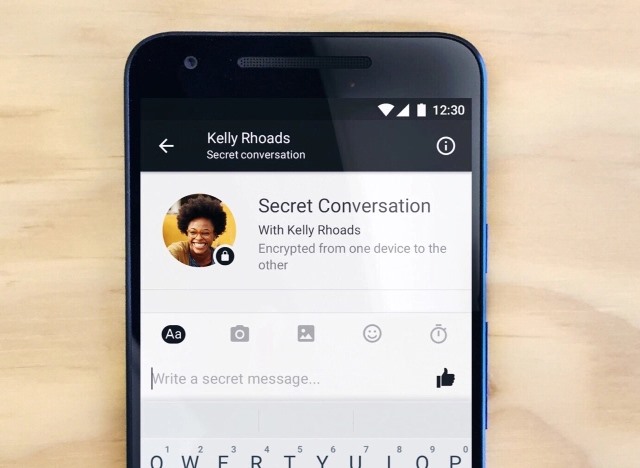
Facebook Messenger ups security with end-to-end encryption in 'secret conversations'

 
Continuing in its relentless drive to take over the world of messaging, Facebook Messenger is gaining end-to-end encryption. To start with, the security feature is only rolling out on a 'limited test basis' but if feedback is positive, it will get a wider airing.
 
Facebook says that the move comes in response to requests for additional security options to protect discussions about sensitive matters, saying that security and privacy experts have been involved in the implementation of the feature.
 
End-to-end encryption has grown in popularity in recent years, and Facebook users have been patiently awaiting its arrival on the platform. The feature is referred to as 'secret conversations', and it is based on the Signal Protocol developed by Open Whisper Systems.
 
Introducing the test rollout, Facebook says:
We are starting to test the ability to create one-to-one secret conversations in Messenger that will be end-to-end encrypted and which can only be read on one device of the person you're communicating with. That means the messages are intended just for you and the other person -- not anyone else, including us. Within a secret conversation, you can also choose to set a timer to control the length of time each message you send remains visible within the conversation.
There are limitations to how secret conversations work -- including the fact that they can only be used on a single device, meaning they won’t necessarily be to everyone's liking. Messages protected with end-to-end encryption are limited to plain text; at the moment it is not possible to send images and videos.
 
Check out the Facebook blog where you can see a video of the feature in action.
 
~ Mark Wilson

6.30.2016

Facebook uses Irish headquarters to skirt privacy laws

 
Facebook has won an appeal against a court ruling that said the social network could not store data about people that did not have an account. It had been ruled that Facebook could not gather data about non-users in Belgium.; Facebook responded by blocking access to those without an account.
 
Back in 2015, Facebook was told to stop this blocking or face hefty daily fines. Facebook felt that the ruling was unfair and appealed. In a new ruling today, the Brussels Court of Appeal said: "Belgian courts don't have international jurisdiction over Facebook Ireland, where the data concerning Europe is processed".
 
Facebook had been ordered to stop storing data about internet users without an account with the social network. The threat of €250,000 ($277,800) prompted the company to fight back against the Belgian data protection commission and today's ruling overturned that of the previous court. Facebook will now allow Belgians without accounts to access pages on the site.
 
The crux of the case is that Facebook is headquartered in Ireland. This meant that -- regardless of the rights or wrongs of what Facebook has done -- the court in Belgium was simply not able to wield any power over the social network.
 
Ireland has been used by many company as a handy way to funnel income whilst avoiding hefty tax bills, and it seems the country could become a means of avoiding certain laws as well.
 
In a statement responding to the ruling, Facebook said:
We are pleased with the court’s decision and look forward to bringing all our services back online for people in Belgium.
Photo credit: dolphfyn / Shutterstock
 
~ Mark Wilson

5.12.2016

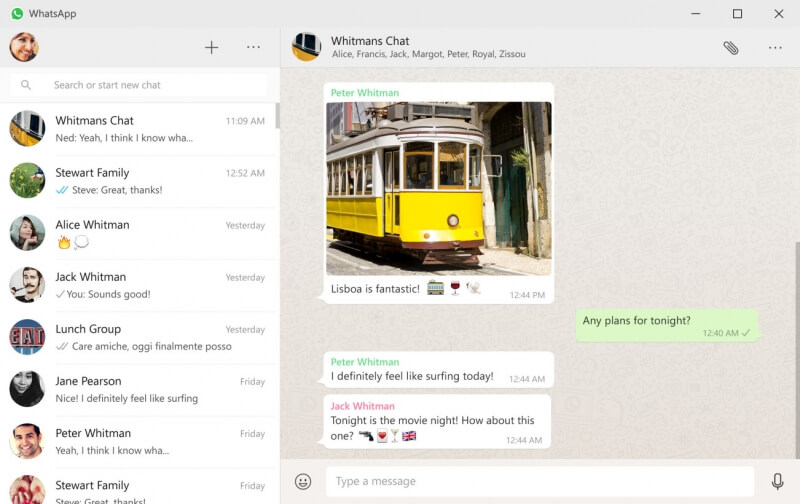
The WhatsApp native desktop app for Windows and Mac has arrived

 
Facebook-owned messaging service WhatsApp has announced the arrival of its native desktop app, which you can download here. It’s available for Windows 8 and above, and for Mac OS X 10.9 (Mavericks) and above.
 
You’ll need to scan a QR code using WhatsApp on your smartphone to log in to the desktop app (look for WhatsApp Web menu under Settings). Once you’re set up, you’ll get desktop notifications, better keyboard shortcuts, and more.
 
This desktop WhatsApp is very similar to the web version that’s been available since 2015, copying much of the user interface. “Like WhatsApp Web, our desktop app is simply an extension of your phone,” the company said in a statement.
 
 
The software syncs with your phone to mirror conversations and messages. It also supports voice dictation. WhatsApp suggests connecting your phone to Wi-Fi as a way of keeping data costs down.
 
Rumors that a full desktop version of the app was in the works surfaced last week after screenshots appeared on Twitter. The app now joins the likes of Facebook Messenger and Skype, both of which have desktop incarnations.
 
WhatsApp was in the news again last week, after being banned in Brazil for the second time in six months. The app was blocked in the country for 72 hours for refusing to hand over chat records related to a drug case, something the company says it couldn’t do as its messages are encrypted. A different judge overturned the ruling and the service was restored 24 hours into the ban.
 
~ Rob Thubron

5.04.2016

Facebook pays $10,000 to 10-year-old Instagram hacker

A photo illustration shows the applications Facebook and Instagram on the screen of an iPhone in Zagreb April 9, 2012.  
Reuters/Antonio Bronic
Social media giant Facebook (FB.O) has paid a $10,000 reward to a 10-year-old Finnish boy for finding a glitch in its picture sharing app Instagram.
 
Jani, whose last name was not released for privacy reasons, is the youngest ever recipient of Facebook's "bug bounty", paid to users who find bugs or weaknesses in its platforms. 
 
"I wanted to see if Instagram's comment field could stand malicious code. Turns out it couldn't," Jani told Finland's Iltalehti newspaper.
 
Facebook said the glitch was fixed in February and the reward was paid in March.
 
Jani, who is still too young to have a Facebook or Instagram account of his own, said he learned coding from Youtube videos and found a way to delete user comments from Instagram accounts.
 
"I could have deleted anyone's comments from there. Even Justin Bieber's," he told Iltalehti.
 
He said he was thinking about a career in data security, but for now his plans include buying a new bike and a football with his reward money.       
 
~ Tuomas Forsell

4.15.2016

Facebook video scam targets Chrome users

 
Researchers at security company ESET have released details of a new piece of malware that spreads disguised as video posts on Facebook.
 
Malicious links appear as a video post you were tagged in on a timeline, or as a message sent to you via Facebook Messenger by a friend. They use the titles, 'My first video', 'My video', 'Private video' or a string of randomly generated characters.
 
Clicking on the link tells you that a plugin is needed in order to play the video. If this is installed your Facebook wall will be flooded with fake video posts tagging various friends. The malware has other functions though, it can add friends, create Facebook pages, share, edit or hide posts or unfollow them -- though ESET says these features are not yet active.
 
At the moment the malware only targets Chrome users but there's no guarantee it won't spread to other browsers in future. The company has detected the threat more than 10,000 times in the past week and users around the world have been infected.
 
Writing on the ESET blog, malware analyst Lukas Stefanko says, "At this very moment, the malicious campaign is spreading spam messages and infecting Facebook accounts with a very high rate of success. However, it has potential to become more dangerous in the future, spreading other, more powerful malware with new capabilities".
 
The blog includes more information on the infection along with details on how to remove it.
 
Photo credit: dolphfyn / Shutterstock
 
~ Ian Barker

10.23.2015

There has never been a better time to tweak your Facebook privacy settings

 
Facebook and privacy are not words you tend to find together in the same sentence -- at least not in a positive sense. Just a few days ago, the social network announced that all public posts were to be made searchable -- although it wasn't really billed as such.
 
You might not be entirely happy with this. While you may now be careful that you only share posts with your friends, a huge number of historic posts have now been made searchable. If you'd prefer to keep your content private, now is the time to act.
 
In fact, there are a couple of things you need to do -- limit the audience that can access everything you post from this point forward, and limit the audience that can access your past posts. Quite why this could not be covered by a single setting is anyone's guess, but that's just the way it is. Here's what you need to do.
  • Fire up your web browser and pay a visit to Facebook.
  • Click the padlock symbol in the blue bar at the top of the page, and then click Who can see my stuff?
  • From the dropdown menu labelled Who can see my future posts?, select Friends -- or anything other than Public.
  • Now click the See More Settings link at the bottom of the Privacy Shortcuts menu.
  • Click Limit Past Posts and you can restrict all of your past posts so they can only be seen by people on your friend list.
  • Click the Limit Old Post button followed by Confirm, and you're done.
Photo credit: graja / Shutterstock
 
~ Mark Wilson

8.26.2015

Facebook is now working on its own digital assistant called M

Sounding like a character from a James Bond movie, M is Facebook's personal digital assistant. Ready to compete with the likes of Cortana, M will live inside Facebook Messenger and take artificial intelligence a step further. Rather than just helping you to find information or create calendar entries, M will actually perform tasks on your behalf.
 
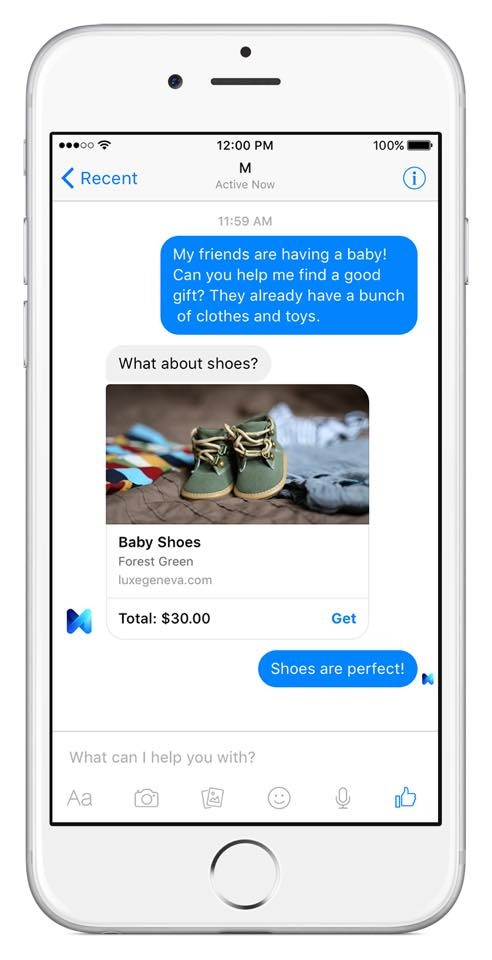
Once up and running, M will be able to book restaurants for you, purchase shopping, and more. It will also be possible to use the service to ask for advice -- such as looking for somewhere to visit nearby, or gift suggestions -- and Facebook says the AI behind M is "trained and supervised by people".
 
Facebook's David Marcus revealed that the social network is currently testing M, stressing that things were only at an early stage. He gave a sneak preview of a few screenshots, all of which show M in use on a mobile phone, and it's not clear if the tool will make its way to the desktop version of Facebook as well. He says:
Unlike other AI-based services in the market, M can actually complete tasks on your behalf. It can purchase items, get gifts delivered to your loved ones, book restaurants, travel arrangements, appointments and way more.
This is early in the journey to build M into an at-scale service. But it's an exciting step towards enabling people on Messenger to get things done across a variety of things, so they can get more time to focus on what's important in their lives.
There's no word on how long it will be before M is launched, nor confirmation of whether M is a codename or what it will actually end up being called. Facebook has also not revealed whether there will be a public testing program ahead of the official launch. Watch this space!
 
~ Mark Wilson

7.10.2015

Hackers of Apple, Facebook seen as independent group seeking money

A man types on a computer keyboard in Warsaw in this February 28, 2013 illustration file photo.        


3.17.2015

Facebook to allow users to send money to friends through Messenger

People are silhouetted as they pose with mobile devices in front of a screen projected with a Facebook logo, in this picture illustration taken in Zenica October 29, 2014.
Credit: Reuters/Dado Ruvic
 
(Reuters) - Facebook Inc said it is adding a new feature to its messaging app that allows friends to send and receive money through it.
 
Users can tap or click a dollar icon in a new chat window to send money to their friends, after they link a Visa or MasterCard debit card issued by a U.S. bank to their accounts. (bit.ly/1xvuNDm)
 
The free feature will roll out over the next few months for users in the United States who access Facebook Messenger through desktop computers or Google Inc's Android and Apple Inc's iOS operating systems on mobile devices.
 
Users can create a PIN or enable Touch ID if they have an iPhone to add a level of security to the payments. 
 
Snapchat had launched a similar service last November, called Snapcash.
 
The mobile messaging company partnered with online payments company Square to allow Snapchat users to link their debit cards to their account and quickly send money to a contact by starting a chat on a smartphone.
 
~ Anya George Tharakan    

2.25.2015

Microsoft to drop Facebook, Google Chat integration in Outlook.com

Summary:Microsoft is discontinuing Facebook and Google Chat integration in Outlook.com, and is advising users to use Skype instead.
 
Within "the next couple of weeks," Microsoft will discontinue support for Facebook Chat and Google Chat in Outlook.com.
 
Microsoft notified Outlook.com customers of the pending change via an e-mail message from the Outlook.com team sent on February 24 (Thanks @lindhartsen)
 
Microsoft attributed the decision to drop Google Chat integration to Google's decision to discontinue the chat protocol used by the Google Talk platform.
 
A link to the Google decision points to a page noting that Google Hangouts replaces Google Talk and does not support XMPP. XMPP is the open-sourced Extensible Messaging and Presence Protocol, an IETF standard for instant messaging. (XMPP originally was called Jabber.)
 
There was no reason given for discontinuing Facebook chat integration.
 
"We understand that this may disappoint some of our customers, but we hope that you'll try Skype for Outlook.com chat, and voice, video calling, so you can take advantage of the more robust ways to keep in touch with friends and family," the e-mail message from the Outlook.com team said. 
 
I've asked Microsoft if the company has any more to say about the reason for the discontinuation of Facebook Chat or Google Chat support -- beyond the desire to push the company's own Skype instant-messaging service.
 
A spokesperson sent the following statement:
"Most Outlook.com customers already prefer to use Skype when they are chatting and we see this as a great option for anyone impacted by Google's decision to shut down Google Talk and associated APIs, or the recent deprecation of Facebook Chat for Outlook.com."
~ Mary Jo Foley 

1.22.2015

Microsoft to give away Windows 10, unveils hologram glasses

An undated handout photo of Microsoft's HoloLens, a holographic lens device that allows users to see three-dimensional renderings of computer-generated images.
Credit: Reuters/Microsoft/Handout
 
(Reuters) - Microsoft Corp (MSFT.O) will give away its upcoming Windows 10 operating system as a free upgrade to users of the most recent versions of Windows and Windows Phone, as the world's largest software company tries to retain customers in the mobile era.
 
The 'free' strategy is a calculated gamble for Microsoft, designed to put Windows in as many devices as possible. The company would then make up for any lost revenue by selling services such as Office over the Internet, or cloud.
 
"It's a necessary evil as CEO Satya Nadella and Microsoft have recognized the 'golden goose' and major revenue opportunities will happen after the upgrades have taken place," said Daniel Ives, an analyst at FBR Capital Markets. 
 
An undated handout illustration of Microsoft's HoloLens, a holographic lens device that allows users to see three-dimensional renderings of computer-generated images.
Credit: REUTERS/Microsoft/Handout
  
"Microsoft needs to lay seeds for its cloud-centric strategy and Windows 10 is the epicenter of that strategy. It's all about making it attractive for the ecosystem to upgrade onto this next-generation platform."
 
The immediate revenue hit is unlikely to be large, as Microsoft gets no more than $500 million of its $20 billion or so annual Windows revenue from upgrades, analysts said. The vast majority of Windows revenue comes from hardware makers installing it on new personal computers and businesses paying for multi-year licenses.
 
Investors were not impressed. Microsoft shares fell 1 percent to $45.91 on Nasdaq shortly before the close.
 
An undated handout illustration of Microsoft's HoloLens, a holographic lens device that allows users to see three-dimensional renderings of computer-generated images.
Credit: REUTERS/Microsoft/Handout
  
The company is expected to say more about the financial effects of the new approach when it reports quarterly earnings next week.
 
Windows 10, expected on the market this autumn, will be available for one year as a free upgrade to users of Windows 7, Windows 8.1 and Windows Phone 8.1, Myerson said.
 
Industry and Wall Street analysts described the move as inevitable.
 
An undated handout illustration of Microsoft's HoloLens, a holographic lens device that allows users to see three-dimensional renderings of computer-generated images.
Credit: REUTERS/Microsoft/Handout
  
Windows only features on roughly 15 percent of computing devices including phones and tablets, and is largely irrelevant for many consumers. It lags Apple Inc (AAPL.O) and Google Inc (GOOGL.O), which regularly update their software systems free for customers.
 
"The way to motivate consumers is to make upgrades transparent and painless - meaning free and low-to-no effort," said Forrester analyst Frank Gillett. "Microsoft had to match the expectation set by the mobile and Web leaders."
 
At an event at its headquarters near Seattle, Microsoft also tried to burnish its flagging reputation for innovation.
 
Microsoft Corp's Ashley Frank talks about Windows 10 at the annual shareholders' meeting in Bellevue, Washington December 3, 2014.
Credit: REUTERS/Jason Redmond
  
Unexpectedly, it unveiled a holographic lens device that allows users to see three-dimensional renderings of computer-generated images. Microsoft HoloLens, which looks like a wireless visor, raises the stakes in the emerging market for virtual and augmented reality, being targeted by Facebook Inc's (FB.O) Oculus and Google's Glass project.
 
The device will be available around the same time as Windows 10 this autumn, a Microsoft executive said.
 
Executives also showed off an Xbox app for games on Windows 10 and a new version of its browser code named 'Spartan,' which lets users make notes on Web pages and share them.
 
Microsoft announced its new Windows 10 operating system in September, billing it as a move to unify all kinds of device users. It skipped Windows 9 altogether, to put some distance between the new system and Windows 8, which confused many users by ditching the start button menu and using a new layout.
 
(Reporting by Bill Rigby; Editing by Jeffrey Benkoe, Andre Grenon and Richard Chang)               

~ Bill Rigby

12.15.2014

Facebook drops Microsoft's Bing in favor of its own search tool

 
Bing has been unceremoniously dumped by Facebook. The social network had been using the Microsoft search tool to power its Graph Search platform for some time now, but no longer. While no announcement has been made, Facebook confirmed the news to Reuters.
 
The lack of official announcement meant that the dropping of Bing was immediately noticed. Facebook does not have a replacement partner in mind -- there is no danger of the social network teaming up with Google -- but will go it alone instead.
 
It seems that the decision tied in with Facebook's recent updating of its own search tool. A few days ago, the search tool was updated to make it possible to find specific posts rather than users and pages. This made Facebook Search more like a "proper" search engine, and probably led to questions about the value of maintaining links with Bing. But there are other reasons behind ditching Bing.
 
Facebook issued a statement to VentureBeat in which it explained the switch in focus:
We're not currently showing web search results in Facebook Search because we're focused on helping people find what's been shared with them on Facebook.
While Microsoft will undoubtedly be unhappy with Facebook's decision, it's one that will probably go down well with users of the site. The move is an interesting one, if not one that is entirely surprising. The problem with using Bing to display web search results within Facebook was that it did just that -- display search results from the wider web rather than just Facebook.
 
This meant that while there was arguably a better experience for users thanks to the extra features, there was a far stronger risk that people would navigate away from Facebook and stop consuming ads. It's not yet clear whether Facebook will start to cast its search net wider, displaying results and pages in a closely controlled built-in browser, but this is certainly something to look out for further down the line.
 
Photo credit: 1000 Words /Shutterstock
 
~ Mark Wilson

10.10.2014

Facebook has no near-term plan to monetize WhatsApp: CEO

Facebook CEO Mark Zuckerberg walks at the annual Allen and Co. conference at the Sun Valley, Idaho Resort July 11, 2013.
Credit: Reuters/Rick Wilking
 
(Reuters) - Facebook Inc (FB.O), which closed its acquisition of mobile messaging service WhatsApp on Monday, has no near-term plan to make money from the service, Chief Executive Mark Zuckerberg said on Thursday.
 
Zuckerberg, who is visiting India to participate in an event to boost Internet usage, did not give details.
 
Facebook's final WhatsApp acquisition price tag has risen an additional $3 billion to roughly $22 billion because of the increased value of Facebook's stock in recent months.
 
WhatsApp works across different types of phones, across borders, and without advertising. The app only charges a 99 cent annual subscription fee, which is waived for the first year.   
 
~ Aditya Kalra

9.07.2014

Facebook ready to spend billions to bring whole world online: Zuckerberg

Mark Zuckerberg (R), founder and CEO of Facebook, gestures during his conference at the Seminar ''Mexico Siglo XXI'', organized by Telmex foundation, in Mexico City, September 5, 2014.
Credit: Reuters/Edgard Garrido
 
(Reuters) - Facebook Inc (FB.O) is prepared to spend billions of dollars to reach its goal of bringing the Internet to everyone on the planet, Chief Executive Mark Zuckerberg said on Friday.  
 
"What we really care about is connecting everyone in the world," Zuckerberg said at an event in Mexico City hosted by Mexican billionaire Carlos Slim.
 
"Even if it means that Facebook has to spend billions of dollars over the next decade making this happen, I believe that over the long term its gonna be a good thing for us and for the world."  
 
Around 3 billion people will have access to the Internet by the end of 2014, according to International Telecommunications Union (ITU) statistics. Almost half that, 1.3 billion people, use Facebook.
 
Facebook, the world's largest social networking company, launched its Internet.org project last year to connect billions of people without Internet access in places such as Africa and Asia by working with phone operators.
 
"I believe that ... when everyone is on the Internet all of our businesses and economies will be better," Zuckerberg said.  
 

~ Christine Murray

7.04.2014

Facebook Messenger update includes new dedicated iPad build

  
Facebook has unveiled Facebook Messenger 7.0 for iOS and Android, a major new version of its dedicated messaging app for Facebook users.
 
Version 7.0 is notable for being the first version to include a native iPad build, coming three years after Facebook originally acquired the app’s forerunner, Beluga. The app also includes improvements to its video functions.
 
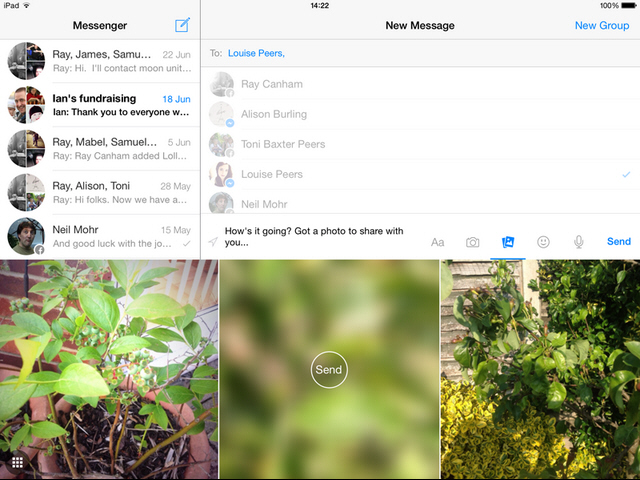
Facebook Messenger 7.0’s iPad build debuts a two-pane window design, with the left-hand pane allowing users to switch between recent conversations, groups, people and settings, where users can toggle notifications on and off, sync contacts and switch accounts if necessary.
 
The right-hand pane contains the currently selected conversation, where users will find the vast majority of features in the iPhone and Android versions are present, including stickers, group chat management and VoIP calling along with the ability to record audio messages.
 
Features not yet implemented from the iPhone build include tap-and-hold video recordings and the split-screen selfie camera.
 
Version 7.0 also now adds support for users to save any video shot in Messenger to their camera roll on both iOS and Android platforms, and rounds out the update with a number of unspecified fixes that promise better reliability.
 
Facebook Messenger 7.0 is available now for iPhone, iPad and Android. The Android version remains non-optimized for tablets for now.
 
~ Nick Peers

6.23.2014

LinkedIn introduces its own job search app

 
LinkedIn has launched its first standalone job search app that provides a dedicated service for users looking to search and apply for jobs on the social network.
 
The decision to release LinkedIn Job Search on iOS comes as no surprise, with 40 per cent of the network's 300 million users accessing the site on mobile devices.
 
The company also revealed that the free app would not publicise your job search to anyone else within your network.
 
"It can be hard to search for a job while you're at your desk, not to mention the potentially awkward conversation with your current boss", product manager Daniel Ayele said in a blog post. "Our goal is to help make this process easier for you and to help you be discreet. Everything you do within the app will be completely private and not shared with your network".
 
The app, which is currently only available in the US, is LinkedIn's latest attempt to make applying for jobs more accessible on mobile devices, and follows a similar update to the company's main app in August 2013.
 
New features available for LinkedIn Job Search include a more detailed, customizable job search function, tailored job recommendations based on your profile and a notifications service that tells you when new jobs are coming up or deadlines approaching.
 
The new app sees LinkedIn expanding the kind of content it offers and opening the platform up as a means of increasing traffic, and therefore, ad revenue. In the last quarter, "Talent Solutions", which includes recruitment advertising, made up 58 percent of LinkedIn's revenue at $275.9 million.
 
This sector also grew by 50 percent last year, providing a thriving area of growth for the company and the firm is likely to have noted the way other social networks like Facebook are diversifying their app portfolios with the standalone Messenger app and Slingshot.
 
The new app, which the company said will launch in other markets soon, faces stiff competition from already established job search apps, such as CareerBuilder and Monster.com, as well as many smaller competitors, like Proven, that emphasise user feedback.
 
Published under license from ITProPortal.com, a Net Communities Ltd Publication. All rights reserved.
 
Image Credit: Maxx-Studio / Shutterstock
  
~ Barclay Ballard

6.10.2014

U.S. spy agency joins Facebook, Twitter

The lobby of the CIA Headquarters Building in McLean, Virginia, August 14, 2008.
Credit: Reuters/Larry Downing
(Reuters) - The CIA, which has long trolled social media to try to uncover global trends and track evil-doers, officially joined Twitter and Facebook on Friday.
 
The spy agency cast the move as an effort to better get out its message and engage directly with the public, but its first Twitter message, sent out shortly before 2 p.m. EDT (1800 GMT), did not indicate there would be major revelations.  
 
It said simply: "We can neither confirm nor deny that this is our first tweet."
 
The lack of content did not dampen interest: in less than 90 minutes, the CIA account had nearly 84,000 followers, and that number was climbing fast.
 
The Central Intelligence Agency has long had a public website, and maintains official accounts on YouTube and Flickr, the photo-sharing site.
 
"By expanding to these platforms (Facebook and Twitter), CIA will be able to more directly engage with the public and provide information on CIA’s mission, history, and other developments," CIA Director John Brennan said in a statement.
 
Among the items to be posted are artifacts from the CIA's (non-public) museum, and updates to its "World Factbook," a compendium of world leaders, maps and similar information.
 
Critics say the Obama administration is more secretive than its predecessors. It has cracked down on once-normal interactions between reporters and intelligence officials.
 
In recent directives, Director of National Intelligence James Clapper has banned intelligence officials from speaking to reporters without permission, even about unclassified information, and also from citing news articles based on unauthorized disclosures.
 
The CIA's Facebook page is www.facebook.com/central.intelligence.agency. Its Twitter "handle" is @CIA. 
 
~ Warren Strobel         

6.05.2014

Facebook acquires mobile data plan firm Pryte

Facebook CEO Mark Zuckerberg speaks during a news conference at Facebook headquarters in Palo Alto, California May 26, 2010.
Credit: Reuters/Robert Galbraith/Files
(Reuters) - Facebook Inc is acquiring Pryte, a Finnish company that aims to make it easier for mobile phone users in under-developed parts of the world to use wireless Internet apps.
 
Facebook did not disclose financial terms of the deal, which spokeswoman Vanessa Chan said is expected to close later this month. 
 
Pryte's service, which has not publicly launched yet, seeks to make it easier for consumers without wireless data plans to use online services by selling short-term passes that would provide access to particular mobile apps, such as Facebook or Foursquare. 
 
Facebook, the world's largest social network with 1.28 billion users, is primarily interested in the team behind Pryte, led by Chief Executive Markku Makelainen, Chan said.
 
The one-year old, Helsinki-based company has valuable experience and relationships working with wireless operators, particularly in emerging markets, she said. 
 
The company has fewer than 30 employees, though it's not clear how many will join Facebook. 
 
The deal marks Facebook’s latest effort to advance its mission of connecting people in under-developed parts of the world to the Internet. Facebook has partnered with wireless operators in certain countries to offer free access to its social network and the company is building drones and satellites that will beam Internet access to remote regions of the world.
 
Facebook Chief Executive Mark Zuckerberg has said that connecting the “next five billion people” to the Internet is one of the company’s top priorities going forward.
     
~ Alexei Oreskovic