Cisco Learning Network Store Promotions Page
Showing posts with label Chinese. Show all posts

1.15.2015

Xiaomi reveals its iPhone 6 Plus competitors

 
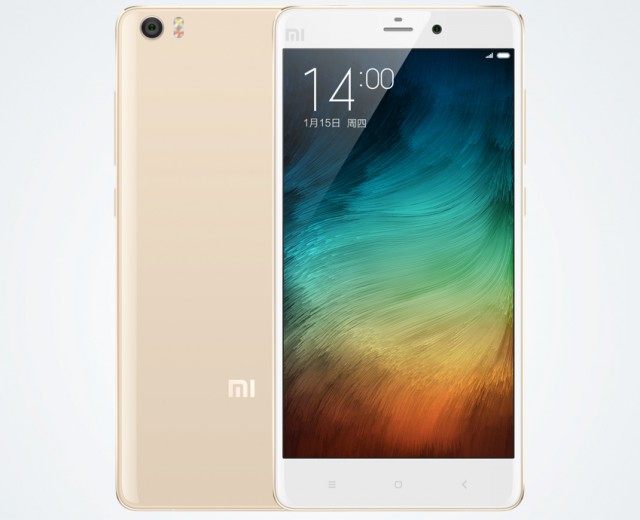
Chinese maker Xiaomi is going after iPhone 6 Plus with two new premium phablets unveiled today at a special event in Beijing. Called Mi Note and Mi Note Pro, the two Android handsets feature high-end hardware and, in typical Xiaomi fashion, lower price-tags than their Apple-made rival.
 
Xiaomi is calling both devices a flagship, although, judging by the specs alone, Mi Note Pro is clearly more deserving of the title, as it features the latest-available technologies. It is also better equipped to take on iPhone 6 Plus, which has proven to be quite successful for a phablet.
 
But, first, let's kick off with the less-expensive and less-impressive of the two. On paper, Mi Note is the phablet that is closer to iPhone 6 Plus with regards to hardware specifications. (That said, its specs are still more impressive, again on paper, than those of iPhone 6 Plus.)
 
It has a 5.7-inch display with a resolution of 1,080 by 1,920. It is protected by a sheet of 3D Corning Gorilla Glass 3 (the 3D bit means it's curved). Power comes from a 2.5 GHz quad-core Qualcomm Snapdragon 801 processor 3 GB of RAM, aided by a 3,000 mAh battery -- Quick Charge 2.0 is supported, as expected. But these are specs that would have been standard a year ago, and today they just don't cut it anymore for a device that is said to be a flagship.
 
On the back there is a 13 MP Sony camera with a wide f/2.0 aperture and optical image stabilization, which should make it a solid low-light shooter. On the front, the camera is a 4 MP unit with two-micron pixels -- it's similar to the camera HTC uses on the back of One (M8) and (M7) going by these two specs.
 
Xiaomi is, however, adding a few interesting bits to Mi Note. The device also gets improvements to the audio quality courtesy of a 24-bit/192 KHz Hi-Fi audio system, and dual-SIM support where both slots are 4G-enabled -- one is a nano-SIM and the other is a micro-SIM.
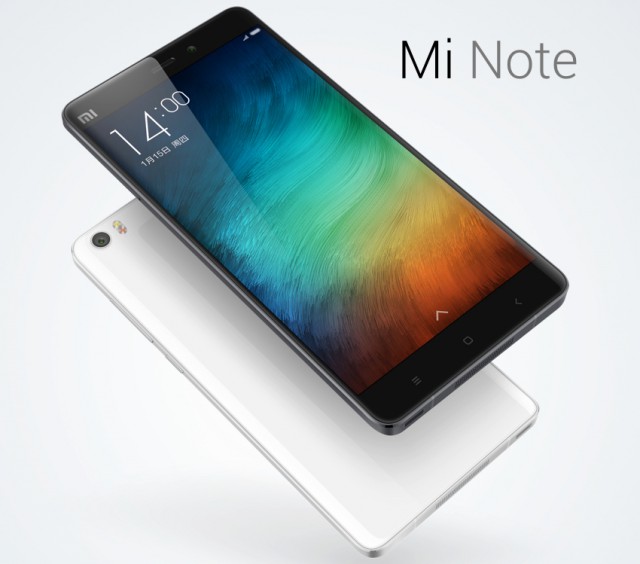
 
 
Mi Note will be offered in two versions, one with 16 GB of internal storage for CNY2,299 (around $371) and the other with 64 GB of internal storage for CNY2,799 (around $452). It comes in at 155.1 x 77.6 x 6.95 mm and 161 grams. Mi Note goes on sale next quarter in Singapore, and, presumably, other markets as well.
 
Mi Note Pro, as I implied, features all the latest goodies that a spec-fan can dream of. It has a 5.7-inch display with a resolution of 1,440 by 2,560. That gives it a pixel density of 515 pixels per inch. Inside, there is an octa-core 64-bit Qualcomm Snapdragon 810 processor aided by Adreno 430 graphics and a whopping 4 GB of RAM.
 
It also features 64 GB of internal storage as standard, which is a capacity that is optional on iPhone 6 Plus as the base model only offers 16 GB. Oh, and just like Samsung's Galaxy Note Pro LTE-A, it supports 4G LTE Category 9 cellular networks, which means download speeds of up to 450 Mbps and tri-band carrier aggregation support.
 
These are the main differences that Xiaomi has revealed so far between Mi Note and Mi Note Pro. The latter, of course, is also more expensive, costing CNY3,299 (about $533). There is no launch date announced for Mi Note Pro yet.
 
You may be thinking how the two stack up to iPhone 6 Plus. Well, as far as power goes it is a difficult comparison to make given the different architectures these devices have. But, here are the main specs of Apple's phablet: 5.5-inch display with a resolution of 1,080 by 1,920; 64-bit Apple A8 processor (dual-core 1.4 Ghz CPU, 1 GB of RAM); 8 MP main camera with f/2.2 aperture and optical image stabilization; 1.2 MP front camera; 16 GB, 64 GB or 128 GB of internal storage. It comes in at 158.1 x 77.8 x 7.1 mm and 172 grams.
 
But what about price? Well, here is where Xiaomi's phablets have a clear advantage. In 16 GB trim, iPhone 6 Plus costs CNY6,088 (about $983 -- I'm bringing up Chinese prices because Xiaomi operates in China and other Asian markets). For a 64 GB iPhone 6 Plus one has to shell out CNY6,8888 (about $1,113). Even Mi Note Pro is less than half the price of a similar iPhone 6 Plus, but Mi Note is nearly two and a half times cheaper. Clearly, price-conscious buyers will see this as a huge advantage, which is what Xiaomi is betting on.
 
~ Mihaita Bamburic

9.27.2013

HP to Stock Ubuntu Laptops in 1,500 China Stores

HP are the latest hardware vendor to increase the number of their China stores selling Ubuntu laptops.
 
The PC manufacturer began stocking two new Ubuntu laptops in over 1,500 of its Chinese stores as of September 16th.

The news comes nearly 2 weeks after Dell also expanded the number of its retail outlets carrying Ubuntu devices.
 
Consumers unfamiliar with Ubuntu will be given ’information packs and marketing materials to help with their purchase,’ say Canonical of the deal, adding that ‘over 4,000 in-store sales staff have also been trained to use and demo Ubuntu to help explain the benefits,”
 
Two laptops will be carried in HP stores:
  • HP Pavilion G14
  • HP Pavilion G15
Both are relatively similar in specifications, offering Intel i3 to i5 processors, 2GB of RAM and between 500GB to 1TB of HDD storage.

The laptops, which went on sale September 16th, start at ¥3,799 (CHY)
 
It seems hardware companies are betting big on Ubuntu in China despite industry experts expecting a sharper drop in PC sales in China than other markets. 
 
~ Joey-Elijah Sneddon 

6.28.2013

Linux Deepin 12.12 Released With New Desktop Environment, More [Video, Screenshots]

Linux Deepin is a Chinese Linux distribution (English ISO files are available as well) based on Ubuntu, that ships with its own desktop environment and some unique applications, which integrate with the overall Linux Deepin look and feel.

 
Linux Deepin 12.12, based on Ubuntu 13.04, has been released today and comes with a huge list of changes and improvements, including a new desktop environment: Deepin Desktop Environment (DDE). Previously, Linux Deepin has used a highly customized GNOME Shell as the default desktop environment.
 
The latest version, 12.12, was supposed to be released by the end of December 2012, but because its developers wanted to offer a stable, high quality Linux distribution and that couldn't be achieved in time, it was postponed until today, when the 12.12 version has finally been released.

Linux Deepin 12.12 video

Deepin Desktop Environment

Deepin Desktop Environment (DDE) tries to continue with the same look and feel Linux Deepin had in the previous releases, but without using GNOME Shell. The menu will probably remind you of the GNOME Shell Activities Overview while the indicators on the bottom dock look more or less like those used in elementary OS Luna. But, unlike Pantheon and GNOME Shell, Deepin Desktop uses Compiz. I didn't look close into this, but it seems that the Compiz version in Linux Deepin comes with some DDE-specific patches.
 
Each desktop component has various useful features, such as:
 
- Application launcher: quickly create a desktop shortcut or add an application to the dock via right click; on the desktop, you can drag and drop an application on to another one to create an application group, useful to keep your desktop organized - you can easily rename the app group, ungroup the applications, delete it and so on:
 
 
- The dock displays live previews for open windows. You can use the previews to switch between windows or close them:
 
 
- Stylish notifications that come with a close button so they never get in your way:
 
 
Linux Deepin 12.12 ships with its own System Settings, this being the first release to include it. The new settings tool is designed to be easy to use and by default, it doesn't display advanced settings that regular users wouldn't understand. Using it, you can configure various system settings such as the sound, multiple monitors and so on as well as change the theme, the dock behavior and more:
 

Default applications

Linux Deepin ships with its own software center, music player, video player and screenshot tool, along with some applications, including proprietary software such as Skype.
 
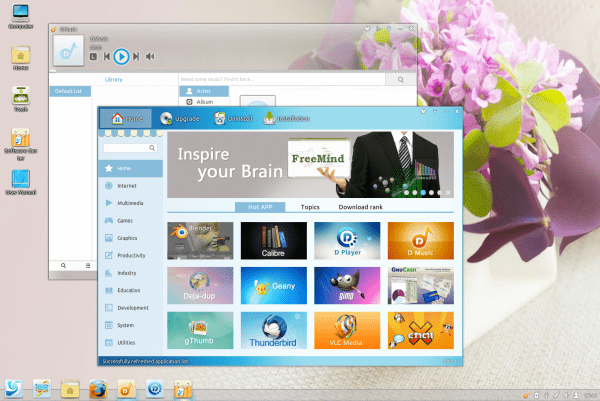
Linux Deepin 12.12 includes Deepin Software Center 3.0, which comes with new features such as:
  • recommendations and download rank added to the home page;
  • various category improvements;
  • Users can now log in using their Linux Deepin forum account to comment and rate applications;
  • The preferred software sources mirrors can now be set via its preferences.
Also, Deepin Software Center comes with a completely reworked backend which should improve its performance.
 
 
The default Linux Deepin video player, DPlayer, has received new features too, including:
  • supports choosing and switching sound tracks and subtitles for multiple languages;
  • can be used to convert video files to various formats;
  • supports DVD/CD playback;
  • multiple instances support.


Another application especially designed for Linux Deepin is DMusic, the default music player. DMusic 2.0, which is included in Linux Deepin 12.12, has received addons support and includes DoubanFM and Internet Radio addons by default, along with some other features:
  • a new mini-mode has been added - you can easily toggle between the regular and mini interfaces from its preferences;
  • supports audio CD and lossless formats playback;
  • can convert between various audio formats;
  • comes with Mpris V2 support so it's integrated into the Linux Deepin sound menu (displayed on the bottom dock).
 
And finally, DSnapshot (previously Deepin Scrot - really), a screenshot tool that's available by default in Linux Deepin, has received support for sharing screenshots on Twitter and other social media websites along with other improvements and bug fixes.
 
 
Besides the applications mentioned above, Linux Deepin 12.12 ships with the following applications by default: Nautilus 3.8.1 (patch to display the gear menu on the left), Firefox 21, Google Chrome 27, Thunderbird 17.0.6, LibreOffice 4.0.2, Kingsoft Office (WPS Office) 9.1.0, GNOME Sound Recorder 3.4.0, Pidgin 2.10.7 and Skype 4.2.0.11, among others. Also, Linux Deepin comes with codecs and Adobe Flash Player installed by default, along with a proprietary Wireless Drivers setup tool.
 
Under the hood, Linux Deepin 12.12 uses GTK 3.8.2 - unlike Ubuntu 13.04 which ships with GTK 3.6 -, a patched Compiz 0.9.99+git, the Ubuntu Kernel 3.8.0, based on the upstream Linux Kernel 3.8.5, and Xorg server 1.13.3.


Here are a few more Linux Deepin screenshots:


Lock screen


Login screen (LightDM greeter)


Download Linux Deepin 12.12


Linux Deepin 12.12 ships with a nice user manual (available on the desktop for easy access) so, even if you've used Linux Deepin before, take a look at the manual to find out some of the basics, like how to create application groups and so on:


~ Andrew (webupd8.org)


12.21.2012

Those sexy Samsungs: Why iPhones are no longer cool in China

After a long delay, China finally approved the domestic launch of the iPhone 5. Apple shareholders would expect this to be a major event, but signs are it won’t be.

According to technology research house Gartner, Apple’s share of the mainland Chinese smartphone market slumped to below 7% in the third quarter of this year. That was a big drop, down from 12% in the second quarter.

Things used to be so different. Less than two years ago, wealthy Chinese consumers loved Apple. But they are a fickle bunch, always looking for the latest cool brand to add to their collection. That used to be the sweet spot the iPhone inhabited. Now, Samsung sits there. And at the lower end, consumers are too price conscious for iPhones.

As a young woman posted on microblogging website Sina Weibo: “I wish I could have an iPhone 5 for my birthday, but my parents saved for months just to get me an iPod.”

While there are a growing number of middle-class Chinese, they are nowhere near as rich as middle-class Westerners. There’s no word yet on what the iPhone 5 will retail for in China but consider that the retail price for an iPhone 4S started at around $780 at today’s exchange rates. Meanwhile, Chinese internet firms including Baidu, Alibaba Group and Shanda have all launched smartphones this year costing under 1,000 yuan (US$160)

Apple now ranks sixth in China’s smartphone league, down from third place in the second quarter, according to Gartner. Samsung has been first for the last six months. Chinese manufacturer Lenovo, which sells cheaper products than Apple, is second. Sandy Shen, a Shanghai-based Gartner analyst, told Quartz she forecasts Lenovo will take the first spot by the end of 2013.

Apple may have lost market share because the iPhone 5 launch was delayed in China. But Shen thinks waiting consumers are actually few.

Apple’s real problems are market saturation, consumers not believing the iPhone 5 is much better than the 4S and high-end consumers being more attracted to what they perceive as Samsung’s superior hardware, Shen says.
The majority of people who should have an iPhone have already got one. And in terms of improvement between the 4S and the 5, its not so big. So people have been kind of disappointed. They are either happy enough with the iPhone 4 or the 4S, or looking for another brand.
On the shift to Samsung, Shen adds:
I’ve been observing high-end consumers who have been using iPhone for the last two to three years now looking to switch to Samsung products. These people are not price sensitive. They are always looking for the latest flagship product to add to their technology collection. They have a laptop, an iPad, an iPhone, and now they are going for the Samsung Galaxy S3 or the Galaxy Note.
Samsung probably has better hardware, Shen continues.
In terms of design and hardware specs,  the Samsung products are seen more sexy than iPhones. The Galaxy Note screen is bigger, for example. The S3 has a better display.
Research firm IHS has said the same thing about the S3′s superior display, though Apple enthusiasts dispute this.

Paul French, Mintel’s chief China market strategist, has a different take on why iPhones are becoming less popular with China’s brand-conscious wealthy. He says it has less to do with technical features, which he believes a lot of Chinese consumers do not show interest in, and more to do with being fickle.
Apple just isn’t really that cool anymore. Teenagers aren’t too interested in it. When I see people in Apple stores here, they tend to be late 20s and early 30s.
He adds:
Most Chinese people won’t be that interested in getting the new iPhone 5 because it has better this or that. I don’t think most Chinese people use their iPhones for the apps or the technology. Before, it was all just ‘look, I got an iPhone’, which people then just used for phoning and texting. I ask people what apps they have, and often they don’t have any.
What’s really popular across Asia right now, including in China, are the big phone-small tablet hybrids. Like the Galaxy Note but cheaper versions too. Teenagers especially are mad about these.
That is a source of hope for Apple’s iPad mini, then. But there are also small, cheap tablets on the Chinese market. A $99 dollar Chinese clone of the iPad mini, called the Goopad Mini, surfaced in China late last month, just days after Apple announced its latest innovation.

In China, as in most emerging markets, being neither cool nor cheap is a big problem. There isn’t much of a middle class or a middle ground.

Apple’s business in the country is still huge, representing 15% of its sales. In its last full year results,
Apple reported it made a whopping $23.8 billion in China, a 79% increase from the $13.3 billion earned in 2011. But those impressive results masked the slowing quarterly trend that Gartner’s data has also picked up. Apple made $5.7 billion in China in its fourth quarter, the three months to September 29, which was a 28% drop from the $7.9 billion it made in the second quarter.

And while crowds of Chinese shoppers besieged Apple’s flagship Beijing store on the day the iPhone 4S was launched there—with some rioting and throwing eggs because the store opening was delayed—these may not have been eager consumers. Instead, they might have been what the Chinese media call “scalpers.” These are speculators who buy potentially scarce goods in bulk in the hope of reselling them at a premium later on.

French argues:
That’ll be because maybe about four years ago some people made good money buying up all the iPhones on day one and selling them for more than the retail price. In China, where everyone wants to make a fast buck, these ideas get around.
The question remains whether they’ll find buyers this time..

~ Naomi Rovnick