Cisco Learning Network Store Promotions Page
Showing posts with label Mobile. Show all posts

3.02.2016

Samsung shifts the paradigm once again

Samsung continues to set the mobile landscape ablaze with speed and size. Find out what the company's latest announcement could mean for you. 

Imagine, if you will, that your mobile device contained the same amount of storage as your SSD-toting desktop or laptop. Gone would be the constant struggle to make room for apps and data. No longer would you see those dreaded Device full errors.
 
If Samsung has its way (and it most assuredly will), the company will be shipping flagship devices that include a remarkable 256 GB memory chip, based on the Universal Flash Storage 2.0 standard. That's right, ladies and gents, a flagship smartphone that contains as much storage as many desktops and laptops. What's best, this new chip from Samsung will outperform the current crop of SATA-based SSDs shipped on most laptops and desktops.
 
"By providing high-density UFS memory that is nearly twice as fast as a SATA SSD for PCs, we will contribute to a paradigm shift within the mobile data storage market," said Joo Sun Choi, Executive Vice President, Memory Sales and Marketing, Samsung Electronics.
 
Yes, indeed, you will.

Size and speed

The chips themselves will be based on Samsung's V-NAND flash memory chips and will included a specially designed, high-performance controller. For those who need numbers (for comparison) the previous generation UFS memory could handle read/write speeds up to 19,000 (input operations per second) and 14,000 (output operations per second). The new Samsung chips can handle read/write speeds of up to 45,000 (input operations per second) and 40,000 (output operations per second). That's a significant leap in performance. Add to that the massive increase in size and you do have a serious game changer.
 
The new 256 GB UFS chips use two lanes of data transfer to move data at up to 850 MB/s. Yet again another massive besting of typical SATA-based SSDs. For sequential writing, the chips support up to 260 MB/s.
 
The besting keeps on coming.
 
In real time, this means that mobile devices will now be able to handle seamless 4K Ultra HD video playback while simultaneously multitasking. These new chips are also even smaller than today's external microSD cards... which means they won't cause problems for smartphone designers and manufacturers.  

Odd timing

But let's consider Samsung alone. Its next flagship device, the Galaxy S7, will not include the beefed up chip (although it will re-introduce external microSD card support). Samsung did eventually release Galaxy 6S variant that included the 128 GB chip. Will the same thing happen this time around? Maybe this is a bit of sleight of hand on the part of Samsung that goes something like this:
  • Hey, here's the latest, greatest smartphone from Samsung
  • Fans purchase shiny new Samsung smartphone
  • Hey, we've invented a faster chip for smartphones
  • Fans groan
  • Hey, we're releasing a variant of our latest smartphone to include the shiny new chip
  • Fans grumble, but purchase the shiny new smartphone with the shiny new chip
  • Samsung bathes in money
Okay, that's a bit of an exaggeration. But you get the idea. What Samsung should be doing is announcing the new chip and then announcing the new device that will include the new chip upon release. That certainly didn't happen. In fact, the announcement of the new chip came a scant three days after the announcement of the Galaxy S7. My guess is that it will do the same thing it did with the 6S and release a variant S7 that includes the new 256 GB chip. When that will happen? No one knows.

The ante is upped

However, the oddly timed announcements is splitting hairs a bit. The truth of the matter is this. Samsung is (once again) seriously upping the ante for the world of mobility. The very idea of having such a high-speed storage chip on a smartphone has been unheard of until now. And as much as I hate the term, this truly is a paradigm shift for the mobile landscape.
 
If you've been anxiously awaiting the release of the Galaxy S7, it might be in your best interest to hold off purchasing until later on in the year. Yes, the variant will probably cost you quite a bit of coin, but having a high-end device with such massive (and speedy) storage would be worth the wait.
 
~ Jack Wallen 

5.13.2015

Microsoft goes public with its list of planned Windows 10 editions

Microsoft is taking the wraps off its SKU line-up for Windows 10. But it still isn't sharing many feature, pricing or licensing specifics.

Microsoft is going public with its list of planned SKUs, or editions, that it will make available for Windows 10 PCs, tablets, phones and embedded devices ahead of this summer's planned launch of the operating system.
 
Not counting the three embedded/Internet of Things (IoT) versions, there will be six Windows 10 SKUs: Home, Mobile, Pro, Enterprise, Education and Mobile Enterprise, according to a May 13 blog post from Windows Marketing chief Tony Prophet.
 
When Microsoft introduced Windows 8 in 2012, there were four main Windows 8 SKUs: The Windows 8 consumer SKU; Windows 8 Pro SKU for tech enthusiasts and business professionals; Windows RT, the version of Windows designed to run on ARM-based hardware; and Windows 8 Enterprise. Microsoft subsequently added a Windows 8.1 for Education SKU.
 
Microsoft is not yet disclosing the standalone pricing or the detailed feature set and licensing specifics of its Windows 10 SKUs.
 
As Microsoft said months ago, the company plans to make Windows 10 available as a free upgrade for consumers running Windows 7, Windows 8.x and Windows Phone 8.1 for the first year following availability of the Windows 10 operating system. Some business users -- those who want Windows 10 Pro -- also will qualify for the first-year-free deal, but enterprise customers will not, Microsoft execs have said.
 
Here's the Windows 10 SKU line-up:
 
Windows 10 Home: The consumer-focused desktop edition. This will include the core Windows 10 features, such as the Edge browser, Continuum tablet-mode for touch-capable devices; Cortana integration; free Photos, Maps, Mail, Calendar; Music and Video apps; and Windows Hello face-recognition/iris/fingerprint log-in for devices that support those technologies. On devices with screen sizes of 10.1 inches or less, users also will get Universal Office apps for free, once they are available.
 
Windows 10 Mobile: This is the SKU for Windows Phones and small Intel- and ARM-based tablets. This SKU will include the core Windows 10 features; free Universal Office apps once they are available; and support for Continuum for Phone, allowing customers to use phones as PCs connected to larger screens (but only on new devices supporting certain screen resolutions).
 
Windows 10 Mobile Enterprise: This is a version of Windows 10 Mobile for volume licensing customers only. According to the blog post, this SKU incorporates the latest security and feature updates to Windows 10 once they are available. There's no word if users will be able to delay these updates in order to test/stagger their delivery, which is offered under Windows Update for Business. 
 
Windows 10 Pro: A desktop version of Windows 10 for mobile workers, tech enthusiasts and other power users. This version is one of at least two -- the other being Windows 10 Enterprise -- that will allow users to opt for Windows Update for Business. Windows Update for Business will allow admins to opt to not receive all feature and security updates from Microsoft immediately after they are available.
 
Windows 10 Enterprise: This is the Enterprise version of Windows 10 that is available to volume-licensing customers. This version is not part of Microsoft's first-year-free upgrade offer, but those with volume-licensing Software Assurance customers will be able to move to this version as part of their licensing terms. The Enterprise version customers get access to the Long Term Servicing Branch of Windows 10 -- which allows them to opt to receive security fixes only and no new features as Microsoft rolls them out.
 
Windows 10 Education: This is the version for staff, administrators, students and teachers, and will be available through academic Volume Licensing. Microsoft officials say there will be paths for schools and students to upgrade from Windows 10 Home and Pro, but don't yet provide details on that front.
 
On the Windows 10 embedded device front, Microsoft also is planning to deliver Windows 10 Enterprise and Windows 10 Mobile Enterprise versions of the operating system for handheld terminals, ATMs, point of sale and other similar devices, as well as a Windows 10 IoT Core for small footprint, low-cost devices.
 
Microsoft execs still aren't providing granular details about upgrades, such as whether those who go for the first-year-free deal with SKUs like Windows 10 Pro will have the option of delaying/staggering their feature and security updates, the way enterprise users will be able to. Another unanswered question: Will Windows Phone users who are running the Windows 10 Mobile (and not Mobile Enterprise) version still be able to use Intune and Microsoft's Enterprise Mobility Suite to lock down their devices? Microsoft isn't yet saying.
 
"The Long Term Servicing branch being an enterprise level feature is the most interesting news here because that's the gateway for businesses who want to continue doing business as usual," said Wes Miller, an analyst with Directions on Microsoft.
 

3.04.2015

Apple plans fix next week for newly uncovered Freak security bug

The Apple logo is pictured on the front of a retail store in the Marina neighborhood in San Francisco, California April 23, 2014.  

Credit: Reuters/Robert Galbraith
 
(Reuters) - An Apple Inc (AAPL.O) spokesman said on Tuesday that the company plans to release a fix next week to mitigate the newly uncovered 'Freak' security flaw affecting Safari browsers on its iOS and OS X operating systems for mobile devices and Macs.
 
The vulnerability in web encryption technology could enable attackers to spy on communications of users with vulnerable software, including Apple's Safari browser and Google Inc's (GOOGL.O) Android browser, according to researchers who uncovered the flaw.
 
A representative for Google said he had no immediate comment. 
 
The Washington Post reported that the bug left users of Apple and Google devices vulnerable to cyberattack when visiting hundreds of thousands of websites, including Whitehouse.gov, NSA.gov and FBI.gov. http: 
 
Whitehouse.gov and FBI.gov have been fixed, but NSA.gov remains vulnerable, the paper cited Johns Hopkins cryptographer Matthew D. Green as saying. 
 
A group of nine researchers discovered that they could force web browsers to use an form of encryption that was intentionally weakened to comply with U.S. government regulations that ban American companies from exporting the strongest encryption standards, according to the paper. 
 

Once they caused the site to use the weaker encryption standard, they were then able to break the encryption within a few hours. That could allow hackers to steal data and potentially launch attacks on the sites themselves by taking over elements on a page, the newspaper reported.
 
The group of researchers dubbed the flaw Freak, for "Factoring RSA-EXPORT Keys," according to a website where they described the vulnerability.
  

~ Jim Finkle

11.17.2014

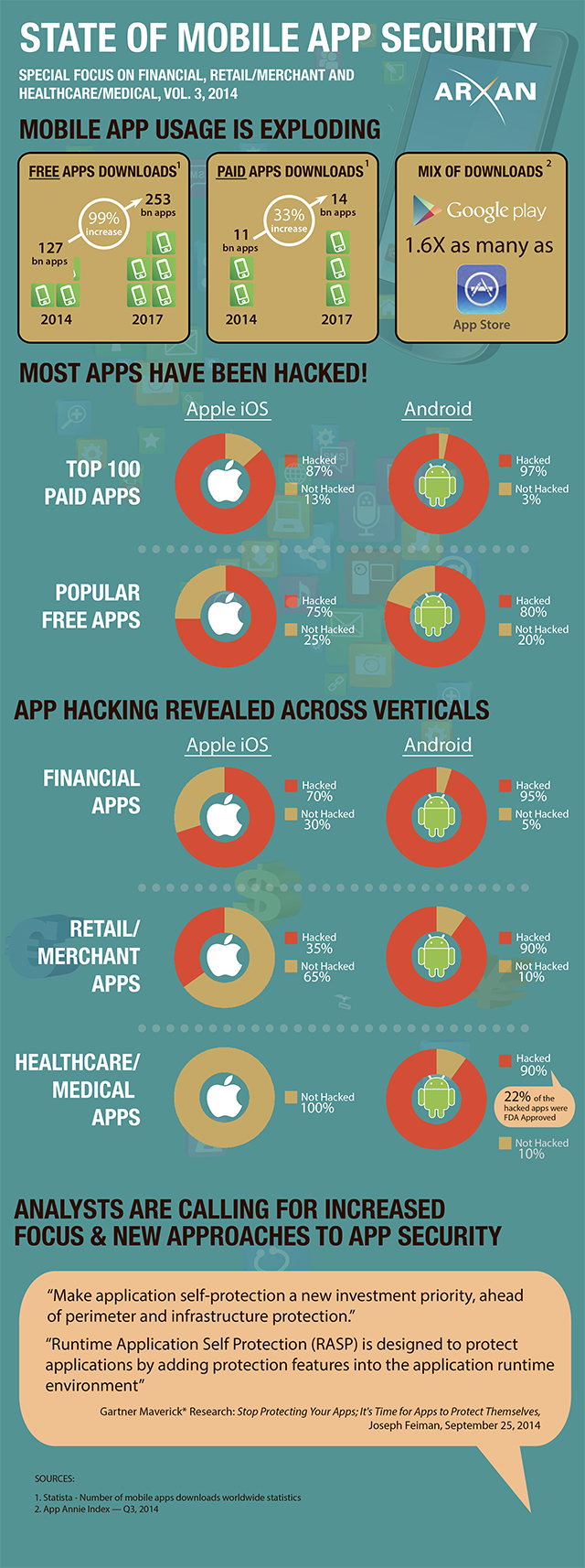
87 percent of the top 100 paid iOS apps available as hacked versions

According to the third annual State of Mobile App Security report from application protection company Arxan Technologies, 87 percent of the top 100 paid iOS apps have been hacked.
 
Don’t feel smug if you're an Android user though as the report reveals 97 percent of the top 100 paid Android apps have been too. But whilst the Android figure is in line with previous years, the iOS percentage represents a jump from 2013 when 56 percent were found to have been hacked.
 
Before you start to panic, what Arxan means by a 'hacked' app, is one that's actually a modified version available from an unauthorized store or torrent site. In the case of iOS apps this also means the device needs to have been jailbroken.
 
The situation isn't much better with free apps. The report shows that 80 percent of popular free Android apps and 75 percent for iOS have also have hacked versions available.
 
Not surprisingly high profile targets like banking are most at risk. 95 percent of the Android financial apps reviewed were 'cracked' while 70 percent of the iOS financial apps were hacked. This is an increase in both cases, with Android hacks growing about 80 percent.
 
Shopping apps are being targeted too with 90 percent of retail/merchant Android apps and 35 percent of iOS apps in the same field having been compromised. Hackers are targeting growth in B2C retail apps, as stores launch mobile payment and wallet services, but also B2B merchant point-of-sale apps. In both cases sensitive data, intellectual property, and financial transactions are at risk.
 
Also worrying is that 90 percent of Android healthcare/medical apps have been hacked, 22 percent of which are FDA approved
 
With app downloads still increasing and forecast to reach 253 billion free and 15 billion paid in 2017 there are potentially huge numbers of people at risk if they venture into unofficial stores. Among the report's recommendations are that apps with high-risk profiles running on any mobile platform should be made tamper-resistant and capable of defending themselves and detecting threats at run time. Also that apps be developed to maintain the confidentiality of the code and that software used to enable mobile wallets and payment apps should be protected with secure crypto and app hardening.
 
"The pursuit of greater mobile application security remains at the forefront our research and development initiatives," says Jonathan Carter, technical director at Arxan. "We continue to evolve our security innovations based on emerging threats to ensure the strongest application protection for our customers in the dynamic battlefield against hackers".
 
The full report is available to download from the Arxan website and there's an infographic summary of the findings below.
 
 
Photo Credit: lucadp/Shutterstock
 
~ Ian Barker

10.22.2014

Log into Gmail with a USB drive -- Google adds support for Security Key

Two factor authentication (or two step verification, if you prefer) is very a la mode at the moment. Actually, it has been pushed by companies for some time, but a number of high profile security problems recently has brought it back to public attention again.
 
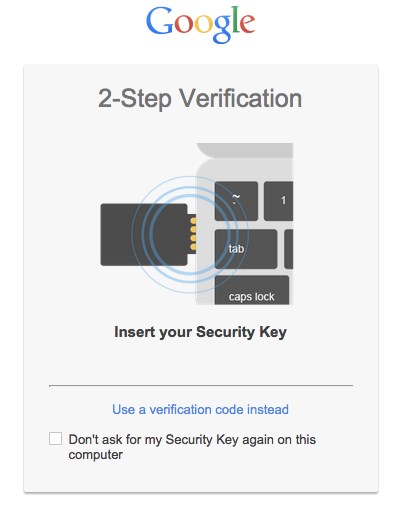
Enabling the security feature usually means entering a password as normal, in addition to a passcode sent to a mobile device. Today, Google makes things a little easier for, in its own words, "particularly security-sensitive individuals" by introducing support for Security Key.
 
Rather than relying on a mobile phone or tablet, Security Key reduces two factor authentication to working with a USB drive. Requirement for a physical 'key' greatly reduces the chances of security breaches and means it matters less if a third party determines your account password.
 
As Google explains in its announcement blog post: "Rather than typing a code, just insert Security Key into your computer’s USB port and tap it when prompted in Chrome. When you sign into your Google Account using Chrome and Security Key, you can be sure that the cryptographic signature cannot be phished".
 
Security is based on the open Universal 2nd Factor (U2F) protocol, so don’t be surprised if support is added to other services as well. This is not a security tool that will be universally embraced as Security Key is only compatible with Google Chrome, although it can be used with Windows, OS X, Linux and Chrome OS.

~ Mark Wilson

7.26.2014

Cellphone unlocking bill clears U.S. House, heads to Obama

 
(Reuters) - The U.S. House of Representatives approved legislation on Friday to give mobile-phone users the right to 'unlock' their devices and use them on competitors' wireless networks, something that is now technically illegal.
 
The legislation cleared the Senate last week. President Barack Obama said in a statement that he looked forward to signing the bill into law.
 
"The bill congress passed today is another step toward giving ordinary Americans more flexibility and choice, so that they can find a cell phone carrier that meets their needs and their budget," Obama said.
 
The lawmaking follows a 2012 ruling by the Library of Congress, the minder of U.S. copyright law, that effectively made phone unlocking illegal, even after the consumer completed the contract with its wireless carrier.
 
U.S. wireless carriers often tether, or "lock," smartphones to their networks to encourage consumers to renew mobile contracts. Consumers, for their part, can often buy new devices at a heavily subsidized price in return for committing to long-term contracts with a single carrier.
 
In December, major wireless carriers - including Verizon Wireless, AT&T Inc, Sprint Corp and T-Mobile US Inc - struck a voluntary agreement with the Federal Communications Commission to make it easier for consumers to unlock their phones after contracts expire.
 
Under current law, someone who unlocks their phone without permission could face legal ramifications, including jail.
 
New legislation, welcomed by consumer advocates, reinstates the exemption given to mobile phones in the copyright law before the controversial 2012 ruling by the Library of Congress and calls on the officials there to reconsider the issue during its next round of reviews in 2015, potentially expanding the exemption to tablets and other devices.
 
"Today's action by the House moves us closer to alleviating any confusion stemming from the Copyright Office’s 2012 decision," Jot Carpenter, vice president of government affairs at the wireless association CTIA, said in a statement.       
 

~ Alina Selyukh

7.04.2012

Firefox OS Powered Smartphones Launching Early Next Year

Mobile phones using Firefox OS will be available to buy early next year, Mozilla have announced.

Network carriers supporting the first batch of mobile phones in 2013 will include Sprint, Deutsche Telekom, Etisalat, Smart, Telecom Italia, TelefĂłnica and Telenor.

Firefox OS devices will be ‘built entirely to open web standards’ Mozilla say, ‘where all of the device’s capabilities can be developed as HTML5 applications.’

Early 2013 will see the first Firefox OS phones launch in Brazil, with other markets to follow thereafter.

Firefox OS

Work on a Mozilla-backed mobile operating system has been going on for the last year.

Called ‘Boot to Gecko’, the project tasked itself with ‘allowing HTML5 applications to access the underlying capabilities of a phone, previously only available to native applications.’ in B2G every application on the phone, be it SMS, Camera or dialer, is an HTML5 application.

But will the largely HTML5-driven devices sport a wide enough feature set to be able to compete with the slickness of Android and iOS?

In all honesty I have no idea.

My gut tells me that if RIM, Palm, Bada, Meego and, to an extent, Microsoft can’t make inroads into the two-horse OS race of Android and iOS, then what chance does Mozilla stand?

But the bones of today’s announcement tell a deeper story. We just have to look at where the first devices are being launched: Brazil.

Brazil is an emerging market for smartphones; a place where some 19 million people own one, but where iOS and Android are not the dominant players.

Cheaper, low-end, smartphones rule the roost here. It’s a place where an underdog competitor can get in early and short up marketshare; a place where an open-source OS, coupled with capable but affordable hardware, could really excel.

And Mozilla are acknowledging this. Boot to Gecko has been engineered for ‘entry-level smartphones’, helping to drive adoption across developing markets.

What would make you switch from your current mobile OS to Firefox OS?

~ Joey Sneddon